
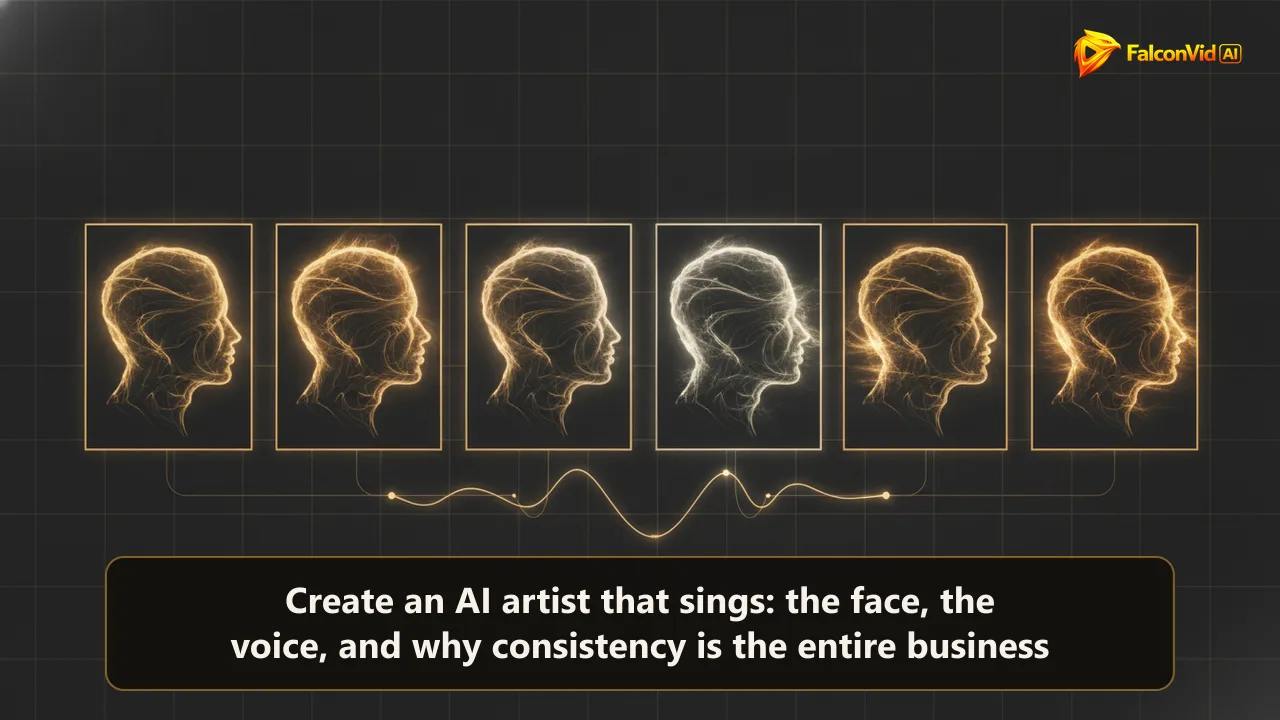
Nobody subscribes to a playlist, they subscribe to a person
Look at what a music listener actually does. They find a track through search or suggested, they let it run, and if it worked they look for more of the same. At that moment the channel either offers a recognizable identity or it offers a wall of unrelated covers. Only one of those converts into a subscriber.
That recognition is not built by the music alone, because at the level most channels operate the music is interchangeable. It is built by the thing that repeats: the same face on every cover, the same voice on every track, the same visual world. Repetition is what makes a stranger think this is somebody rather than something.
This is the reason a channel with a created artist behaves differently from a channel with generic covers. It is not that the videos are better. It is that the forty videos add up to one thing instead of forty things.
- A listener who liked one track goes looking for more of the same, and that is the subscribe moment.
- At the generic level the music is interchangeable, so identity has to come from what repeats.
- Forty videos with one face read as an artist. Forty covers read as a folder.
The three things that have to be locked
The face. In FalconVid you create the artist once, and their photo becomes the reference for every video and every cover the channel produces. The same person appears in each clip, not a person who looks similar. Drift between uploads is the single most common way an AI presenter stops reading as real, and locking the reference is what prevents it.
The voice. A sung channel with a different singer each week has no artist, it has a compilation. The voice is fixed to the artist through a persona, so the timbre carries across tracks. Where a persona is not available, a fixed vocal descriptor covering range, texture and delivery goes into the prompt of every track, which produces a similar voice rather than an identical one. That distinction is worth knowing before you promise your audience a signature sound.
The format. A music channel is born as one of three shapes and stays that way: a long instrumental session, one sung track per video, or a compilation of several sung tracks. This is deliberately not editable afterwards, because changing it halfway would turn the catalog into two channels sharing a name.
- Face: the artist photo becomes the reference for every video and cover, so it does not drift.
- Voice: fixed through a persona, or through a fixed vocal descriptor that keeps range, texture and delivery.
- Format: long instrumental session, one sung track, or a compilation. Chosen at birth, not editable later.
Where the lyrics come from, and why that matters more than it sounds
There is a small design decision in FalconVid that changes what the channel feels like. The lyrics are written when the calendar is approved, not when the video is generated. That means you see the words before anything is produced, and you can rewrite them.
The reason is practical. Whoever writes the chorus names the song, because the title has to live inside it. If the lyrics were written at generation time, the calendar would show you one title and the channel would publish another. Approving the calendar would stop meaning anything.
The second reason is ownership. A lyric you wrote yourself is marked as yours and generation never overwrites it. You can leave every song to the machine, or take over the three that matter and let it handle the rest. Both are valid; what you cannot have is a system that quietly rewrites your words.
- Lyrics are written when you approve the calendar, before anything is generated.
- The chorus names the song, so writing lyrics late would break the titles you approved.
- A lyric you write yourself is never overwritten by generation.
What an artist channel costs to run
The costs are itemized, so there is no guessing. A 10 hour session video costs 894 credits: 480 for the 10 distinct tracks, 200 for the render hours and 214 for the thumbnail. A 1 hour video costs 714 credits, because between one duration and the next it is mostly the render that moves. In between: 2 hours 734, 3 hours 754, 5 hours 794, 8 hours 854.
You control the number of distinct tracks, and that is the main lever. A session reuses them across the runtime, so a 10 hour video and a 1 hour video can both pay for the same 10 tracks. For a sung channel with one track per video the reuse does not apply, because the point of that format is a new song each time, and a single sung track of around 4 minutes costs 299 credits.
Put that against the narrated pipeline on the same account: a 12 minute talking video costs 1,584 credits in economy mode, 9,000 in balanced and 27,084 in premium. A full 10 hour music video costs about a tenth of one 12 minute video in balanced mode.
By plan, at 894 credits per 10 hour video: Starter with 15,000 credits carries 16 a month, Pro with 30,000 carries 33, Business with 95,000 carries 106, Agency with 190,000 carries 212, and Scale with 320,000 carries 357.
- 10 hour session: 894 credits. 1 hour session: 714 credits. Single sung track: 299.
- Distinct tracks are the lever: sessions reuse them, so runtime is cheap to extend.
- 16 ten hour videos a month on Starter, up to 357 on Scale.
One artist, several channels, several niches
The mistake people make with a working artist is stretching them across everything. A voice that suits sleep does not suit a driving compilation, and a face built for meditation looks wrong on a jazz cover. The audience notices before you do.
The cleaner move is one artist per niche and one channel per artist, which is exactly what the plans are built around. Starter runs 1 channel with 2 simultaneous generations, Pro runs 5 channels with 5, Business 10, Agency 25, and Scale 50 channels with 50 simultaneous generations. Each channel keeps its own DNA: its own artist, voice, visual style, pacing and niche, so three channels never blur into each other.
The engine ships 11 genre contracts: lofi hiphop, ambient focus, meditation, phonk, brazilian phonk, synthwave, cinematic, forró, lullaby, smooth jazz and christmas. Niches like sleep, study, piano and manifestation are produced on top of the ambient focus and meditation contracts, since the music channel takes the niche, the theme, the calendar and the cover from you. That is enough surface for three or four channels that do not compete with one another, run by one person approving calendars.
- One artist per niche, one channel per artist. A sleep voice does not carry a jazz channel.
- Channels by plan: 1 Starter, 5 Pro, 10 Business, 25 Agency, 50 Scale.
- 11 genre contracts: lofi hiphop, ambient focus, meditation, phonk, brazilian phonk, synthwave, cinematic, forró, lullaby, smooth jazz, christmas. Sleep, study and manifestation come out of ambient focus and meditation.
What the artist can and cannot do for you
It can carry a channel visually and vocally across hundreds of uploads without a single recording session. It can appear on every cover, in every clip and in the channel art, and it can front the same project in more than one language, since narration and metadata run in up to 63 languages.
It cannot make you a verified music artist on streaming platforms. FalconVid publishes to YouTube, Instagram, TikTok, Rumble and Facebook. It does not upload to Spotify, Apple Music or Deezer. The tracks it produces are yours, so you can take them to a distributor and put them on streaming yourself, and an official artist channel on YouTube requires exactly that distributor relationship. Any tool telling you it publishes straight to Spotify is describing something it does not do.
It also cannot rescue a bad niche choice. A consistent artist in a saturated genre with no angle is still a channel nobody finds. The identity multiplies whatever the niche gives you; it does not replace it.
- Carries hundreds of uploads visually and vocally with zero recording sessions.
- Publishing covers YouTube, Instagram, TikTok, Rumble and Facebook. Streaming needs your own distributor.
- An official artist channel on YouTube requires that distributor relationship too.
The order to build it in
Pick the niche before the artist. The genre decides the voice, the face and the visual world, and doing it backwards produces a character you then have to force into a lane. Lofi and study want calm and young; sleep wants almost no personality at all; manifestation wants warmth and authority; jazz wants age and texture.
Then create the artist and lock them: photo, voice, format. Then approve the first calendar and read the lyrics before anything generates, because that is the last cheap moment to change direction.
Then hold it. Three videos a week for the first 90 days, which is 36 to 39 uploads, with the same face and the same voice on all of them. Before Studio publishes anything you can watch version 1 and adjust it: shorten the intro, swap a scene, change the mix. What you should not do is change the artist. Consistency is not a stylistic preference here, it is the product.
- Niche first, artist second. The genre decides the voice and the face.
- Lock photo, voice and format, then read the lyrics in the calendar before generating.
- 3 videos a week for 90 days with the same artist on every one.