
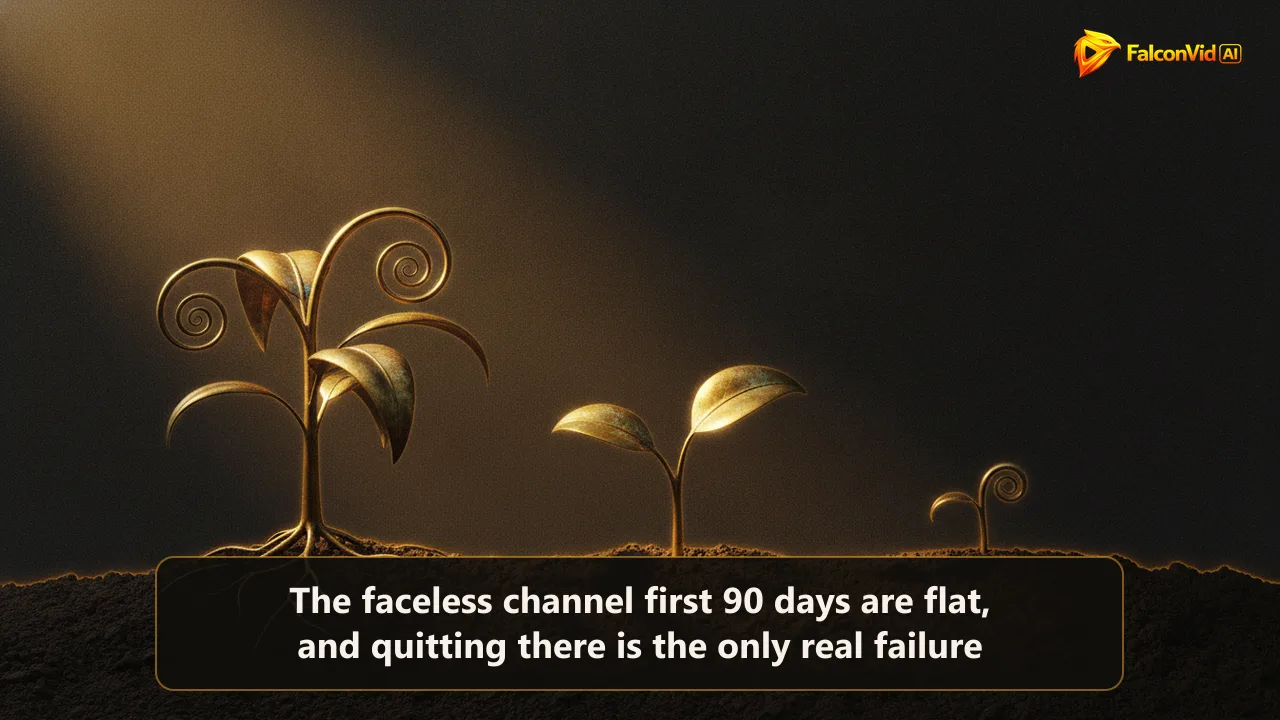
The first 90 days are flat by design, and that is not the channel failing
The honest version that never makes it into a thumbnail is that a faceless channel spends most of its first 90 days looking like nothing is happening. You publish, the view counter reads 14, then 31, then 9, and the subscriber number crawls up one at a time. This is not a warning sign. It is the ordinary opening of almost every channel that later works, including the ones whose owners now tell the story as if it grew overnight.
What is actually happening in those quiet weeks is that the recommendation system is building a model of who your videos are for, and it does not have the data yet. With 4 videos live it has almost nothing to go on. With 30 to 40 videos across one consistent theme, it finally has enough signal to test your content on strangers who never searched for you. The flat stretch is the system learning, not the system rejecting you.
So the single most valuable thing to fix before day one is your own definition of success for month one. If success is views, you will quit in week three when the views do not come. If success is 12 to 13 videos shipped on schedule under identical conditions, you will still be standing on day 90 when the compounding starts. The number one killer of faceless channels is that their owners quit during the flat part, sometimes only days before the numbers would have turned.
- Views of 9, 14 and 31 in the first weeks are normal, not a verdict on the channel
- The algorithm needs 30 to 40 videos on one theme before it can test you at scale
- Set month one success as videos shipped, never as views or subscribers
- Most channels die in weeks 3 to 7, during the flat part, not at the finish line
- Overnight growth stories almost always hide 6 to 18 quiet months underneath
- The counter crawling one subscriber at a time is the system learning, not refusing you
- The only failure inside 90 days is stopping, because stopping resets the learning
Month 1, days 1 to 30: pick one niche, build the buffer, publish into the quiet
Month one has three jobs and none of them is going viral. First, pick exactly one niche and stay in it, because a channel that jumps between three topics gives the algorithm nothing to model. Second, build a buffer of at least 9 finished videos before you publish a single one, which is three weeks of cover at three videos a week. Third, start publishing three times a week at fixed days and times, and then leave the schedule alone.
The realistic numbers for these 30 days are humble on purpose. You will publish roughly 12 to 13 videos. Impressions stay mostly flat and often look broken, sitting at a few hundred per video with click through rates that swing wildly because the sample is tiny. Subscribers land somewhere between 0 and 100 for most channels, and a good chunk of those are friends, the curious, and people who will never watch again. None of this predicts month three.
The only win available in month one is consistency, so measure that and nothing else. Shipped 12 videos on the days you promised yourself? That is a successful month, full stop. The buffer is what makes it survivable: with 9 videos already finished, a bad week costs you nothing, a weak render gets replaced instead of published, and no upload ever goes out purely because it was the only thing ready. Channels that publish their worst work are almost never lazy, they are simply at zero buffer on a Tuesday night.
The buffer is also where month one dies before it begins, because 9 finished videos by hand is 36 to 72 hours of work at four to eight hours each, demanded of you before a single view exists to justify it. In FalconVid the same cushion is a batch: research, script, narration, editing and sound design are handled by AI specialists working at the same time instead of in a queue, so a long video is finished in up to 30 minutes, and several generate side by side, 2 concurrent on Starter, 5 on Pro, 25 on Agency, 50 on Scale. Nine videos of cover become an afternoon of approving rather than three weekends of production, which is the difference between opening the channel with a cushion and opening it exposed.
- One niche only, held for the full 30 days, so the algorithm has something to model
- Build 9 or more finished videos before publishing the first one
- Publish 3 a week on fixed days and times, then stop touching the schedule
- Expect about 12 to 13 videos live and 0 to 100 subscribers by day 30
- Impressions stay mostly flat, and click through rate swings because the sample is tiny
- Measure videos shipped on schedule, treat views as noise this month
- The buffer is what stops a bad week from becoming a missed publication
Month 2, days 31 to 60: find the cluster that actually holds retention
Around day 35 to 50, with a couple dozen videos live, the recommendation system usually starts doing something visible. You get the first small spikes: a video that quietly reaches 400 views instead of 40, then one that touches 2,000 while the rest sit still. These are not luck. They are the algorithm testing your library on outside viewers and reading how long those viewers stay. The video that spikes is telling you which corner of your niche holds attention.
The numbers open up a little this month. You will add another 12 to 13 videos for roughly 25 to 26 total, and subscribers might reach somewhere between 100 and 500 if the spikes land, though plenty of honest channels sit lower and are still perfectly on track. Somewhere in here you usually get your first real outperformer, a video that does 2 to 5 times your own median. That single video is the most useful piece of data the channel has produced so far.
So month two has one instruction: double down on what worked, and read retention to find out what that was. Do not just copy the topic of the video that spiked, study its first 30 seconds, its pacing, its exact sub topic, and make three more like it. The goal by day 60 is to know which cluster inside your niche earns your best average view duration, because that cluster is where month three gets spent.
Acting on that signal fast is the part almost everyone postpones, because three more videos like the winner is another twelve to twenty four hours by hand, and by the time they go out the read is two weeks stale. With generations running in parallel the follow ups drop into the next open slots the same day you read the retention curve, so the experiment stays warm. And you do not have to guess at the sub topic either: the Spy and the channel modeler in FalconVid read what already monetizes around that theme and extract the pattern, so the cluster you double down on starts from something that is already working rather than from your hunch.
- First spikes usually appear between day 35 and 50, once a couple dozen videos are live
- A video reaching 400 or 2,000 views is the algorithm testing your library, not luck
- Expect roughly 25 to 26 total videos and 100 to 500 subscribers if the spikes land
- Your first outperformer typically does 2 to 5 times your own median views
- Study the winner's first 30 seconds and pacing, not only its topic
- Make three more videos like anything that held retention above the rest
- Exit month two knowing which cluster earns your best average view duration
Month 3, days 61 to 90: compounding starts and a breakout becomes possible
Month three is where the earlier work quietly pays off, because the back catalog starts getting discovered. A video you published in week two can suddenly pick up views in week eleven, since the algorithm now trusts the channel enough to keep testing older uploads. This is the compounding everyone talks about and almost nobody films, and it only exists because you kept publishing through the flat weeks when it felt pointless.
The realistic range by day 90 is wide, and honesty means naming that. Most channels that publish three times a week and lean into their best cluster land somewhere between 300 and 2,000 subscribers, with roughly 36 to 39 videos live. The variance is enormous: niche, thumbnails, and one lucky breakout can move you fivefold in either direction, so comparing your day 90 to someone else's screenshot is a fast way to quit for no reason.
A genuine breakout, a single video that outruns your whole channel, becomes plausible this month, but plan as if it will not happen and treat it as a bonus if it does. What is not realistic for most channels is monetization by day 90, and any content that implies otherwise is selling you something. The right move on day 90 is boring and correct: keep the cadence, keep feeding the winning cluster, and let the machine keep learning.
- Older videos start getting discovered as the algorithm re trusts the channel
- Realistic day 90 range is 300 to 2,000 subscribers with about 36 to 39 videos live
- Variance is huge, so your day 90 versus someone's screenshot proves nothing
- A single breakout video becomes plausible, but plan as if it will not arrive
- Compounding exists only because you published through the flat weeks
- Monetization by day 90 is rare, treat any promise of it with suspicion
- The day 90 move is boring: hold cadence and keep feeding the winning cluster
The realistic numbers, month by month, with nothing rounded up
Here is the whole first 90 days as a plain table you can hold against your own dashboard. Month one, days 1 to 30: about 12 to 13 videos published, 0 to 100 subscribers, mostly flat impressions, and the thing to measure is videos shipped on schedule. The buffer target entering this month is 9 finished videos so the cadence never depends on your mood.
Month two, days 31 to 60: another 12 to 13 videos for roughly 25 to 26 total, 100 to 500 subscribers if the first spikes land, first outperformer at 2 to 5 times your median, and the thing to measure is average view duration by cluster. Month three, days 61 to 90: about 36 to 39 videos total, a wide 300 to 2,000 subscriber range, back catalog starting to compound, and the thing to measure is which cluster deserves more slots next month.
Read that table twice, because its real purpose is to protect you from your own week three. When the numbers in month one look like failure, the table says they are exactly on schedule. Faceless growth is not linear, it is flat then flat then steep, and the steep part sits on the far side of the exact weeks most people quit. Almost nobody hits monetization inside this window, and that is the normal shape, not a personal shortfall.
- Month 1: about 12 to 13 videos, 0 to 100 subs, flat impressions, measure videos shipped
- Month 2: about 25 to 26 total videos, 100 to 500 subs, measure average view duration by cluster
- Month 3: about 36 to 39 total videos, 300 to 2,000 subs, measure which cluster earns more slots
- Buffer target is 9 finished videos entering month one, rebuilt whenever it drops below 6
- Growth is flat, then flat, then steep, and the steep part is on the far side of the quit weeks
- Comparing your real day 90 to a stranger's screenshot is the fastest route to giving up early

Monetization inside 90 days is rare, and the honest math shows why
The YouTube Partner Program asks for 1,000 subscribers plus either 4,000 valid public watch hours in the past 365 days or 10 million valid public Shorts views in the past 90 days. Those are the numbers until 31 January 2027. From 1 February 2027 a channel entering new needs 8,000 hours or 20 million Shorts views, so a library you start today is worth more the earlier it starts stacking. The subscriber count is often the easy half. The watch hours are where 90 days usually runs out, and it helps to see the arithmetic instead of hoping.
Four thousand watch hours is 240,000 watched minutes. On an 8 minute video held at a healthy 45 percent average viewed, that is about 3.6 minutes per view, so you need on the order of 66,000 full quality views just to clear the hours bar. Producing roughly 39 videos in 90 days and getting 66,000 accumulated watch minutes deep enough to count is possible, but it is not the common case for a channel that was flat for its first month.
So the honest expectation is that monetization is usually a 4 to 8 month journey for a faceless channel, not a 90 day one, and treating month three as the finish line is how people quit at month four. The Shorts path can be faster for some niches but demands enormous view volume, and mixing formats muddies the retention data you are trying to read. Aim your first 90 days at a clean, comparable library and a winning cluster, and let monetization arrive when the watch hours actually stack up.
- The bar is 1,000 subscribers plus 4,000 public watch hours in 365 days, or 10 million Shorts views in 90, until 31 January 2027. From 1 February 2027 a new channel needs 8,000 hours or 20 million Shorts views
- 4,000 watch hours equals 240,000 watched minutes, the part most channels underestimate. 8,000 hours is 480,000
- At 45 percent viewed on an 8 minute video you need roughly 66,000 full views to clear the hours
- Monetization is typically a 4 to 8 month journey for a faceless channel, not 90 days
- The Shorts path can be faster but demands enormous volume and muddies your retention data
- Treating day 90 as the finish line is exactly how people quit in month four
The real killer is quitting on day 40, right before it turns
If you plot the deaths, faceless channels do not fail evenly across 90 days. They cluster hard around weeks 5 to 7, the exact stretch where month one is over, the effort felt real, and the reward is still a handful of views. The owner concludes it does not work, stops publishing, and never sees the month two spike that was two or three uploads away. The channel did not fail. It was abandoned on the runway.
Beating this is less about motivation and more about instrumentation. Change your scorecard so the thing you check is videos shipped and buffer depth, not the subscriber number, because the subscriber number is designed to be discouraging in month one. Keep the buffer at 9 or more so a bad week never forces a decision. Pre commit to 90 days before you publish anything, and write day 90 on a calendar as the earliest date you are allowed to judge the channel.
The uncomfortable truth underneath every growth story is that the winners are rarely the most talented, they are the ones who kept publishing while the numbers were flat. Consistency is not a personality trait you either have or lack, it is a system: a buffer that absorbs bad weeks, a cadence you can hold in your worst month, and a definition of success that does not depend on views you cannot control for the first 60 days.
It is worth being blunt about what that system costs. Held by hand, a buffer and a cadence are twelve to twenty four hours every week for thirteen straight weeks, spent precisely while the dashboard rewards you with nothing, which is exactly why weeks 5 to 7 are a graveyard. When the calendar is approved once and the FalconVid pipeline produces against it, the cadence stops competing with your worst week, and the discipline you have to supply shrinks to reading the numbers and choosing the next cluster. The flat part still exists. It just stops being expensive to sit through.
- Channel deaths cluster in weeks 5 to 7, right before the month two spikes arrive
- The subscriber number is discouraging by design in month one, so stop scoring by it
- Score by videos shipped and buffer depth, the two things you actually control
- Keep the buffer at 9 or more so no bad week forces a publish or skip decision
- Pre commit to 90 days and mark day 90 as the earliest date you may judge the channel
- Winners are usually the most consistent, not the most talented
- Consistency is a system of buffer and cadence, not a personality trait
Three videos a week for 90 days is only survivable with a pipeline
This is the part FalconVid was built around, because the plan above has one weak point: three finished videos a week, held for 90 straight days, is a heavy manual load right when your motivation is lowest and the views are flattest. You set the calendar itself, which days, how many videos per day, and the exact time of each publication, then you approve it once. From that point the pipeline generates each video ahead of its slot, with narration, captions, and a thumbnail, and publishes it on YouTube, Instagram, TikTok, Rumble, and Facebook at the time you approved.
The numbers, with the quality mode named, because the mode is what decides them. A 12 minute long video costs 1,584 credits in economy, 9,000 in balanced and 27,084 in premium, so the mode weighs more than the plan you are on. Starter has 15,000 credits: that is 9 videos if the whole month stays in economy, or exactly one if everything is shot in balanced. Nobody runs a month on a single mode, so the realistic Starter plan is around 4 videos a month, most of them in economy with the one that matters pushed to balanced, which carries a 90 day run at two or three a week; if you want three a week in pure economy for the full 90 days, Pro covers it with room to spare at 29 economy videos a month. Pro has 30,000 credits, 18 economy videos and 5 channels, up to Scale with 317 economy videos a month, 50 channels and 50 concurrent generations.
Narration runs in 63 languages, and once a cluster proves itself you can duplicate the project into a second language paying only the difference instead of producing a second month from scratch. That is the cheapest second bet available to a 90 day old channel: a format you already validated, dropped into a market that usually has thinner competition than the one you just learned to survive.
It is fair to say what stays with you, because a pipeline does not replace judgement. You pick the niche, you read which cluster holds retention, and you decide which theme earns more slots for month two and three. What leaves is the nightly grind that ends most channels before day 90: no blank timeline at 11pm, no bad upload published only because it was the one that was ready. If a first cut comes out crooked you open the Studio, shorten the intro, swap a piece of media or change the music, and it is included on every plan, since every creation feature is on every plan and what changes as you climb is volume, concurrency, channels, the Senior Analyst from Pro up with a 7 day trial on Starter, and support.
So there are two honest versions of the first 90 days. Done by hand: about 39 videos at four to eight hours each, twelve to twenty four hours a week for thirteen weeks, and the ceiling is your patience during the flattest stretch of the entire project. With a pipeline: the same 39 videos generated in parallel, each ready in up to 30 minutes and published on its own, leaving you 30 to 60 minutes a week to read retention and pick the next cluster. The flat weeks do not disappear, because the algorithm still needs its 30 to 40 videos before it can test you properly. What disappears is the production load that makes people quit before the algorithm finishes learning. There is a free plan with 4 videos a month and no card to watch that happen after it.