
Why the usual number is meaningless
Search for the best faceless YouTube tools and every roundup lands on the same figure: twenty to thirty dollars a month. That number answers a different question. It is what a seat costs, not what a video costs.
The gap matters because generation is metered. A single long video can burn more compute than a whole month of short ones. If you plan a channel around a monthly price, the first long upload breaks the budget.
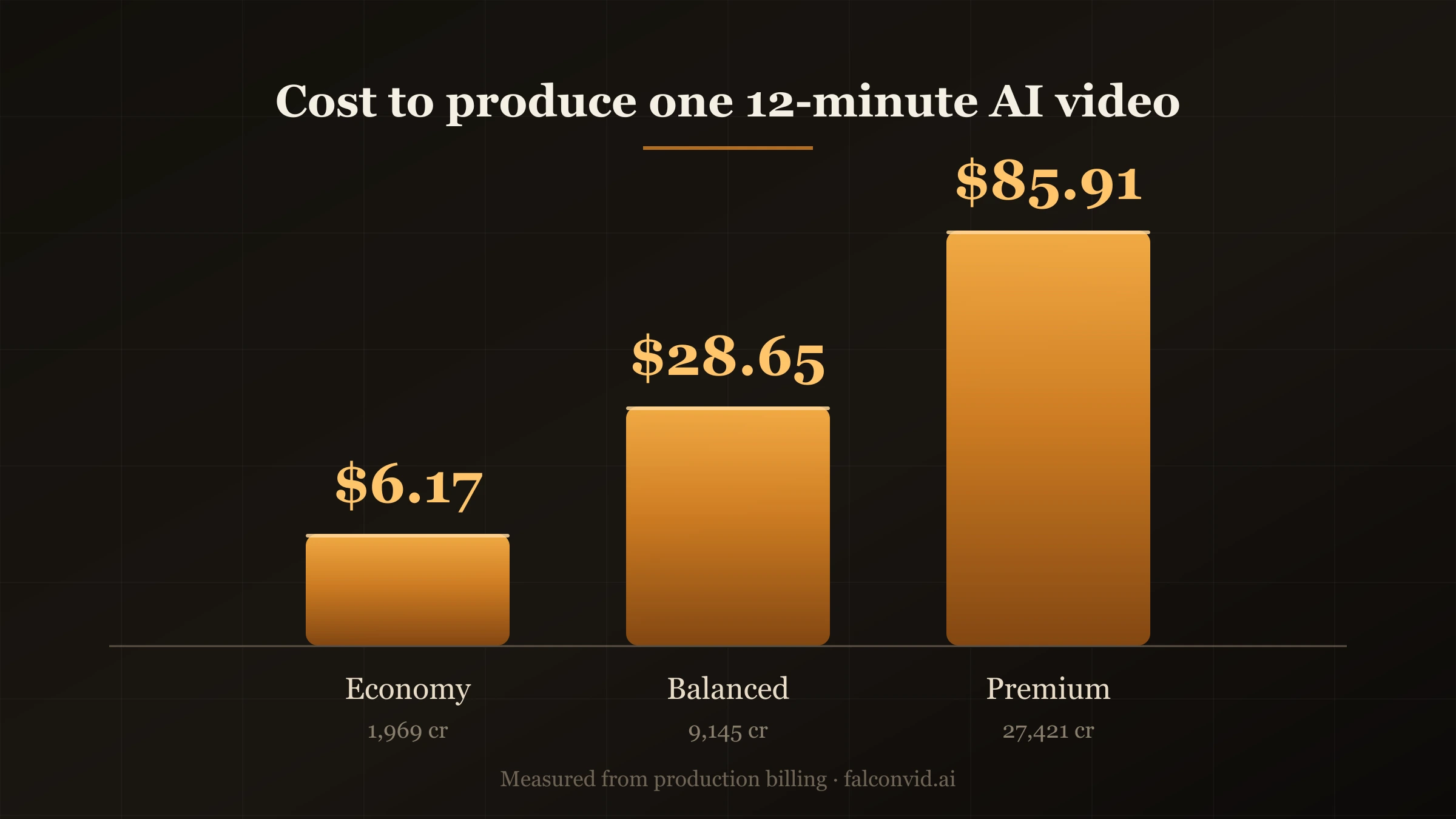
The measured cost of one 12 minute video
Three quality modes, the same 12 minute reference video, priced from the production billing engine per credit.
Economy runs 1,731 credits. Stock footage with motion applied to still frames.
Balanced runs 4,597 credits. AI generated imagery for every scene.
Premium runs 16,131 credits. Cinematic generation, with motion synthesised per shot.
The spread between cheapest and most expensive is 9.3 times. That ratio, not the monthly plan, is what decides whether a channel is viable.
Where the money actually goes
Instrumenting the pipeline call by call showed the cost is not spread evenly. Image generation dominates everything else.
Across 185 measured calls, the image model averaged $0.14082 per call. The reasoning model used for scripting and planning averaged $0.01749. The fast model used for short structured tasks averaged $0.00028.
That is a spread of roughly 500 times between the cheapest and most expensive call in the same pipeline. Every extra scene multiplies the expensive one.
What this changes about quality settings
Quality is usually presented as a slider you set once. Priced per video, it becomes a decision you make per video.
A tutorial that lives on search traffic for two years may justify the 16,131 credits of premium. A daily news recap with a 48 hour shelf life does not, and the 1,731 credits of economy buy the same watch time.
The mistake is not picking the expensive mode. It is picking one mode for the whole channel. The same per video logic applies to the sales formats the pipeline produces: a VSL modeled with AI runs its lead tests in economy and the winning version in balanced.
How these numbers were produced
The per video figures come from the credit engine of FalconVid, an AI video automation platform, using its published credit price and the credit cost of a 12 minute reference video in each mode.
The per call figures come from 42 production runs with cost instrumentation enabled, covering 185 individual model calls. Small sample, real invoices, no estimates.
Prices move as model providers change theirs. The method matters more than any single figure: measure per video, not per month.