
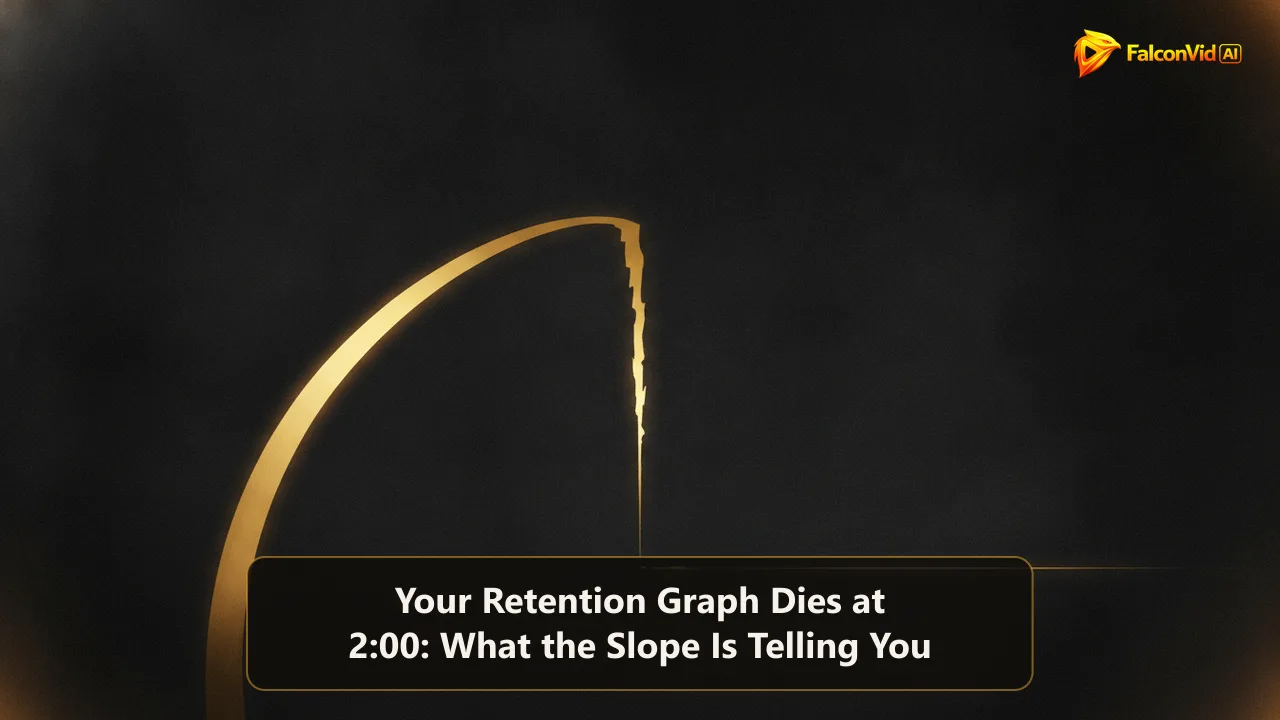
The normal curve and the sick curve
Falling at the start is not a defect. On a 10 to 12 minute video, losing 20 to 30 percent of viewers in the first 30 seconds is what a healthy graph looks like. That stretch is a sieve, removing whoever misread the title or wanted a different depth. A video that loses nobody in the first half minute usually has a title so vague that nobody arrived with an expectation at all.
What decides the video is the slope between 0:30 and 2:30. In that window the audience is no longer being filtered, it is being kept or lost. A healthy graph gives up another 10 to 15 points there and starts to flatten. A sick one keeps falling at the rate it fell in the first 30 seconds, so by 2:30 you are under 40 percent with nine minutes still to run.
Memorize the band: average percentage viewed between 35 and 50 percent on a 10 to 12 minute video is a working channel. At 45 percent on 12 minutes each viewer gives you 5 minutes and 24 seconds; at 30 percent, 3 minutes and 36. Reaching 4,000 watch hours then costs roughly 44,000 views instead of roughly 66,000, and from 1 February 2027 a channel applying new chases 8,000 hours, so the same gap becomes roughly 88,000 views against roughly 133,000. Same content, 22,000 extra views bought by ninety seconds of slope, twice that under the new ruler.
The minute 2 valley: two opposite deaths
Almost every long video that stalls concentrates its damage between 1:30 and 2:30, and it dies in one of two ways that are exact opposites. Either the hook already delivered everything it promised, or it has still delivered nothing. Both make an ugly graph and the repairs point in opposite directions, so guessing here costs a month of uploads.
Death by early delivery is a step: the line runs level and drops vertically inside three seconds, 62 percent at 1:48 and 44 percent at 1:56. People got exactly what the title promised and left satisfied, which is nine minutes of watch time handed back. The other version of the step is the viewer realizing the answer is not in here at all, and the chart cannot tell those apart. Open that second and watch it.
Death by boredom is a ramp: no cliff anywhere, just 2 to 3 points lost every 15 seconds from 0:30 to 4:00. Nothing bad happened; nothing happened at all. That shape almost never comes from the writing, it comes from pacing. The same image on screen for 18 seconds, narration held on one flat note, a block running 3 minutes without restating why the viewer is still there.
How to read the shape of the fall
In YouTube Studio open the video, go to Analytics and find the audience retention chart under engagement. Absolute retention shows the percentage still watching at each second. Relative retention compares it against videos of similar length on the platform, which is how you learn whether a fall at 2:00 is your fault or simply what a 12 minute video does. The key moments panel points at the seconds worth opening.
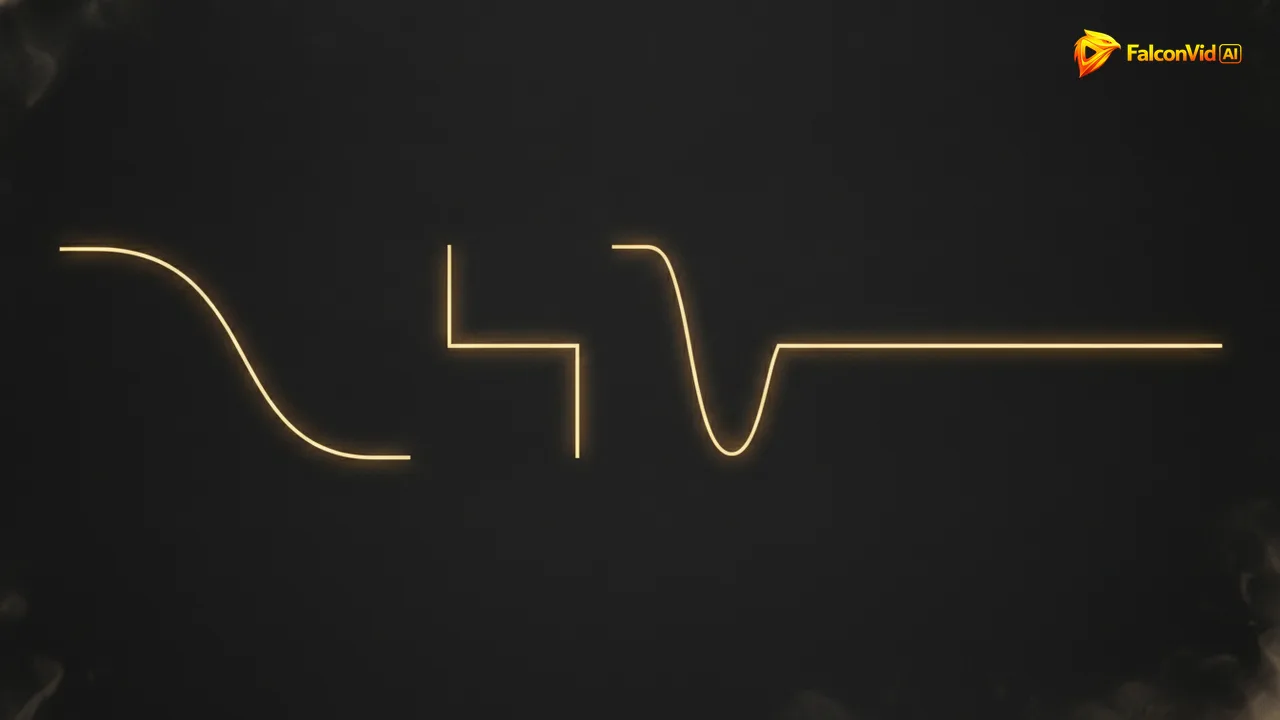
Every retention chart is built from five shapes, and each one names a different disease.
Then comes the habit that pays, and it is boring: open each broken second and watch 15 seconds either side with the sound on. Nine times out of ten the cause is embarrassingly visible, a slow transition, a sentence repeating a point you already made, an image that appeared two minutes earlier. Ten minutes of chart reading replaces months of guessing at the thumbnail.
- Step: a vertical fall inside 3 to 5 seconds. That precise second ejected people
- Ramp: 2 to 3 points lost every 15 seconds with no cliff. That is pacing, not content
- Valley: a fall that recovers 30 to 60 seconds later. A dead block viewers skipped
- Spike: a small rise. People rewound, so that moment deserved to happen earlier
- Plateau: a flat stretch. This is the part that works, so study it before touching it
The five real causes of the fall
The first is the introduction that keeps introducing: 30 to 60 seconds of context, a greeting, a summary of what the video will cover. On a 12 minute video a 45 second setup is only 6 percent of the runtime, and it is the most expensive 6 percent you own. The second is the missing bridge, because a long video is five or six blocks and every seam that ends on a full stop is an exit.
The third is visual pacing. The same frame held 15 to 20 seconds reads as a slideshow, while a change every 4 to 8 seconds means 90 to 180 scenes on a 12 minute video, a number manual editors quietly refuse to hit. The fourth is narration on one note for 12 straight minutes. The fifth is the cruelest, the promise of the title paid in full inside the first 40 seconds.
Three of those five are production defaults rather than talent, which is why they repeat identically on every upload from the same setup. FalconVid writes the script with the retention structure already inside it, a pre hook, an open loop and blocks that hand off to each other, and assembles a new scene every few seconds with ultra realistic narration that varies its pace. That leaves the promise and the topic, the two decisions that deserve you.
- A 30 to 60 second introduction spent on context instead of substance
- No bridge between blocks, so every seam becomes a natural exit
- The same image held 15 to 20 seconds, which reads as a slideshow
- Narration on one flat note, same speed and volume, for 12 straight minutes
- The promise of the title paid in full inside the first 40 seconds
- A change every 4 to 8 seconds means 90 to 180 scenes on a 12 minute video
Where FalconVid fits into this
Retention is decided in the script and in the assembly, not rescued later on the timeline, which is why FalconVid starts there. The AI scriptwriter builds the video with the structure described above already in place: a pre hook at 0:00, one open loop stated early and paid before the end, blocks of 90 to 120 seconds that hand the viewer to the next one. The editor cuts a new scene every few seconds, so the flat 18 second image never happens.
The second change is how many attempts you get. Specialists work in parallel, a researcher, a scriptwriter, a narrator, an editor and a sound designer at once, and a video is ready in up to 30 minutes. Generations run side by side, 2 at a time on Starter, 5 on Pro, 10 on Business, 25 on Agency and 50 on Scale, so three different openings for the same topic get compared in the time one manual re-edit takes.
Then the part every editor dreads. Moving an intro from 45 seconds to 8 on an exported 12 minute video means re-cutting narration, re-syncing every visual after the cut point and re-rendering, 2 to 4 hours for a change you are not sure about. In the Studio you watch the first cut, shorten the intro, swap a piece of media or change the music, and the video re-assembles itself and goes out on the calendar you already approved.
The economics are plain. A 12 minute video costs 1,584 credits in economy mode, 9,000 in balanced and 27,084 in premium, so the mode weighs more than the plan. Starter includes 15,000 credits, 9 videos in pure economy or a realistic 4 a month mixing economy with one in balanced. Every plan ships every creation feature, with a free plan with 4 videos a month and no card.
The structural fix: 8 seconds, one loop, 90 second blocks
Start with an 8 second pre hook at 0:00, before any context: the sharpest sentence or the most surprising image of the whole video, borrowed from minute seven if that is where the good part lives. Its only job is to buy the next 20 seconds, and it works because the viewer who arrived at second zero has not decided anything yet.
Then open exactly one loop, stated before 0:20 and paid before the end, something like the number that made me change everything is at the end of this video. One loop per video, honest, and actually paid, because a loop you never close costs you the next video too. Inside that frame, change the visual every 4 to 8 seconds and build the body as blocks of 90 to 120 seconds, each carrying its own micro promise and ending by opening the next. On 12 minutes that is six blocks and five bridges.
None of this is hard to describe and all of it is expensive by hand: a longer script, more scenes to source, more cuts to place, a full re-render every time you change your mind. That asymmetry is the whole argument for automating it.
That is exactly the part FalconVid refuses to leave to your patience. The AI scriptwriter lays out the blocks with their own micro promise already written in, each one closing by opening the next, so the bridges are not something you have to remember to glue on at eleven at night. The editor places a visual change every few seconds across the entire runtime, which is the 90 to 180 scenes nobody cuts by hand on a 12 minute video. And when the first version comes back with a 40 second opening, you watch it in the Studio and shorten the intro right there, no timeline, no re-syncing, no render to babysit. By hand, that same change on an exported 12 minute video is 2 to 4 hours.
- An 8 second pre hook at 0:00, before any context, greeting or logo
- One open loop stated before 0:20 and genuinely paid before the end
- A visual change every 4 to 8 seconds, never the same frame for 15
- Blocks of 90 to 120 seconds, each with its own micro promise
- A bridge sentence at every seam, so no block ends on a full stop
- By hand that re-edit is 2 to 4 hours. In the Studio it is one adjustment
What to measure next week, and how to iterate without re-recording
Give any structural change 7 days and at least 4 videos before judging it, and track three numbers. Retention at 0:30 tells you whether the title and the pre hook are matched. Retention at 2:30 tells you whether the body earned the stay. Average percentage viewed tells you what the whole thing was worth, and that is the one that turns into watch hours and revenue.
Change one variable per batch. Four videos with an 8 second pre hook, measured against your previous four, is an answer you can act on. Four videos where you also cut the runtime, changed the voice and rebuilt the thumbnail is a mood. The discipline is unglamorous and it is the whole difference between a channel that learns and one that redecorates.
This is where doing it by hand runs out of room. Four videos per test, several tests to isolate one variable, one person editing each 12 minute video: that is months per answer. Produced in parallel the same batch is days, so the ceiling in this article was never yours, it belonged to the timeline. You approve the calendar and the videos are produced and published on their own, which is how a faceless channel runs several openings, several topics and several channels at once, each with its own identity, language and schedule.
Iterating is only cheap when producing is cheap, and that is the whole trick. FalconVid runs the specialists in parallel and hands the first version back in up to 30 minutes, and generations run at the same time, 2 on Starter, 5 on Pro, 10 on Business, 25 on Agency and 50 on Scale, so two different openings for the same topic get tested in the same week instead of the same quarter. The cost sits with the mode, not with your patience: a 12 minute video is 1,584 credits in economy mode and 9,000 in balanced, so a full four video test in economy runs around 4,032 credits, about a quarter of the 15,000 credits a month on Starter, with the rest of the month still free for the calendar. Test the opening, keep the winner, move the whole calendar onto it.