
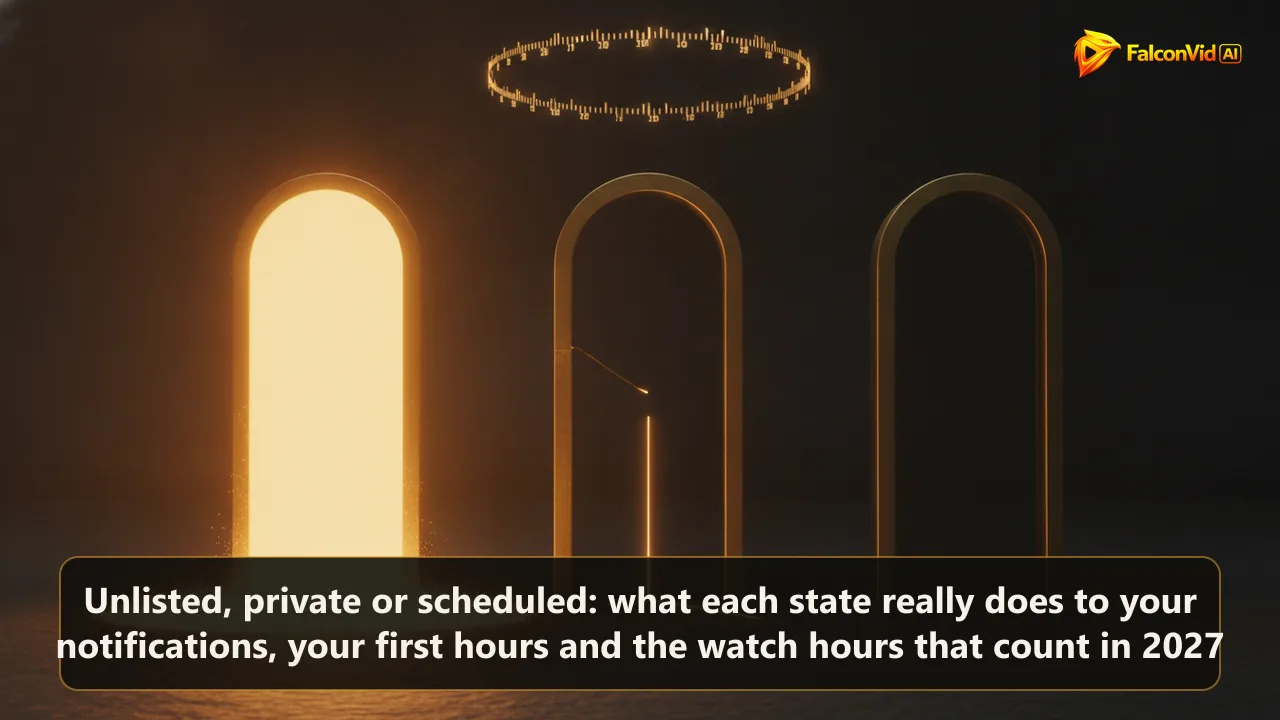
The five states, and what each one actually does
The visibility menu holds three states, public, unlisted and private, plus two behaviors that people discuss as if they were states, scheduling and premiere. Public is the complete one: the video appears for everybody, enters the Videos tab of the channel, shows up in YouTube search and in Google, enters recommendations, fires the notification and lands in the subscriptions feed. It is also the only state whose hours count as qualified public watch hours for the Partner Program, and that last clause is the one that costs money.
Unlisted means only whoever holds the link can watch. It notifies nobody, it does not appear in search, it does not appear in the Videos tab of your own channel and it never enters recommendations. It is not a secret either: anyone with the link can watch it and forward that link to anyone else. The honest way to read unlisted is not as private, it is as public without a storefront, and the hours made in that state do not count toward the monetization ruler.
Private is the actual lock. Only you and up to 50 invited accounts per video, and each invited person has to be signed into the exact account you invited, which is where most private links die in practice. It counts nothing and it notifies nothing, so it is excellent for a client review or an internal approval and useless as a soft launch. People reach for private when they mean unlisted, and for unlisted when they mean scheduled, and both mistakes end up costing the same thing.
Scheduling is not a fourth state, it is a public transition on a timer: the video sits private until the marked hour and turns public on its own, and that is the exact moment the notification goes out. A premiere goes one step further, building a page with a countdown and a live chat before the hour, so the audience arrives together and the video becomes an ordinary video once it is over. Those two exist precisely so nobody has to remember to flip a switch at nine in the morning.
- Public: everyone, Videos tab, search, recommendations, notification, and the only hours that count for monetization.
- Unlisted: link only, no notification, no search, not in the Videos tab, no recommendations, and hours that do not count.
- Unlisted is not private: whoever receives the link can watch it and forward it to anybody.
- Private: you plus up to 50 invited accounts per video, each signed into the account that was invited.
- Scheduled: private until the marked hour, then public on its own, and that is when the notification fires.
- Premiere: countdown page and live chat before the hour, then it turns into a normal video.
The notification fires once, and only when the video goes public
A subscriber finds out about a new video in three places: the bell notification, the subscriptions feed and the Videos tab of your channel. An unlisted video misses all three at the same time. Somebody who deliberately opens your channel looking for what is new still will not see it, because it is not in the tab, and that is not a glitch, that is the definition of the state you picked.
The first hours of a video are the hours where distribution decides what to do with it, and none of that machinery runs while the video is hidden. Search does not have it, recommendations do not have it, the subscriptions feed does not have it. A video that spent its first three days unlisted spent its first three days outside the shop window, and no switch later in the week rewinds the calendar to put them back.
That is the whole reason premiere exists. Instead of a public transition nobody notices, you get a page with a countdown and a live chat that people can sit on, and the audience shows up inside the same window rather than trickling in across a week. After the countdown it becomes an ordinary video, so there is nothing to undo afterwards. On a faceless youtube channel publishing on a fixed schedule it is a cheap way to concentrate the first hour.
The mechanical half of this is where automation earns its keep. In FalconVid the video leaves the approved calendar already public, on the date and at the hour of its slot, on YouTube, Instagram, TikTok, Rumble and Facebook. There is no gap where a finished file waits in a folder for somebody to remember it, and nobody ends up with a video parked in unlisted because Friday got busy and Monday looked different.
The 2027 ruler: 8,000 public hours, and the word public is doing the work
From the 1st of February 2027, for whoever enters new, the Partner Program asks for 1,000 subscribers plus 8,000 qualified public watch hours in 365 days, or 1,000 subscribers plus 20 million qualified Shorts views in 90 days. Both thresholds doubled, and until the 31st of January 2027 the old ruler of 4,000 hours or 10 million Shorts views is still the one in force. Whoever is already inside the program is not affected by the new numbers, but does have to accept the updated terms in YouTube Studio by that same date.
Run the arithmetic once and the rule stops being abstract. 8,000 hours is 480,000 minutes. A 12 minute video watched at 40% average percentage viewed gives 4.8 minutes per view, so 480,000 divided by 4.8 is 100,000 views to clear the new ruler, against 50,000 for the old one. At 50% it is 80,000 views, at 30% it is 133,333, and a 20 minute video at 40% needs 60,000.
Now shrink the same math down to one video. At 1,000 views on a 12 minute video watched at 40%, that single video banks 80 hours. Eight thousand divided by eighty is 100 videos, which is the point of counting it this way: the ruler is a production number long before it becomes an audience number, and the audience half is the one nobody honest will ever promise you.
The production half, on the other hand, is something you can plan down to the credit. A hundred videos in economy mode cost 158,400 credits, and that covers the entire line, research, script, narration, editing, captions and thumbnail. By hand, a faceless channel realistically delivers 4 to 8 videos a month, which puts those same 100 videos somewhere between 12 and 25 months away. The requirement did not change, the clock did.
- From 1 February 2027, new entrants: 1,000 subscribers plus 8,000 qualified public watch hours in 365 days.
- Or 1,000 subscribers plus 20 million qualified Shorts views in 90 days. Both numbers doubled.
- Until 31 January 2027 the old ruler still applies: 4,000 hours or 10 million Shorts views.
- Already in the program: the new numbers do not apply, but the updated terms must be accepted in YouTube Studio by 31 January 2027.
- 8,000 hours is 480,000 minutes, which is 100,000 views on a 12 minute video watched at 40%.
- At 1,000 views per video that is 80 hours each, so 100 videos to clear the ruler.
The hours you throw in the bin every time a video hides
Here is the bill, with numbers on it. Ten videos left unlisted for three months to test the format, each doing 1,000 views in that period on a 12 minute video watched at 40%, is 80 hours per video and 800 hours in total. Eight hundred hours is 10% of the 8,000 the new ruler asks for: produced, paid for and then thrown away, because hours made in unlisted are not qualified public hours and never become them.
Flipping the switch later does work, and it is worth doing today for anything hidden that should not be. From the moment the video turns public it counts and it gets distributed like any other video on the channel. What does not happen is retroactive. The hours accumulated while it was hidden do not come back, they were never qualified in the first place, and no amount of flipping recovers a single one of them.
The second cost is the calendar, and this one is easy to miss. The 365 day window is rolling, not fixed: an hour watched 366 days ago drops out of the count today. So a video sitting in unlisted burns the window twice, once for the hours it did not bank and once for the days it spent not banking them, while the hours you earned last spring quietly fall off the back of the window.
The honest question is what unlisted was solving in the first place. Almost always it was fear, the fear that the video comes out wrong and gets seen wrong. That fear has a much cheaper answer than hiding a finished video for a quarter. In FalconVid you watch version one and adjust it in the Studio, shortening the intro, swapping a clip, changing the music, and a fix costs between 5 and 320 credits against 1,584 to 27,084 to produce the whole video again. Fixing before publishing is exactly what removes the need for a test room built out of lost hours.
Where FalconVid sits in all of this
Publishing is part of the product here, not a step you perform afterwards. You approve the calendar once and the video leaves already public, on the date and at the hour of its slot, on YouTube, Instagram, TikTok, Rumble and Facebook, in up to 63 languages. There is no state to remember, no dropdown to fix and no video parked in unlisted because the week got away from you.
The speed comes from working in parallel. Research, script, narration, editing and sound design run as separate AI specialists at the same time, simultaneous generations go from 2 on Starter to 50 on Scale, and a video is ready in up to 30 minutes. The manual version of 100 videos is 100 trips into YouTube Studio, one upload, one thumbnail, one description and one visibility dropdown at a time, and that dropdown is precisely where the mistake in this article gets made.
The cost is counted in credits and depends on the quality mode. A twelve minute video costs 1,584 credits in economy mode, 9,000 in balanced and 27,084 in premium. Starter includes 15,000 credits, 1 channel and 2 simultaneous generations, and the realistic working plan there is around 4 videos a month mixing economy with one in balanced, because nobody runs a whole month in a single mode. Pro includes 30,000 credits, 5 channels and 5 simultaneous generations.
Every creation feature is on every plan, including karaoke captions, 4K, Shorts, voice cloning, the ai avatar and automatic comment replies, so what changes between plans is volume, channels, simultaneous generations, the dedicated server from Pro, the Senior Analyst from Pro with 7 free days on Starter, and support. Channels go from 1 on Starter to 50 on Scale, each one with its own calendar, its own identity through the channel DNA, its own voice and its own language.
Three traps that turn a careful decision into a mess
The first one catches people who did everything else right. An unlisted video sitting inside a public playlist is shown to anyone who opens that playlist, so the video you kept out of the channel tab is browsable in a list anybody can reach. It is not a leak in the ordinary sense, it is the playlist doing its job, and it is the single most common way an unlisted video ends up in front of an audience that was never meant to see it.
The second is the link itself. Unlisted is not a password, it is an unlisted phone number: whoever receives the link can watch it and can forward it, and nothing stops the second person from doing the same. If the content genuinely must not travel, the only state that enforces that is private, which is you plus up to 50 invited accounts per video, each of them signed into the account you invited. Anything above 50 people is not a private video, it is a public video you have not decided about yet.
The third is the batch. Producing a week of content in one afternoon is efficient, publishing a week of content in one afternoon is not: the videos compete against each other in the same feed, and the same subscriber gets notified seven times in three hours. Scheduling exists exactly to separate the day you produce from the day you publish, and it is the one part of this entire conversation that is free, immediate and impossible to get wrong.
There is a fourth reason people end up with videos in the wrong state, and it is the one that hits anyone doing youtube automation by hand: they built their own publisher and it quietly ran out. The YouTube Data API gives 10,000 units a day per project and a single upload costs 1,600, which is about 6 uploads a day, and a project that has not passed the compliance audit has its API uploads locked to private, so the video goes up, the log says success and nobody on earth can watch it. In FalconVid none of that quota arithmetic ever lands on your desk.
- A public playlist shows the unlisted videos inside it to anyone who opens the playlist.
- An unlisted link can be watched and forwarded by anybody who receives it.
- Private is the only state that enforces access, and it caps at 50 invited accounts per video.
- Each invited person has to be signed into the exact account that received the invitation.
- Publishing a whole batch on the same day makes your own videos compete in the same feed.
- Your own publisher means 10,000 API units a day and 1,600 per upload, so about 6 uploads.
What to do with the videos already sitting hidden
Start with an audit, and it takes twenty minutes. Open the content list in YouTube Studio, filter by visibility and write down everything that is unlisted or private. For each one, ask a single question: is there a real reason this cannot be in the storefront? A client sample, an embed on a private page and an internal test are real reasons. I will make it public when it is ready is not a reason, it is a video quietly counting nothing on a rolling window.
Everything that fails that test goes public today, not next Monday. From the moment it flips it counts and it gets distributed, and the difference between doing it now and doing it in three weeks is three weeks of window spent for nothing. Spread the flips across a few days rather than turning ten videos public in one afternoon, for exactly the same reason you would not publish ten fresh videos in one afternoon.
Then repair the process that created the pile. Unlisted stops being your test room, because the test room is the version you watch and fix before it goes out, and scheduling stops being an afterthought, because it is the only tool that lets you produce in batches and publish in a rhythm. Both changes cost nothing, and together they are the whole difference between a channel that banks its hours and a channel that produces them and files them away in the dark.
The manual version of this discipline is where it breaks, because 100 videos by hand is 100 evenings and 100 visibility dropdowns, and one distracted Friday is 80 hours that never counted. On the automated side the calendar is approved once, AI specialists work in parallel, a video is ready in up to 30 minutes, and every video leaves public at the hour it was supposed to leave. The promise on the front page is literal: several channels on autopilot, in as many channels as you want, and not one of them with a video forgotten in unlisted.