
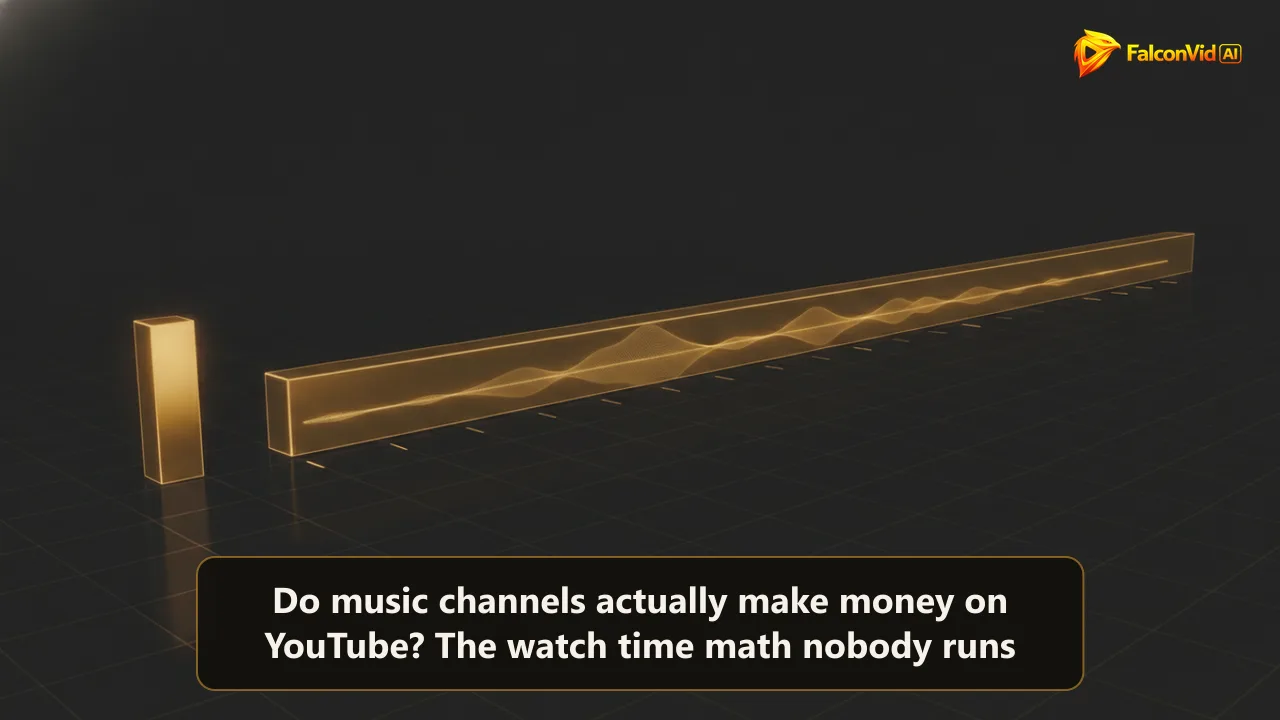
Low RPM is the headline. Watch time is the business
Every argument against music channels starts and stops at RPM. Ambient, lofi and sleep content sits in a low advertiser band, typically $0.50 to $2 per thousand views, against $4 to $12 for a general English speaking audience and far more in finance or software. That part is true and there is no clever way around it.
What that argument never does is finish the calculation. YouTube does not pay you for views, it pays you for ads served against watch time, and monetization eligibility is measured in hours, not in clicks. A music channel is the only faceless format where a single view can be worth an hour of watch time.
Put both halves on the table and the picture inverts. You are paid less per thousand views and you collect far more minutes per view. Whether that trade is good depends entirely on which number moves more, and it is not close.
RPM ranges quoted here are market benchmarks, not official YouTube or Google data.
- Ambient and sleep music: roughly $0.50 to $2 RPM, against $4 to $12 for general English content.
- YouTube pays against watch time, and monetization eligibility is measured in hours.
- A music view can be worth an hour. A talking head view is worth about 5 minutes.
4,000 hours: 3,000 views instead of 44,500
Monetization needs 1,000 subscribers and 4,000 public watch hours in 12 months until 31 January 2027. From 1 February 2027 a channel entering new needs 8,000 hours, and the Shorts door moves from 10 million to 20 million qualified views in 90 days. Run it for a narrated channel first. A 12 minute video at 45% average view duration delivers 5.4 minutes per view, so 4,000 hours is 240,000 minutes, which is about 44,500 views, and 8,000 hours is about 89,000. That is the number a talking channel has to reach.
Now run it for sleep music. A 10 hour video does not get watched for 10 hours, but it is not watched for 5 minutes either. A realistic average view duration on long sleep and study content sits between 45 and 90 minutes, because people start it and leave. At 60 minutes per view, 4,000 hours is 4,000 views. At 90 minutes it is about 2,700. At a pessimistic 45 minutes it is 5,300. Under the 8,000 hour rule that starts on 1 February 2027 each of those doubles: 8,000 views, about 5,300 and 10,600.
So the same threshold that costs a narrated channel 44,500 views costs a music channel roughly 3,000 to 5,500. That is eight to fifteen times fewer views for the same milestone, and it is the single most underrated fact about the format. The ratio does not change in 2027, because both sides of the comparison double together.
The catch is real and worth stating: fewer views also means fewer ad impressions, so reaching monetization fast does not mean earning a lot immediately. It means you cross the gate early and then scale a catalog that keeps collecting hours while you sleep.
- Narrated 12 minute video at 45% retention: about 44,500 views for 4,000 watch hours, about 89,000 for the 8,000 hours that start on 1 February 2027.
- Sleep music at 45 to 90 minutes average view duration: roughly 2,700 to 5,300 views.
- Eight to fifteen times fewer views for the same monetization gate.
The second engine: a music catalog does not decay
A news video is dead in 72 hours. A tutorial fades when the software updates. A 3 hour rain sounds video published in 2023 is still collecting views tonight, because the demand it serves is permanent and undated. Nobody searches for last year's sleep.
That changes what a catalog is worth. Ten evergreen music videos each holding 200 views a day is 2,000 views a day arriving with no work at all, and unlike a talking catalog it does not need updating, correcting or refreshing. The asset ages into the background of thousands of bedrooms and offices.
It also changes the shape of the risk. A music channel is slow at the start, because a new channel with no signal does not get pushed into sleep and study rotations. The payoff is that once a video is placed, it stays placed for years.
- Music demand is undated: a 2023 rain video still performs tonight.
- Ten evergreen videos at 200 views a day is 2,000 daily views with zero work.
- Slow to start, very slow to die. The opposite risk profile of news content.
What a 10 hour video actually costs to make
This is where the format used to die. Producing 10 hours of original music, visuals and a render by hand is not a weekend, it is a small studio. Licensing 10 hours of music you are allowed to monetize costs more than the video will earn in its first year.
In FalconVid a music channel is a project type of its own, and the cost is fully itemized. A 10 hour session video costs 894 credits: 480 for the 10 distinct tracks, 200 for the 10 hours of render, and 214 for the thumbnail. A 1 hour video costs 714 credits, because from one duration to the next it is mostly the render that changes: 2 hours 734, 3 hours 754, 5 hours 794, 8 hours 854.
Compare that to the narrated pipeline on the same platform: a 12 minute video costs 1,584 credits in economy mode, 9,000 in balanced and 27,084 in premium. A 10 hour music video costs about a tenth of one 12 minute video in balanced mode, for fifty times the runtime.
The reuse setting is what makes it work. You choose how many distinct tracks the session uses, and the video is built from those, so a 10 hour video and a 1 hour video pay for the same 10 tracks. You are billed for what is generated, not for what is on screen. A single sung track of around 4 minutes, the other format, costs 299 credits. The arithmetic month by month, including what makes the bill go up and how many sessions fit in each plan, is in the monthly cost of an AI music channel.
- 10 hour session video: 894 credits (480 tracks + 200 render + 214 thumbnail).
- 1 hour session video: 714 credits. Between durations it is mostly the render that moves.
- Narrated 12 minute video for comparison: 1,584 economy, 9,000 balanced, 27,084 premium.
How many music videos each plan actually carries
At 894 credits for a 10 hour video, Starter with 15,000 credits carries 16 of them a month, which is 160 hours of published content. Pro with 30,000 credits carries 33. Business with 95,000 credits carries 106. Agency with 190,000 credits carries 212. Scale with 320,000 credits carries 357.
Nobody publishes 16 ten hour videos in a month on a new channel and should not try. The realistic first 90 days is 2 videos a week, which is 8 to 9 a month and fits inside Starter with room left for thumbnails you regenerate and tests you throw away. If you want a 3 a week cadence, Pro carries 33 a month.
The plan differences that matter for music are channels and simultaneous generations, not creation features. Starter runs 1 channel with 2 generations at once, Pro runs 5 channels with 5, Business 10, Agency 25, and Scale 50 channels with 50 simultaneous generations. Every creation feature is on every plan: nothing about the music pipeline is locked behind a tier. What changes beyond volume is the AI Senior Analyst, included from Pro up with a 7 day trial on Starter, and the support level.
- 10 hour videos per month: 10 on Starter, 33 on Pro, 106 on Business, 212 on Agency, 357 on Scale.
- Realistic first 90 days: 2 videos a week, 8 to 9 a month, comfortably inside Starter.
- What plans change is channels, simultaneous generations, the AI senior analyst from Pro and support, never a creation feature.
The part that turns a music channel into a brand: an artist
Most music channels are interchangeable. The same stock loop, the same anime girl at a desk, the same title. They collect passive views and never build anything you could sell or grow.
FalconVid lets the channel have an artist instead: a face you create once, with a locked voice, that appears in every video and on every cover. The face does not drift between uploads, the voice does not change between tracks, and after twenty videos the channel reads as a project rather than as a folder of uploads. That is the difference between a channel people leave running and a channel people subscribe to.
The format is chosen when the channel is born and does not change afterwards: a long instrumental session, one sung track per video, or a compilation of several sung tracks. The engine ships 11 genre contracts: lofi hiphop, ambient focus, meditation, phonk, brazilian phonk, synthwave, cinematic, forró, lullaby, smooth jazz and christmas. Niches like chillhop, deep work, sleep and frequency channels such as 432 Hz and 528 Hz are produced from the ambient focus and meditation contracts, since the music channel takes the niche, the theme, the calendar and the cover from you.
One thing to be exact about, because plenty of people online are not: FalconVid produces and publishes to YouTube, Instagram, TikTok, Rumble and Facebook. It does not upload to Spotify. The tracks it generates are yours, so you can take them to Spotify through a distributor yourself, but that step is on you and no tool should tell you otherwise.
- A created artist with a locked face and voice, consistent across every video and cover.
- Three formats chosen at birth: long instrumental session, one sung track, or a compilation.
- 11 genre contracts: lofi hiphop, ambient focus, meditation, phonk, brazilian phonk, synthwave, cinematic, forró, lullaby, smooth jazz and christmas. Sleep and frequency niches come out of ambient focus and meditation.
- Publishing goes to YouTube, Instagram, TikTok, Rumble and Facebook. Spotify needs your own distributor.
Who this format is wrong for
If you need income in 60 days, this is the wrong lane. Music channels build slowly and the first three months usually look like nothing is happening, because the algorithm places long sessions conservatively and the payoff is in placement, not in launch spikes.
If you want high RPM per view, this is also the wrong lane, and no amount of optimization changes a $0.50 to $2 band into a finance channel. The money in music comes from hours accumulated across a catalog, not from any single video performing.
It is the right lane if you want an asset that keeps paying with no maintenance, if you want to cross the monetization gate on a fraction of the views, and if you can hold a schedule for six months without checking the numbers every day. That is the honest version of the pitch. And if the temptation is to skip the catalogue and open a live radio instead, the arithmetic of both sides is in a 24/7 live stream against published long videos.
- Wrong if you need income in 60 days: the first three months look flat by design.
- Wrong if you want high RPM per view: the band is structural, not an optimization problem.
- Right if you want a low maintenance catalog and an early monetization gate.