
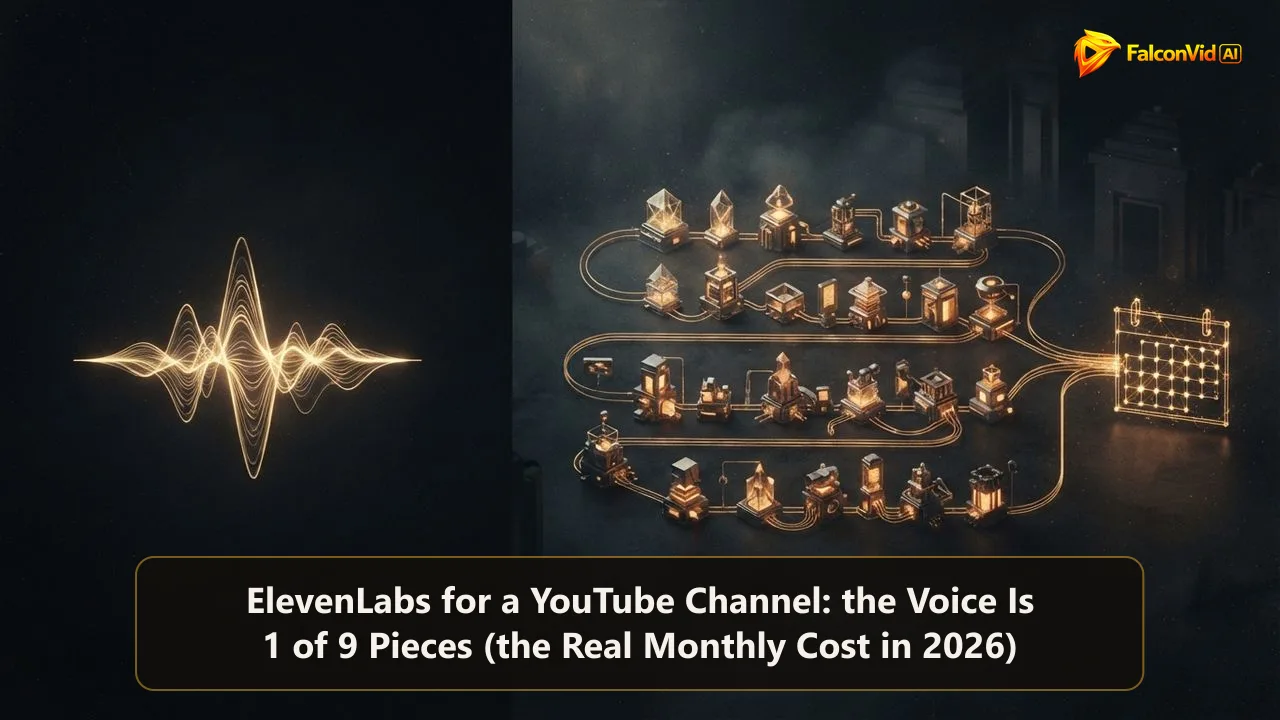
What ElevenLabs sells: characters of audio, and it sells them well
ElevenLabs is one of the best AI voice generators on the market, and most people who search for an AI voice for YouTube end up there for a good reason. The voices carry emotion, the pacing sounds human, the multilingual model handles accents well, and voice cloning lets a creator narrate with a copy of their own voice. Nothing in this guide argues otherwise. The question is narrower: what exactly are you buying when the goal is a YouTube channel that publishes every week, and not a single voice over.
Per their pricing page in September 2026, ElevenLabs sells credits, and in text to speech a credit is a character. The Free plan gives 10,000 credits a month, around 10 minutes of audio, with no commercial license. The Starter costs US$ 6 a month for 30,000 credits, around 30 minutes, with a commercial license and instant voice cloning. The Creator costs US$ 22 a month, with the first month at 50 percent off, for 121,000 credits, around 121 minutes, and adds professional voice cloning. The Pro costs US$ 99 a month for 600,000 credits, around 600 minutes. The Scale costs US$ 299 a month for 1,800,000 credits, and the Business US$ 990 a month for 6,000,000 credits.
On the Multilingual v2 model, text to speech costs 1 credit per character. The faster Flash and Turbo models cost between 0.5 and 1 credit per character. Prices and allowances in AI tools change often, so check the page on the day you decide. The pattern is stable, though: the unit you pay for is characters of text turned into audio, and every time you turn the same text into audio again, you pay again.
That unit is fair for the jobs the tool was built for: an audiobook chapter, a podcast intro, a game character, a product demo, a single voice over dropped into a video you are editing yourself. In every one of those, the audio is the deliverable. In a YouTube channel the audio is one track on a timeline, and the deliverable is the finished video, published on its date. The difference shows up as soon as you run the numbers for a month.
The character math of a channel month: 11,000 credits per video
Narration runs at about 150 words per minute. A twelve minute video, a normal length for history, finance, true crime, curiosities or explainer niches where watch time is the currency, needs about 1,800 words of script. In English an average word plus its space is close to six characters, so 1,800 words are about 10,000 to 11,000 characters. On Multilingual v2, at 1 credit per character, that is about 11,000 credits for one clean pass of one video.
Clean passes are rare. A paragraph comes back with the emphasis on the wrong word, a proper name is mispronounced, a number is read as a date, the energy drops at the end of a long sentence. Each fix means regenerating that paragraph, and each regeneration consumes characters again. In practice it is prudent to budget 1.3 to 1.5 times the script length, which puts one twelve minute video at about 14,000 to 16,500 credits.
Now the month. A modest faceless channel publishes two videos a week, eight a month. That is about 88,000 credits of raw narration, and about 115,000 to 130,000 with retakes. The Starter, with 30,000 credits, covers about two videos. The Creator, with 121,000, is borderline: it fits the month only if retakes stay close to the low end. The Pro, with 600,000, fits the calendar easily, with room for about 36 to 42 videos. Switching to Flash or Turbo cuts the credits per character by up to half, which at best roughly doubles the count.
In money, the voice is cheap. On the Creator, 16,500 credits are about US$ 3 of the monthly fee, and on the Pro about US$ 2.70. Even against a professional voice actor it wins by a wide margin, a comparison worked out line by line in the cost of AI versus human narration. The problem is not the price of the voice. It is everything the voice does not include.
The other eight pieces the voice does not include
ElevenLabs delivers an audio file. A faceless channel video is that file plus eight other layers, and none of them is in the credits you paid for. This is what people discover after the first export: a perfect twelve minute narration sits on the timeline, the screen is black, and the real work has not started.
Each piece is a task, and each task has a cost in hours or in freelancer fees when it is done by hand:
- Research: facts, numbers and an angle before a line is written, about one to three hours for a twelve minute video.
- Script: 1,800 words with a hook, open loops and a payoff; a freelance script writer charges about US$ 15 to 50 per video.
- Scenes and cut rhythm: stock footage, generated images, motion and a cut every few seconds, the slowest part of the job; a freelance editor charges about US$ 30 to 150 per video.
- Music and sound design: a track that fits the mood, effects on the transitions and a mix where the voice sits above the background.
- Subtitles, ideally karaoke style and synced word by word, since many viewers watch with the sound low or off.
- Thumbnail: the image that decides the click before the voice is ever heard, about US$ 5 to 20 per video from a freelancer.
- Video SEO: title, description, tags and chapters written for search, not for the ear.
- Scheduling and publishing: the upload, the metadata, the date on the calendar, and the same video repeated on other networks.
The turn: the voice is the cheapest piece, the hours live elsewhere
Put the numbers side by side. A twelve minute faceless video done by hand takes about 6 to 10 hours across all the steps. The narration with ElevenLabs is maybe 20 to 40 minutes of that, retakes included. The rest is research, writing, editing, sound, captions, cover, SEO and upload. In money, the voice costs about US$ 3 per video on the Creator, while the freelancers for script, edit and thumbnail add about US$ 50 to 220 per video.
Across a month of eight videos, the manual version is about 48 to 80 hours of work, or about US$ 400 to 1,760 in freelancers on top of the voice plan. The voice is the smallest line on that bill. Swapping it for a better or cheaper voice changes almost nothing in the total, and that is the trap of shopping for a channel by comparing AI voice generators.
That is also the manual ceiling. At 6 to 10 hours per video, one person with a day job runs one channel at two videos a week and stops there. A second channel or a second language doubles the hours. The ceiling is not the voice. It is the eight pieces around it, done one after the other by hand.
The ceiling falls when the pieces run in parallel. In FalconVid the voice is one of the AI specialists on a production line: the researcher, the scriptwriter, the narrator, the editor and the sound designer work on the same video at once, and it is ready in up to 30 minutes. The hours stop living in the edit and move to the only decision that is yours: approving the calendar. From there the videos publish by themselves on their dates.
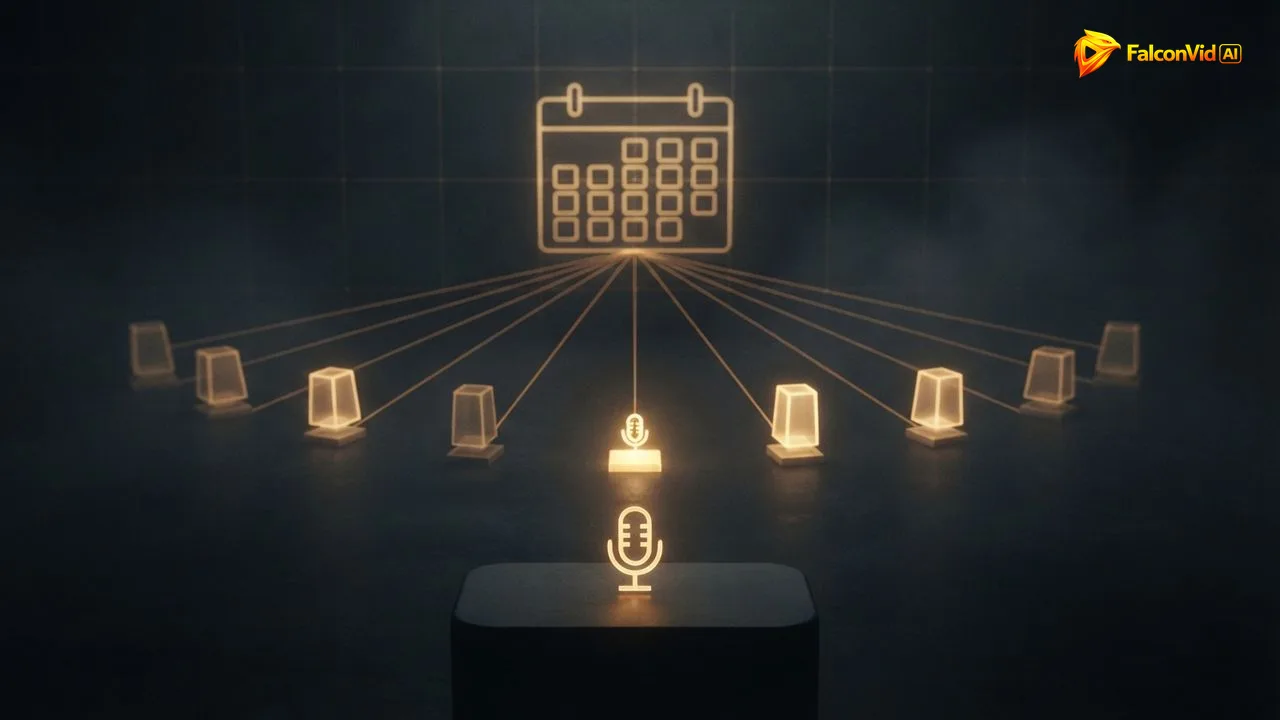
The voice inside the FalconVid pipeline
In FalconVid, the autopilot channel platform, narration is not a separate subscription. It is the narrator on the production line. For each video the researcher gathers facts before the script exists, the scriptwriter writes to the length you set, the narrator reads in a premium ultra realistic voice or in your cloned voice, the editor builds the scenes to match the words, the sound designer adds music and effects from the library, and the subtitles come out as karaoke captions in more than 15 styles. The thumbnail, the video SEO and the Shorts in 9:16 come out of the same run.
The unit changes too. Narration in FalconVid is billed per minute of video, not per character and not per attempt. Premium voices cost 24 credits per minute, so a twelve minute video is 288 credits of narration. The economy FalconVid AI voices cost 3 credits per minute, so the same twelve minutes are 36 credits. Those credits are already inside the cost of the finished video, not a separate bill. The AI voice narration feature page shows the voices, the cloning and the 63 narration languages.
Because the price is per minute of video and not per voice, a second voice costs zero extra. A documentary with a narrator and an interviewer, a story with three characters, a debate format with two hosts: each character gets a distinct voice, and the narration bill is the same as with a single narrator. On a character based model, every extra voice means more characters and more retakes.
Cloning is included. An instant clone is free, and a pro clone is available for creators who want their own voice with more fidelity. The voice, the style and the structure of the channel are stored in the channel DNA, the persistent identity of the channel, so video 1 and video 200 sound like the same host. And the channel does not start from a blank page: the Spy maps what already monetizes in the niche, so you start from what works, not from zero. If a first version needs a tweak, the Studio lets you watch it and shorten the intro, swap a scene, change the music or open the timeline.
What a narrated channel costs in today's credits, plan by plan
On today's ruler, a twelve minute video costs 1,731 credits in economy, 4,597 in balanced and 16,131 in premium, and that includes research, script, narration, scenes, editing, music, subtitles and thumbnail. Economy builds scenes from image banks with movement; premium generates cinematic scenes with engines such as Veo 3 with audio and Seedance Pro. These are FalconVid credits, a different unit from ElevenLabs credits, but the contrast shows where the weight of each model sits: in one, the voice is the whole product; in the other, the whole video is.
Plan by plan: the Starter, with 15,000 credits, 1 channel and 2 simultaneous generations, runs 8 twelve minute videos in economy or 3 in balanced, so the eight video calendar from the start of this guide fits in economy. An honest mix is 2 balanced and 3 economy, 14,387 of 15,000 credits. The Pro, with 30,000 credits, 5 channels and 5 simultaneous generations, runs 17 videos in economy, 6 in balanced or 1 in premium; a mix of 4 balanced and 6 economy is 28,774 credits. From the Pro up you also get the dedicated server and the Senior AI Analyst, a fixed person with a name, a face and a voice who reads your account and writes to you every two days.
The Business, with 95,000 credits, 10 channels and 10 simultaneous generations, runs 54 videos in economy, 20 in balanced or 5 in premium. The Agency, with 190,000 credits and 25 channels, runs 109, 41 or 11. The Scale, with 320,000 credits and 50 channels, runs 184, 69 or 19. Nobody runs a month in one mode; you mix, and the estimate in credits appears before each video is generated, so the month is planned, not discovered.
Languages are where the character model grows fastest, because every new language is a new script, new characters and new retakes. In FalconVid a project is duplicated into another language reusing the media already generated: only narration and subtitles are regenerated, and you pay only the difference. Which markets pay best for the same video is covered in the best languages for AI voice over.
Where manual production stops at two videos a week for one channel, the pipeline runs several videos at once, up to the simultaneous generations of your plan, and several channels at once, each with its own voice, language and calendar.
When ElevenLabs is the right tool, and when the channel is
ElevenLabs is the right purchase when the audio is the deliverable. Audiobooks, podcasts, dubbing a video you already edited, a voice for a game or an app, the narration of a course where you control every other layer. It is also a sensible choice for an editor who already has a production line and only needs the voice track: at about US$ 3 per twelve minute narration, it is hard to beat.
The signal that you are in the wrong tool is the calendar. The moment the goal is a faceless channel that publishes every week, grows watch hours and earns from ads, the unit changes from characters of audio to videos published on schedule. Now you need research, script, scenes, music, captions, thumbnail, SEO and publishing every single week, and the voice is about 5 percent of the hours.
The choice of voice still matters, a lot. The tone that holds a true crime audience is not the one that holds a finance audience, and a wrong fit costs retention in every video. How to match the voice to the niche, with examples, is in which AI voice fits your niche. The point is that the choice happens once, in the channel DNA, and not again in every video.
A simple test: count the videos you want to publish in the next 90 days. If it is three voice overs for videos you are editing anyway, ElevenLabs wins. If it is twenty four finished videos of twelve minutes, you are running a channel, and a channel is a calendar you approve, not a credit balance you ration.
Four mistakes that sink a narrated faceless channel
The first is monetising audio from a plan without a commercial license. Per the ElevenLabs pricing page, the Free plan does not include one, so audio generated there should not go into a monetised channel. Check the license of any voice tool before the first upload, not after the first payout.
The second is changing the voice midway. Audiences bond with a voice as much as with a face, and a channel that swaps narrators every few weeks resets that bond each time. If a change is unavoidable, there is a right way to do it, step by step, in changing the channel voice midway.
The third is budgeting the script and not the retakes. A month planned at 88,000 credits that actually consumes 125,000 runs out in week three, usually right before the video that matters. In FalconVid narration is billed per minute of finished video, not per attempt, and a mispronounced name is fixed without re-recording the whole narration.
The fourth is treating the voice as the channel. A great voice over a slow edit, a generic thumbnail and a title written without search in mind still loses. The voice holds the second minute; the other eight pieces earn the click, the first minute and the tenth. That is why they have to be produced together, every week, and not only when there is time left.