
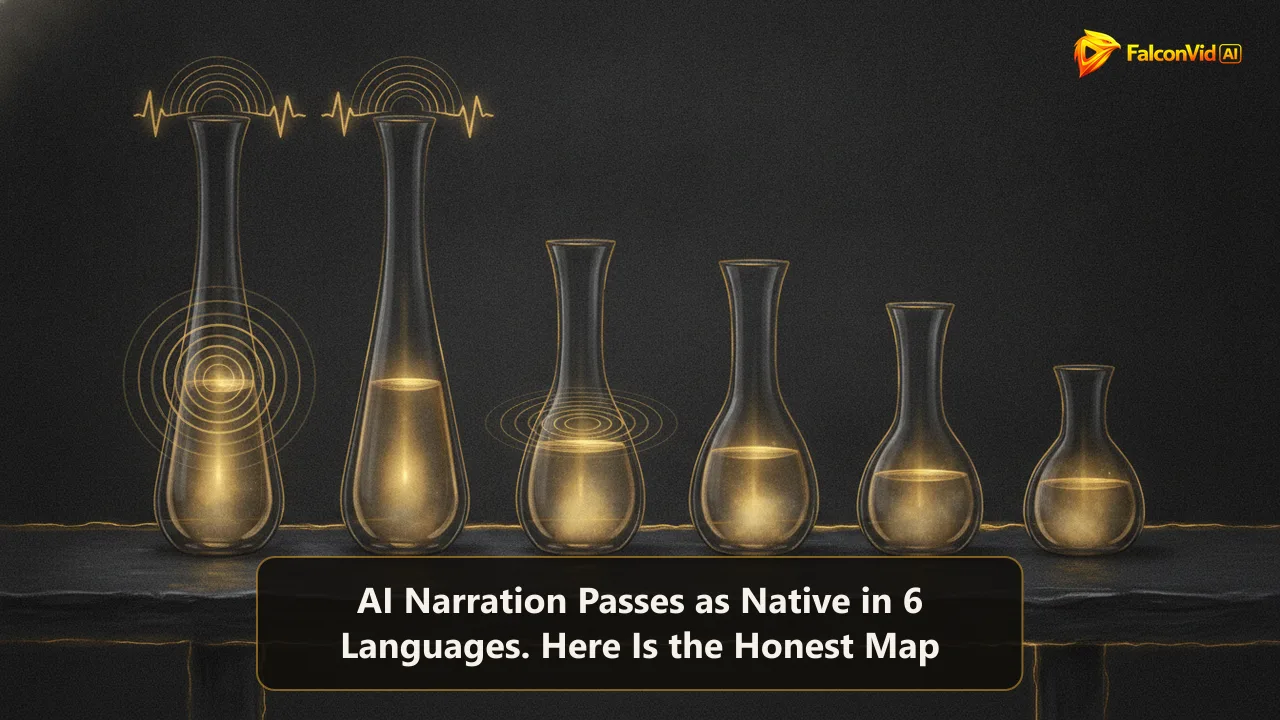
Why some languages sound native and others sound imported
Three things decide how native an AI voice sounds, and none of them is the tool you picked. Training data volume comes first: a model that heard two hundred thousand hours of English and nine hundred hours of Yoruba is not equally good at both. After that comes phonetic structure, and then the number of regional variants the language carries.
Phonetics matters more than people expect. Italian, Spanish, Turkish and Indonesian are nearly phonetically transparent, so the spelling tells the engine how a word is said and errors stay rare. Tonal languages sit at the opposite extreme, because pitch has to carry word meaning and sentence emotion at the same time.
Variants are the quiet killer. Spanish has two well fed standards, neutral Latin American and Castilian, and each sounds correct to its own audience and slightly wrong to the other. So the useful question is never whether a tool supports your language, it is whether it supports the variant your audience actually speaks.
- Recorded hours decide everything: English has orders of magnitude more transcribed speech than anything else
- Phonetically transparent languages get the word right on the first try far more often
- Tonal languages make pitch carry meaning and emotion at once, so expressiveness fights comprehension
- Unwritten information (Russian stress, undiacritised Arabic, kanji readings) forces the engine to guess
- A supported language only proves a voice exists, not that the voice sounds local
Tier A: the six languages where AI narration already passes
These are the languages where a well written script and a good voice simply will not be flagged in the comments. Blind listening tests on top systems reach roughly 4.5 out of 5 on mean opinion score here, inside the range where casual listeners stop separating synthetic from recorded. That is not flawless, it means the remaining errors are the ones a tired human narrator also makes.
English carries the American and British standards on the deepest data that exists. Spanish is strong in both neutral Latin American and Castilian, Brazilian Portuguese is excellent and clearly better served than European Portuguese, and French, German and Italian close the group. All six have large, expressive voice catalogues rather than two token voices.
What still fails here is narrow: emphasis landing on the wrong word inside a long sentence, a foreign proper noun read with local phonetics, a German compound split at the wrong seam. All three are script problems rather than model problems. The section on illusion breakers below is where you fix them for good.
Which voice you are handed matters as much as the tier, and that is a purchasing decision rather than a linguistic one. FalconVid narrates in 63 languages using ultra realistic premium voices, the catalogue tier where the mean opinion scores above actually come from, and it can clone your own voice instead if that is the brand. If your format has more than one speaker, multi character narration gives each one a distinct voice rather than a single reader changing pace. All of it is on every plan, Starter included, because every creation feature ships with every plan; what moves with the plan is volume, channels, simultaneous generations, the AI senior analyst (from Pro, with a 7 day trial on Starter) and support.
- English, US and UK: the deepest catalogue anywhere, just avoid British voices reading American slang
- Spanish, neutral LatAm: the safest single choice, accepted from Mexico to Argentina
- Spanish, Castilian: excellent audio, but distinción and vosotros mark it instantly outside Spain
- Brazilian Portuguese: very strong sentence rhythm; European Portuguese has a visibly thinner catalogue
- French: liaison and elision are clean, but numbers above sixty still trip some engines
- German: strong overall, with compound nouns split at the wrong seam as the main defect
- Italian: phonetically the friendliest here, with wrong syllable stress only on rare words
Tier B: very good, once you tune the script
This is where most creators quit too early. The raw output is about eighty percent of the way there, and the missing twenty percent sits in a handful of entirely predictable failure types. Expect to rewrite three to eight lines in a 1,200 word script, not to rewrite the script.
Japanese, Korean and Mandarin are held back by their writing systems rather than by their voices. Kanji has multiple readings and the engine picks the wrong one for names, Mandarin has polyphonic characters and tone sandhi, and Korean mixes native and Sino Korean counters. Writing the ambiguous word in kana, pinyin or plain hangul removes most of it.
Russian, Polish, Turkish, Hindi, Dutch, Indonesian and Modern Standard Arabic each carry one dominant defect instead of general weakness. Russian stress is not written and moving it changes the word, Arabic without diacritics is genuinely ambiguous, and Hindi scripts are code mixed with English at exactly the point where the accent slips.
The catch is that tuning three to eight lines assumes somebody wrote the script in the first place, which by hand is the expensive half of the video. In FalconVid the script is produced for you and you can open it and edit it before anything is narrated, so the ambiguous kanji, the Russian stress or the Hinglish switch gets fixed in the one place where fixing is free. That is the whole Tier B workflow: read, touch three lines, generate. It is a minute of attention rather than an afternoon of writing.
- Japanese: pitch accent is fine, but kanji readings for names fail, so write those in kana
- Korean: fluent and warm, with native versus Sino Korean numbers as the recurring slip
- Mandarin: tones flatten under emphasis, and polyphonic characters need the reading spelled out
- Hindi: excellent in pure Hindi, wobbly at every Hinglish switch point
- Russian: the engine guesses stress, and a wrong guess changes the word outright
- Turkish and Polish: reliable sounds, wrong internal rhythm on very long inflected forms
- Dutch and Indonesian: clean pronunciation, flat prosody, so shorter sentences recover naturalness
- Modern Standard Arabic: strong but broadcast formal, and ambiguous words need diacritics
Tier C: where it still trips, and exactly what goes wrong
This is the honest part. There is a long list of languages where the menu offers a voice but the hours behind it are thin, and publishing there costs you a channel instead of saving you time. The pattern is easy to spot before you commit: one or two voices instead of dozens, no emotional range, and demos that only read short, easy sentences.
The failures cluster in three shapes. Prosody, where every sentence lands on the same falling melody, so eight minutes sound like a list read aloud. Rhythm, where pauses follow punctuation instead of breath. And proper nouns, where local names get foreign rules, which is the most commented on error in every language on earth.
Undertrained tonal languages are the hardest case, because an error there is not an accent, it is a different word. Arabic dialects come second: Modern Standard is well covered and Egyptian is passable, while Gulf, Levantine and Maghrebi stay far behind despite being what hundreds of millions of people actually speak at home.
- Arabic dialects: Egyptian is the best served, while Gulf, Levantine and Maghrebi read like phrasebooks
- Vietnamese, Thai, Khmer, Burmese: tone and segmentation errors that change meaning, not just accent
- Cantonese: six to nine tones on far less data, so it inherits Mandarin habits it should not have
- Yoruba, Igbo, Hausa, Amharic: tone marking is inconsistent in writing, so the engine flattens it
- Bengali, Tamil, Telugu, Marathi: improving fast, but thin catalogues and very limited emotional range
- Danish, Norwegian, Finnish, Greek, Hebrew: decent sounds, few voices, unwritten information to guess

What breaks the illusion in every language: numbers, acronyms, names, dates
Here is the uncomfortable finding: most complaints that an AI voice sounded foreign are not accent problems at all. They are six text types the engine has to expand into speech, and every language expands them differently. A native listener forgives an odd vowel without noticing, but nobody forgives a year read out like a phone number.
The cause is mechanical. Your script says 1.250 km/h in 2026 and the engine has to decide, before speaking, whether that dot is a decimal point or a thousands separator, whether the unit is an abbreviation or a phrase, and how a year is spoken there. It guesses from the language setting, and it guesses wrong once or twice per video.
The fix needs no technology: write the script the way it should be spoken out loud. Spell numbers as words, spell acronyms the way people say them, write dates as phrases, and write foreign names the way your audience pronounces them. It costs about ninety seconds per script.
It also has to survive the moment one slips through, because one will. This is where a finished first cut beats a raw export: in FalconVid you watch the V1 before anything is published, and the Studio lets you correct the line, change the media under it or open the full timeline and regenerate only what you touched, rather than re rendering ten minutes because a year was read as a phone number. That single detail is what makes publishing in a language you do not speak survivable, and it is included on every plan.
- Numbers: write one thousand two hundred fifty, never 1.250, and never let a separator decide
- Dates: write the third of April, twenty twenty six, since 03/04/2026 differs by market
- Acronyms: decide out loud, since NASA is a word and CEO is three separate letters
- Units: km/h, m2, percent, degrees and currency all read differently, so write the phrase
- Proper nouns: spell foreign names the way your audience says them, not the original spelling
- Loanwords: English words inside a Portuguese, French or Hindi script are where accent slips
- Abbreviations: expand etc, vs, Dr and approx before generating, every single time
The accent matters more than the language
This mistake kills more duplicated channels than any audio artefact ever has. You pick Spanish, the audio is technically perfect, and the channel still dies because your audience is Mexican and the voice is from Madrid. To that viewer it is not a neutral voice, it is a specific and strange choice, and it registers within ten seconds.
The same trap is set in every language. European Portuguese on a Brazilian channel is a foreign accent, not a variant. British English on an American home improvement channel changes who the video feels made for. Modern Standard Arabic on a casual lifestyle channel sounds like a news anchor reading somebody's diary aloud.
The rule that survives contact with reality is simple. Pick the variant your largest audience segment speaks, then keep the script vocabulary consistent with it. A Castilian voice saying computadora is worse than either choice made cleanly, because it belongs nowhere at all.
Which is an argument for separate channels rather than one channel with two accents in it. In FalconVid each channel carries its own Channel DNA, a persistent identity holding its language, voice, format and visual style, so the Mexican channel never inherits a Madrid voice because somebody reused a template. And the second variant is not a second production: you duplicate a finished project into another language and pay only the difference, which is how a format proven in one market reaches the next one without being rebuilt.
- Spanish: neutral LatAm for a regional channel, Castilian only when Spain is the main market
- Portuguese: Brazilian and European are different products, and comments identify yours within a minute
- English: US, UK, Australian and Indian change the perceived audience with an identical script
- French: France and Quebec differ enough that the wrong one reads as imported content
- Arabic: Modern Standard fits documentary and explainer, and fails at casual or comedic
How to test a language before you commit a channel to it
Two weeks and three videos are enough to know. The usual mistake is testing with the vendor demo, a short clean sentence with no numbers in it, chosen precisely because it is easy to say. Test with your real script, in your real niche, at your real length.
Run the sixty second test. Take the first minute of an actual script and make sure it holds at least one number, one acronym, one proper noun, one date and one English loanword. Then send it to three native speakers outside your team and ask a single question: does this sound like a person from here.
Then let the data vote. Publish three videos and read the first thirty seconds of retention against your main channel baseline. A voice problem shows up as a cliff between second eight and second fifteen, long before the content could be the reason anybody left.
Done by hand this test costs you two weeks per candidate language, which is why almost nobody runs it on more than one and then commits to whichever they guessed. With generations running in parallel it becomes one calendar: FalconVid produces videos side by side, 2 at a time on Starter, 5 on Pro, 10 on Business, 25 on Agency and 50 on Scale, so three candidate languages can be tested in the same fortnight instead of six weeks apart. The free plan with 4 videos a month and no card is enough to hear your own script in a few of them before you decide anything.
- Use sixty seconds of your real script, never the vendor demo sentence
- Force the hard cases: one number, one acronym, one proper noun, one date, one loanword
- Three native speakers, none of them on your team, asked only whether it sounds local
- Publish three videos rather than one and compare thirty second retention to your baseline
- A drop before second fifteen is voice; a drop after second forty five is content
The economics: one script, three channels, three different RPMs
The reason any of this matters is arithmetic. Research and scripting are the expensive part and the first language already paid for them, while narration is the cheap part. So one video in three languages is roughly one unit of work and three units of inventory, and those three units do not earn the same.
Long form RPM by audience country in 2026 runs roughly as listed below, and the spread across markets passes ten to one. Duplicating an English channel into German or Japanese is a revenue play. Duplicating it into Indonesian or Hindi is an audience play, where reach is cheap and the money arrives later through offers.
The wall is operational, not linguistic. Three languages mean three calendars, three schedules and three sets of uploads every day, which is where the plan usually dies in week three. That is the part FalconVid handles: you approve a calendar, which days, how many videos each day and the exact time of each, and the research, script, narration, editing and sound design run in parallel as AI specialists rather than in a queue, so a long video is finished in up to 30 minutes and published on its own across YouTube, Instagram, TikTok, Rumble and Facebook, in any of 63 narration languages. Each channel keeps its own calendar, identity and language, from 1 channel on Starter to 5 on Pro, 10 on Business, 25 on Agency and 50 on Scale.
The budget deserves the real numbers, with the mode attached, because the mode decides more than the plan does. A 12 minute long video costs 1,584 credits in economy, 9,000 in balanced and 27,084 in premium. Starter includes 15,000 credits, so 9 videos if you never leave economy, or exactly one if you shoot everything in balanced. Nobody works in a single mode, so the honest Starter month is around 4 videos mixing economy with one in balanced, and the second language costs far less than the first because duplicating a project into another language only bills the difference, which is the narration: 36 credits in economy, about 3.6% of the video. Pro carries 30,000 credits, 5 channels and 5 concurrent generations, and Scale carries 50 channels and 50 concurrent generations. Every creation feature is on every plan, so the 63 languages, the Studio and the five networks are not tier upgrades; what moves with the plan is volume, channels, concurrent generations, the Senior Analyst and support.
So the ceiling depends on who is producing. By hand, one language done well is a full schedule and the second one is where the calendar starts slipping, which is the honest limit and the reason most duplicated channels are abandoned by month two. With production running in parallel the limit moves off production entirely: what is left is picking the right variant, reading three retention curves and deciding what each channel talks about. That is judgment, it takes thirty to sixty minutes a week per channel, and it is the only part of this worth your time.
- Higher RPM: United States $6 to $14, United Kingdom $5 to $12, Germany $4 to $9
- Middle RPM: Japan $3 to $6, Spain $2 to $4, Mexico $0.50 to $1.20
- Lower RPM: Brazil $0.30 to $1.50, India $0.30 to $1.50, Indonesia $0.20 to $0.80
- Competition thins fast outside English: 400 videos on a topic in English, 30 in Polish
- 12 minute video: 1,584 credits economy, 9,000 balanced, 27,084 premium
- Starter with 15,000 credits: about 4 videos a month mixing modes, or 9 straight economy
- Duplicate a project into another language and pay only the difference, 63 available
- Start with one Tier A language, prove retention for thirty days, then add the second