
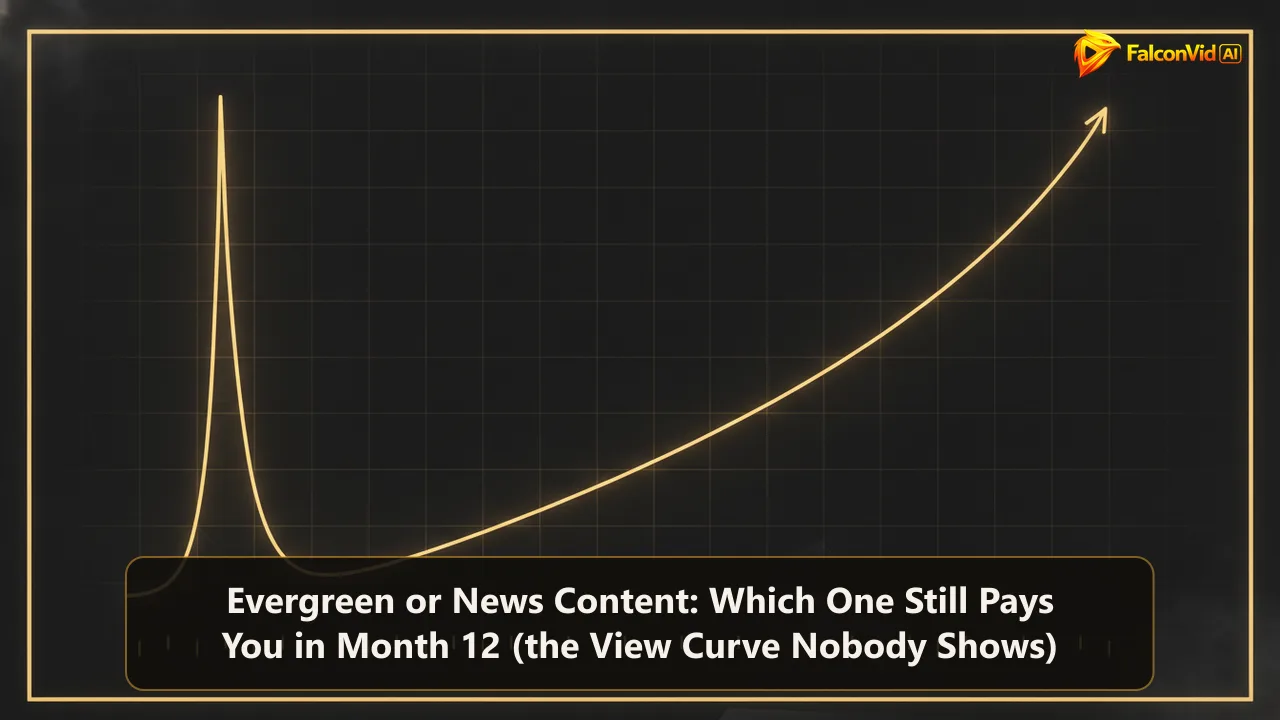
Two curves on the same chart: 78% in three days against a video that peaks in month 12
This decision goes wrong because nobody ever puts the two curves side by side. A news video collects most of its lifetime views in the first 48 to 72 hours, typically 70% to 85% of the total, and after 30 days the tail is close to zero. An evergreen video does the exact opposite: only 10% to 20% of its first year views land in month 1, and month 12 usually delivers more than month 1, because YouTube search and Google take months to decide that your video is the answer.
Put real numbers on it. A news video that finishes with 4,000 lifetime views typically collects around 3,100 of them in the first 72 hours, another 550 across the rest of that week, 250 in the remainder of month 1, and roughly 100 spread thin over the following eleven months. That is 97% of everything it will ever earn arriving inside 30 days, on a video you will never touch again.
The evergreen curve reads like a different asset class. Month 1 lands near 800 views, the launch push from subscribers and browse. Months 2 and 3 dip to around 400, the stretch where most people conclude the video failed. From month 4 it climbs, 570, 650, 720, and the plateau shows up near month 9 at roughly 800 views a month, with month 12 at about 850. Year one total: close to 8,000 views. At week 2 the news video shows 3,100 and the evergreen shows 380, which is exactly why people quit the wrong lane.
- News: 70% to 85% of lifetime views inside 48 to 72 hours, 97% inside 30 days.
- Evergreen: 10% to 20% of year one views in month 1, and month 12 beats month 1.
- Typical news video: 4,000 views, of which 3,100 arrive in the first three days.
- Typical evergreen video: 800 in month 1, a dip to 400, a plateau near 800 a month from month 9.
Where the curves cross: month 7, and why month 12 looks like a tie
Now run both lanes on the same schedule, 2.5 videos a month, 30 videos in a year. The news lane is a flat line: every month the catalog delivers whatever the new videos produce, about 9,750 views, plus a residual of a few hundred from everything published before. Nothing accumulates. The evergreen lane starts far behind and stacks: month 1 delivers 2,000 views, month 3 about 3,950, month 5 about 6,575, and month 7 about 10,000, which is where it passes the news lane for the first time.
The crossover lands in month 7 in this model, and between month 5 and month 8 on most real channels depending on how contested the queries are. After that point the gap widens every single month without any extra work, because you are no longer publishing into a bucket with a hole in it. By month 12 the evergreen catalog delivers around 20,000 views in that month alone against roughly 10,000 for the news catalog.
Here is the trap that keeps people in the wrong lane: the twelve month totals are a tie. News finishes year one at 120,000 views, evergreen at about 119,000. A full year of work and the annual report shows the same number, which is why the argument never gets settled by looking at year one. The difference is entirely in what month 13 looks like. Stop publishing and the news catalog goes to near zero, while those 30 evergreen videos keep running and settle near 24,000 views a month once every one of them matures. That is 288,000 views in year 2 from videos you already paid for.
- At 2.5 videos a month, the news lane is a flat 10,000 views a month that never compounds.
- The evergreen lane crosses it in month 7, and in month 5 to 8 on most real channels.
- Year one is a tie: about 120,000 views for news against 119,000 for evergreen.
- Year 2 with nothing published: news near zero, evergreen near 288,000 views.

The revenue math: the same year one, and a year 2 worth $1,150 to $3,460
Convert the views with RPM bands. Long form video in the United States commonly runs $4 to $12 per thousand views, and in Brazil $0.60 to $2. These are market benchmarks and RPM ranges observed by creators, not figures published by YouTube, and your niche moves them far more than your country does. Year one, both lanes land in the same place: 120,000 news views is $480 to $1,440 in the United States or $72 to $240 in Brazil, and 119,000 evergreen views is essentially identical.
Year 2 is where they stop being comparable. Publish nothing new and the news catalog is cold, a few thousand residual views, call it $12 to $36. The evergreen catalog delivers 288,000 views for $1,150 to $3,460 in the United States, or $173 to $576 in Brazil, from a library that is already paid for. Same year one, same effort, and one of them turned into an asset while the other turned into a shift you have to work again next month.
There is a second RPM effect people miss. Hard news, politics, crime and disaster coverage sit at the bottom of the band, sometimes below $2, because advertisers exclude sensitive contexts, and those videos carry the highest chance of a limited monetization icon. Evergreen in finance, software, tools and how to buys the top of the band. Manual production is what forces you to pick one of them: a 12 minute evergreen video written, narrated and edited by hand costs 4 to 8 hours, so one person alone publishes 4 a month and has nothing left for the news lane. In FalconVid that same video comes out ready in up to 30 minutes, which is why the choice is a symptom of doing it by hand and not a law of YouTube.
- RPM bands used here: $4 to $12 per thousand views in the US, $0.60 to $2 in Brazil.
- These are market benchmarks and RPM ranges, not official YouTube or Google data.
- Year one: $480 to $1,440 in the US for either lane, on 120,000 views.
- Year 2 with zero new uploads: $12 to $36 for news against $1,150 to $3,460 for evergreen.
What news buys that evergreen never will: the window and the subscribers
News is not a mistake, it is a different instrument, and it buys three things evergreen cannot. Distribution today, because browse and suggested traffic is cheapest when a topic is hot. Subscribers fast, which is the only realistic route to 1,000 subs on a young faceless channel. And the audience base that gives every evergreen video its month 1 push of around 800 views, without which the launch spike shrinks and search maturation takes even longer.
The price of all that is the window. Publish inside 2 hours of the story breaking and you ride the wave. Publish at 12 hours and you are collecting leftovers behind channels the algorithm already ranked for that query. Building one news video by hand takes 2 to 3 hours between research, script, narration and edit, which means the manual creator is almost always publishing at the edge of the window or after it has closed.
This is where a feed stops being a reading habit and becomes a production line. In FalconVid the channel points at the RSS feeds of its beat and each item becomes a finished video on its own, script, narration, media, karaoke captions and video SEO on title, description and tags included, with a video ready in up to 30 minutes. The news lane stops depending on you being awake, and that is what makes the 2 hour window a routine instead of a sprint.
- News buys reach today, fast subscribers, and the base that powers your evergreen launches.
- The window is real: 2 hours catches the wave, 12 hours collects leftovers.
- Manual news video: 2 to 3 hours of work for a 3 day lifespan.
- RSS to video runs the news lane automatically, with a finished video in up to 30 minutes.
What evergreen demands: search intent titles and 6 to 9 months of patience
Evergreen is not simply content that does not expire, it is content that answers a query somebody types every month. The formats that behave this way are narrow: how to do X, how much does Y cost, X versus Y, best X for Z, X for beginners, X mistakes. If nobody searches the phrase, the video does not get a second life, it just gets a slow first one. Picking the query before writing is the whole discipline.
The patience is measurable, and it is where most channels give up. Months 2 and 3 sit at roughly 400 views a month, search maturation takes 4 to 6 months, and the plateau only shows up around month 9. Judging an evergreen video at week 2 is reading the wrong number at the wrong time: at that moment it is showing you 5% of what it will do, while the news video next to it has already shown you 78%.
Choosing the topics is the other half of the job, and it is the half that decides whether the catalog compounds or just sits there. In FalconVid the evergreen lane runs off a posting calendar built from your niche, which you approve once, and the channel modeler lets you start from formats that already monetize instead of from a blank page. You approve the calendar, and the writing, narration, editing, thumbnail and video SEO come out on the other side, in up to 63 languages.
- Evergreen formats that actually rank: how to, how much does it cost, X versus Y, best X for Z.
- Months 2 and 3 are the dip, around 400 views, and where most people quit.
- Search maturation takes 4 to 6 months, plateau around month 9.
- You approve the calendar once and the videos come out written, narrated, edited and SEO tagged.
How FalconVid runs both lanes at the same time, without one waiting behind the other
The reason the two lanes usually fight is production capacity, and that is exactly what gets removed here. FalconVid runs the news lane from RSS to video automatically and the evergreen lane from a calendar you approved once, and neither queues behind the other because production is parallel: a researcher, a scriptwriter, a narrator, an editor and a sound designer working at the same time, video ready in up to 30 minutes, with simultaneous generations set by plan, 2 on Starter, 5 on Pro, 10 on Business, 25 on Agency and 50 on Scale. The breaking story does not sit in line behind a 12 minute evergreen render.
Cost per video is where the portfolio gets efficient, and the mode is always part of the number. A 12 minute video costs 1,584 credits in economy mode, 9,000 in balanced and 27,084 in premium. That maps cleanly onto the two lanes: the news video lives for three days and does not deserve premium engines, while the evergreen video will be on screen for three years and earns the balanced or premium treatment. Starter includes 15,000 credits, 1 channel and 2 simultaneous generations, which realistically means about 4 videos a month mixing economy with one already in balanced, or 9 in pure economy, which is 2 hours of video.
Above that, Pro includes 30,000 credits, 5 channels and 5 simultaneous generations, Business includes 95,000 credits and 10 channels, Agency includes 190,000 credits and 25 channels, and Scale includes 320,000 credits, 50 channels and 50 simultaneous generations. The whole creation platform is included on every plan, so what changes is volume, channels, simultaneous generations, the senior analyst from Pro and support, not the creation features. Nothing publishes blind either: the first version lands in the Studio, where you shorten an intro, swap a scene or change the music before it goes out. Credit packs never expire, Boost 2,000, Power 6,000 and Mega 14,000, and there is a free plan with 4 videos a month and no card.
- News from RSS and evergreen from the approved calendar, running in parallel, not in a queue.
- Simultaneous generations by plan: 2 on Starter, 5 on Pro, 10 on Business, 25 on Agency, 50 on Scale.
- 12 minute video: 1,584 credits in economy, 9,000 in balanced, 27,084 in premium. News in economy, evergreen in balanced or premium.
- Starter with 15,000 credits is about 4 videos a month mixing modes, or 9 in pure economy, which is 2 hours of video.
The portfolio: 70/30 for income, 30/70 for growth, and where the ceiling really sits
The honest answer is a split, not a choice. If the goal is revenue that survives a month off, run 70% evergreen and 30% news: on a 20 video month that is 14 evergreen and 6 news, and after twelve months you own a catalog paying every month plus a news lane keeping the channel visible today. If the goal is subscribers fast on a new faceless channel, invert it to 30/70 for the first 90 days, then rotate toward 70/30 once you clear 1,000 subscribers.
The two lanes feed each other when you plan them together. Every news story that performs is a signal for an evergreen video, because people who searched the story then search the explanation, and every mature evergreen video is worth a Short. The news lane funds the subscriber base, and the subscriber base is what gives each new evergreen video its 800 view launch push in month 1 instead of 200. Run them apart and you get two mediocre channels, run them together and each one raises the other.
So where is the ceiling? By hand it is brutal: 4 to 8 hours per evergreen video and 2 to 3 per news video means about 25 to 35 hours a week just to hold 10 videos a month, which is why the standard advice is to pick one lane and forget the other. That ceiling belongs to the manual route, not to the strategy. A faceless channel on FalconVid runs both lanes at the same time, because production is parallel and a video is ready in up to 30 minutes, on 1 channel with Starter, on 5 with Pro, and on up to 50 channels with Scale, where 50 generations run at the same time. The correct answer was always the portfolio, and youtube automation is what makes the portfolio affordable.
- 70% evergreen and 30% news for income, 30/70 for the first 90 days of subscriber growth.
- On a 20 video month: 14 evergreen and 6 news, or the reverse while you chase 1,000 subs.
- Manual ceiling: 25 to 35 hours a week for 10 videos, which forces the choice.
- Automated: both lanes in parallel, 1 channel on Starter up to 50 channels and 50 simultaneous generations on Scale.