
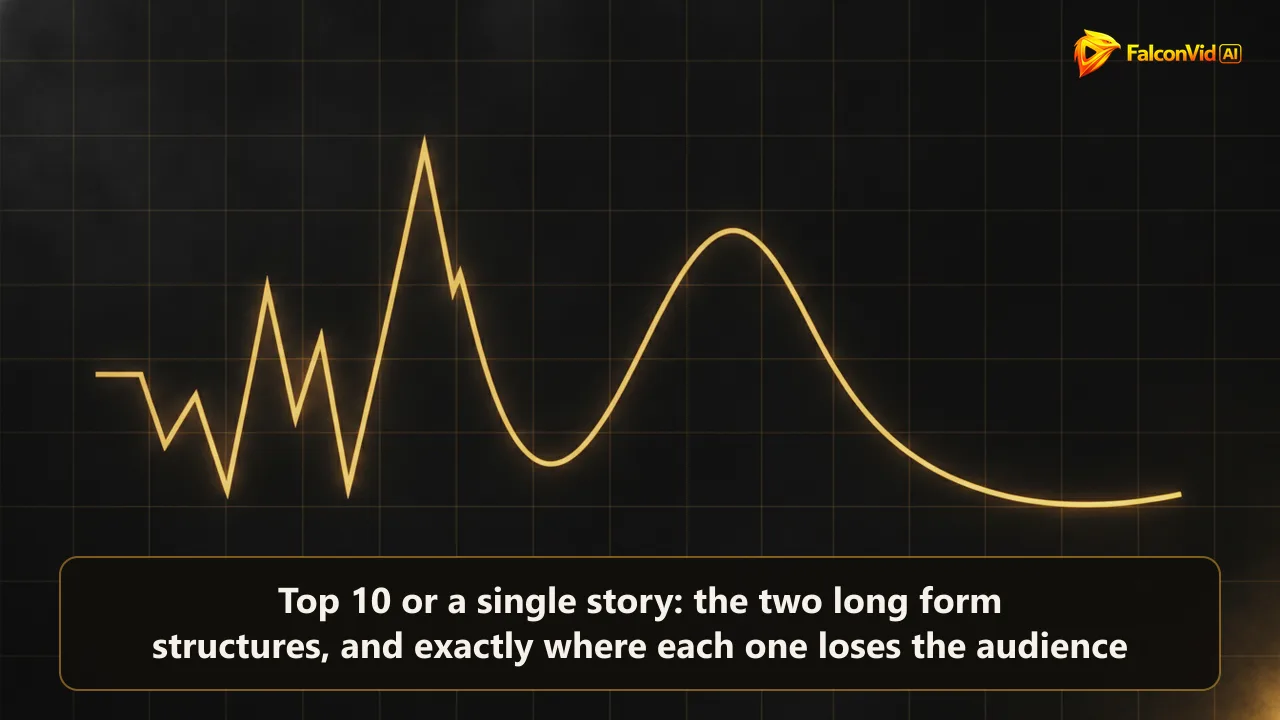
Two structures, two completely different retention graphs
Open the retention graph of a list video and you see a sawtooth: a dip, a recovery, a dip, a recovery, once per item. Open the retention graph of a narrative video and you see a slope, a long steady decline with one or two visible cliffs and, if the video works, a lift at the very end when the payoff lands. Those two shapes are not quality signals, they are structural signatures, and reading a list video as if it were a narrative is how people conclude their content is bad when it is simply built differently.
The mechanism is easy to state. In a list, the promise resolves partially every item. The viewer gets something complete, and a complete thing is a natural moment to leave. But an item boundary is also the only place where you get to hook them again from scratch, with a new subject, a new visual and a new reason to care. Every boundary is a door that opens both ways.
In a narrative there are far fewer doors. The promise made in the first thirty seconds stays open until the end, which is why a good narrative holds people much later into the video than a good list does. The cost is that when it fails, it fails hard: there is no re-hook to catch anyone, so a boring stretch at minute four is not a dip, it is an exit.
The list: every item is an exit and a re-entry
In a twelve minute list with ten items, each item gets roughly 72 seconds. That is ten complete little videos with ten endings, so a list video has ten places where the viewer can decide they got what they came for. On a browse driven channel that is a feature: someone who arrived from the home feed and does not know you gets ten separate chances to be convinced, and only needs one of them to land.
This is also why lists forgive a weak opening. If your hook is a five out of ten, a narrative is already lost, but a list can recover at item two, or item four, because each item restarts the clock on interest. New channels lean on lists for exactly this reason, and it is a sound instinct rather than laziness.
The price is that a list rarely gets anybody to the end. Watch the numbers on real channels and you see the same pattern: the top of the list holds well, the middle sags, and the last item is watched by a fraction of the people who watched the first. If your monetization depends on watch hours, and the 2027 ruler asks new entrants for 8,000 qualified public hours in 365 days, that sag is not an aesthetic problem, it is the difference between reaching the threshold this year and next.
The narrative: one question, held open on purpose
A narrative video makes one promise and refuses to resolve it. How this company went from nothing to a billion. Why this plane should not have crashed. What actually happens to the money. The viewer stays because the answer has not arrived yet, and there is no natural place to stop, because stopping means not knowing.
That is a stronger grip and a much more fragile one. It works when the question is genuinely interesting to the specific audience, and it collapses the moment the viewer decides they can guess the answer. The most common failure is not boredom, it is premature resolution: a script that answers its own question at minute three and then spends nine minutes elaborating on an answer the viewer already has.
Narratives also do far better in search than in browse, because a person who typed a question is already committed to wanting one answer, while a person scrolling a feed has not committed to anything. If your traffic comes from search and suggested video from your own catalogue, narrative structure pays. If it comes from the home feed and from Shorts, lists usually pay more. It is also why a faceless AI documentary channel is built on one open question stretched across thirty minutes, not on a countdown.
Counting down, counting up, and the three mistakes that kill a list
There is a real difference between counting up and counting down, and it is not style. Counting down keeps the largest promise unresolved until the last item, so the viewer who wants to know number one has to stay for all of them. Counting up delivers your best material first and then asks people to sit through progressively smaller payoffs, which is exactly the wrong shape for retention even though it feels generous.
Beyond direction, three mistakes account for most of the damage. The first is announcing the whole list in the first minute, which is done to prove value and instead hands the viewer everything they needed, so they leave with the information and without the watch time. The second is items of unequal weight, where item three is four minutes and item seven is thirty seconds, which teaches people the list is padded. The third is having no bridge: a hard cut from one item to the next with no line that connects them, so each boundary is a clean, frictionless exit.
The bridge is the cheapest fix in this entire article. One sentence at the end of each item that creates a reason for the next one to exist, and one sentence at the top of the next item that references the previous, turns ten separate endings into one continuous line. It costs nothing to write and it is invisible when done well, which is why almost nobody notices its absence in their own scripts.
- Count down, not up: the biggest promise has to be the last thing that resolves
- Never announce the full list in the opening, it hands over the payoff for free
- Keep item weights roughly even, uneven weights read as padding
- Bridge every boundary with one closing line and one opening line
- Put the second best item first and the best item last, the weakest goes in the middle third

Which one to use, by niche, by traffic source and by channel age
Some niches only work as lists. Anything comparative, anything where the value is coverage rather than depth, anything where the viewer is shopping: tools, gear, niches, ideas, mistakes, tips, places. The thumbnail can carry a number, the title carries a number, and the number is itself the promise. Trying to make one of those a narrative usually produces a video that takes eight minutes to say what a list says in two.
Other niches only work as narratives. Cases, disasters, biographies, investigations, explanations of how something works, anything where the value is a chain of cause and effect. Chopping those into a list destroys the causality, and causality was the reason to watch.
Channel age is the tiebreaker for everything in the middle. A new channel with no audience is being sampled by strangers, so lists, which forgive a mediocre hook and re-hook every seventy seconds, get more people to the point where they decide to subscribe. An established channel is being watched by people who already trust the presenter, and those people will follow a narrative for twenty minutes. The move that works is to start list heavy, watch which items generate the comments, and turn the best of those items into narrative videos of their own.
The hybrid that usually beats both
The strongest long form structure in practice is neither pure form. It is a narrative spine with numbered beats: one question held open for the whole video, divided into visible, numbered stages that give the viewer the sense of progress a list provides without ever resolving the main promise. Three reasons this company collapsed, told as one story where reason three is the actual cause.
This keeps both mechanisms. The numbers give you the re-hook points and the chapter structure, so the viewer always knows where they are and how much is left, which is worth real retention. The single open question gives you the reason to stay past the last number, so the end of the video is not the end of the reason to watch.
It also makes the video far easier to produce consistently, which matters when you publish on a calendar rather than when inspiration strikes. Three to five numbered beats inside one question is a template a channel can run weekly without every script becoming a blank page, and it is the shape most high retention long form on YouTube quietly uses.
Changing the structure costs 307 credits, changing the video costs 1,584 to 27,084
Here is the part that should change how you experiment. Structure lives in the script, and the script is the cheapest piece of the entire pipeline. Research and script together are a flat 307 credits, regardless of length, while a finished twelve minute video costs 1,584 credits in economy mode, 9,000 in balanced and 27,084 in premium. Re-narrating twelve minutes is 36 credits in economy and 288 in premium. So testing a different structure on the same topic is a rounding error next to producing the video at all. If the first draft of that structure comes out of a chat box, the six parts a script prompt has to carry is what decides whether you get five equal points or a real shape.
That inverts the usual advice. Do not agonise over the structure decision, run it. Take a topic that underperformed as a list and rebuild it as a narrative, or the reverse, and compare the retention graphs on your own channel with your own audience, because the correct answer is niche specific and no article can give it to you. Two structures on one topic costs one extra script, and it answers the question permanently for that channel.
In FalconVid the structure is a decision at the script stage of a calendar you approve once, and then the pipeline does the rest: AI specialists work in parallel, a researcher, a scriptwriter, a narrator, an editor and a sound designer at the same time, with a video ready in up to 30 minutes and simultaneous generations going from 2 on Starter to 50 on Scale. If version one comes back with the payoff in the wrong place, fixing that piece in the Studio costs 5 to 320 credits instead of regenerating the whole video, and the same topic can be duplicated to another language repaying essentially only the narration.