
You already do the hardest part of a YouTube channel
Ask anyone who has tried to run a faceless channel what kills it, and the answer is rarely editing. It is the blank page. Finding a topic every week, researching it, having an opinion about it and writing it down. That is the part most channels never sustain past month two.
Newsletter writers have been doing exactly that, on a deadline, for years. A weekly issue is 52 pieces a year. Three years in, that is more than 150 issues, every one of them researched, written and sent to people who chose to receive it. Most YouTube channels would kill for that backlog.
And yet the archive mostly sits there. Substack, beehiiv, Ghost and Kit style publications all keep a web archive, but an issue from fourteen months ago gets almost no new readers. Email is a delivery channel, not a discovery channel. The list grows only when something outside the inbox sends people into it, and in 2026 YouTube search is one of the few places where a written idea can keep finding strangers for years.
The arithmetic: how much video is inside one issue
Start with the numbers, because they decide the format before anything else. Narration runs at roughly 150 words per minute, so a finished 12 minute video needs around 1,800 words of continuous script.
Most newsletter issues land somewhere between 800 and 2,000 words. A 1,000 word issue read at that pace is about 6 to 7 minutes. A 2,000 word deep dive is about 13. So you have three honest options for a typical issue: let it become a shorter 6 to 7 minute video, combine two related issues into one 12 minute piece, or expand a single issue with fresh research until it carries the full length.
The third option is the one that usually performs best, and it is where FalconVid earns its place. The pipeline starts with a researcher agent, so your issue becomes the angle and the spine while the research layer adds the context, the examples and the numbers a video needs to hold someone for 12 minutes. You bring the theme and paste the material, and the script is written from there.
An issue is written for the eye. A video is heard by the ear
Links carry half the argument: click here, see this thread, the chart below. Bullet lists compress ideas that a listener cannot see. The personal opener, hope your week is going well, works in an inbox and wastes the first 15 seconds of a video, which are the seconds that decide retention. The sponsor block in the middle belongs to a deal that has nothing to do with YouTube. And a lot of issues are anchored to a date: this week's launch, yesterday's announcement, the price as of Tuesday.
None of that is a flaw in your writing. It is the format doing its job. But a video script has a different job. It needs a hook in the first sentence, ideas said in full instead of linked, transitions the ear can follow, and claims that still make sense when someone finds the video eight months later.
FalconVid writes the narration as prose built for listening, not as your email read back to you. That is the difference between a channel and a podcast feed of your inbox, and it is the conversion that actually pays.
Reading the issue aloud is exactly what YouTube targets
There is a policy reason not to take the shortcut. On 15 July 2025 YouTube renamed what it used to call repetitious content to inauthentic content inside the Partner Program policies, aimed at mass produced, templated videos with little variation. Separately, the reused content rule asks for meaningful original commentary or transformation when a video is built on existing material.
Here is the good news: the text is yours. Nobody is going to question your right to use your own newsletter. The risk is format, not rights. A static screen with a voice reading an email, links and all, looks a lot like the templated output the policy describes, and the same weakness shows up when stock clips are matched word by word over a narrated text, as our guide on turning a script into video explains.
The same logic catches channels that narrate someone else's text with a free license, which is the trap described in narrating Wikipedia articles on YouTube. Owning the words, or having permission to use them, does not make a reading into a video.
Your archive is a backlog of tested topics
Most YouTube channels guess what their audience wants. You do not have to. Every issue you ever sent comes with an open rate and a click rate, which means your archive is already ranked by real demand. An archive of 100 issues is 100 topics that were tested on real readers before a single frame was rendered.
Sort the archive in two passes. First by open rate, because the subject line that got opened is usually close to a search people actually type. Then split evergreen from dated. In a typical archive, an illustrative split might be 40 evergreen issues that still hold up and 60 tied to a week, a launch or a price that no longer exists. The 40 are your first season. The 60 are raw material for roundups and comparisons later.
Forty evergreen issues in economy mode at 1,731 credits per 12 minute video is 69,240 credits. On Starter that is a first season spread across five months at 8 videos a month in economy. On Business, with 54 economy videos a month and 10 pipelines at once, it fits in a single monthly cycle.
And you do not have to paste every issue by hand. If your newsletter has a public web archive with an RSS feed, the RSS to video feature can feed new posts into the pipeline as they go out, so each week's issue turns into a video draft without you starting a new project. It is available on every plan.
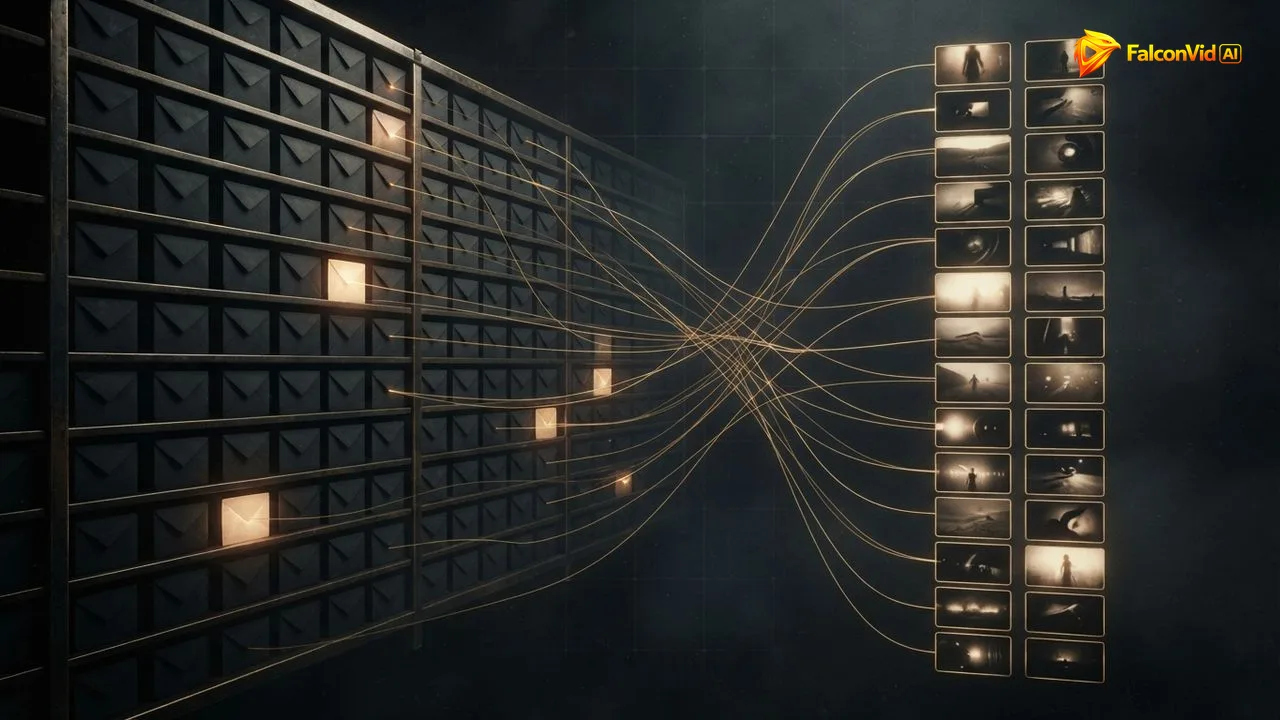
What FalconVid does with a newsletter issue
A researcher, a scriptwriter, a narrator, an editor and sound design work in parallel, and a finished video can be ready in up to 30 minutes. Plans run several pipelines at once, from 2 simultaneous generations on Starter to 50 on Scale, which is what makes a 100 issue archive a quarter of work instead of two years of weekends.
Narration uses ultra realistic premium voices in 63 languages, so you never record anything and never appear on camera. Footage, images, karaoke style subtitles in more than 15 styles, music and sound design are assembled automatically, and each issue can also become Shorts in 9:16. Channel DNA keeps the voice, look and tone of the channel consistent, so the video series feels like the same publication your readers already trust.
The Studio lets you watch version one and adjust before anything goes out: shorten the intro, swap a piece of media, change the music, or open the full timeline. You approve the calendar and the channel publishes to YouTube, Instagram, TikTok, Rumble and Facebook.
On today's engine ruler a finished 12 minute video costs 1,731 credits in economy, 4,597 balanced and 16,131 premium, and a 1 minute Short in economy costs 583. The broader logic of written sources becoming video is on our text to video generator page.
YouTube is the channel that sends readers back to your list
The reason to do this is not to replace the newsletter. It is to feed it. A video found in search two years from now still has a link in the description, a pinned comment and an end screen, and every one of those can point to your signup page. Email lists rarely grow on their own. Search traffic that converts into subscribers is the kind of growth a list can compound on.
The same applies to whatever already earns money in your issues. If you recommend tools or run affiliate links, the description box works the same way it does for any faceless channel, which we unpacked in affiliate links on a faceless channel. Sponsor blocks stay in the email, and the video drives people to where the sponsor lives.
Monetisation on YouTube itself is a longer road, and the bar is rising. Until 31 January 2027 new channels need 1,000 subscribers plus 4,000 public watch hours in 365 days, or 10 million Shorts views in 90 days. From 1 February 2027, new entrants need 1,000 subscribers plus 8,000 hours, or 20 million Shorts views in 90 days. That is exactly why a steady cadence matters more than one viral piece.
A weekly newsletter maps cleanly to that cadence. Four issues a month as 12 minute videos in economy is 6,924 credits. Add three Shorts per issue, 12 a month at 583 each, and that is another 6,996. The total, 13,920 credits, fits inside Starter's 15,000. Over a year that is 52 long videos and 156 Shorts from writing you were going to do anyway.
Manual versus automated: where the real limit sits
Doing this by hand is possible, and the numbers explain why almost nobody keeps it up. A freelance editor commonly charges somewhere around US$ 50 to 150 or more for a 10 minute video, before scripting and voice. If you do it yourself, rewriting an issue for the ear, recording, finding footage and editing usually takes the better part of a working day per video. Catching up a 100 issue archive at those rates runs into US$ 5,000 to 15,000 or more, or months of evenings, on top of the newsletter you still have to write every week.
That ceiling belongs to the manual version. Automated, the same 100 issues in economy mode are 173,100 credits. Agency carries 190,000 credits a month, 109 videos of 12 minutes in economy across 25 channels with 25 pipelines at once, so the whole archive fits in one cycle. Business, at 54 economy videos a month, clears it in two. Nobody runs a whole archive in one mode, you mix them: the strongest evergreen issues in balanced at 4,597 credits, the rest in economy.
So the honest answer is not that you can manage one video a week. That is the manual ceiling. With production running in parallel, your archive becomes a calendar you approve once, in as many channels and languages as you want to run. The FalconVid home page shows the whole flow end to end.