
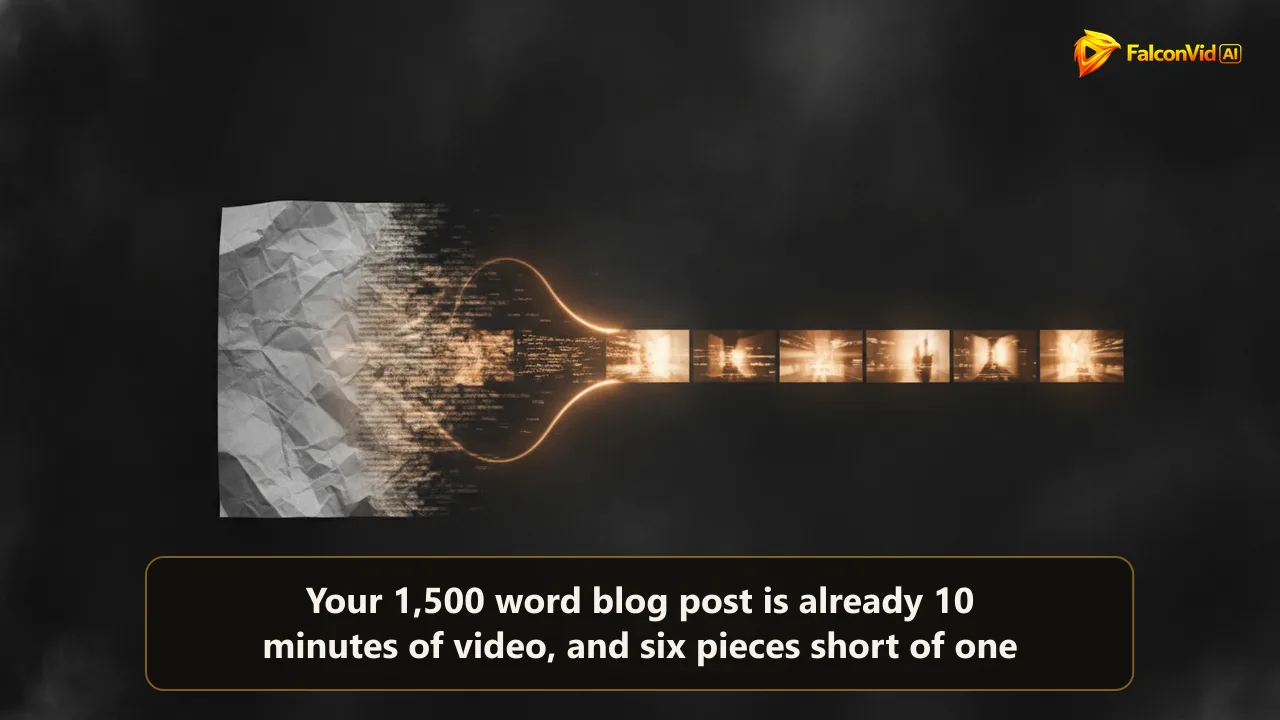
The arithmetic that makes this tempting
Comfortable narration runs at about 140 words per minute. So a 1,500 word blog post, the length most people land on without trying, is 10 minutes and 43 seconds of spoken audio. A 1,680 word post is twelve minutes, which is the length most long form channels build their whole format around. The conversion is not approximate, it is arithmetic, and the full word to runtime table has the ruler for every duration.
That is why the idea shows up in every content meeting. You already paid for the research. You already argued with the structure. You already know the piece performs, because you can see it in your analytics. Turning it into a video looks like getting a second asset for free out of work that is already done and already sunk.
The premise is right. Most of the value in a video sits in knowing what to say and in which order, and that part of the job is finished. What people underestimate is the distance between a text that is correct and a script that holds attention through a screen, plus the pieces a text file simply does not contain. Both are fixable, and both are the reason a straight copy and paste produces a video nobody watches to the end.
Why pasting the post straight in produces a video nobody finishes
A blog post is a random access document. The reader skims, jumps to the subhead that matters, scrolls back, reads the bolded line, ignores four paragraphs, and leaves satisfied. Every convention of web writing exists to serve that behaviour: short paragraphs, descriptive subheads, bullet lists, bold key phrases, an introduction that restates the promise for people who arrived from search.
A video is linear. The viewer cannot skim. They receive one sentence at a time, in your order, at your pace, and they can only do two things about it: keep listening or leave. Every convention that made the text scannable becomes dead weight the moment it is read aloud. The subhead that helped a reader navigate becomes an awkward pause. The bullet list becomes a monotone recital. The SEO introduction that restates the topic becomes thirty seconds of a viewer being told what they are about to be told, at exactly the moment retention is most fragile. Script to video tools that match one stock clip per sentence make it worse, which is the core of why a script to video AI becomes a slideshow.
That is the honest reason so many blog to video experiments underperform. It is almost never the visuals. It is that the words were correct and the shape was wrong, and shape is what the first thirty seconds are made of. The same failure shows up in its purest form on a channel built from Reddit threads, where the text being pasted was not even written by the person publishing it.
The six rewrites that turn the text into a script
None of these require new research. They are edits to a document you already own, and together they are the difference between a read-aloud article and something built for listening. A weekly email carries the same problem in a stronger dose, and turning newsletter issues into videos starts with these same six edits.
The largest single win is the first one. A blog introduction is written to reassure a reader who arrived from a search result, so it repeats the query and promises the answer. A video opening has to earn the next fifteen seconds from somebody who is not committed to anything, which means starting with the sharpest concrete claim in the entire piece, usually a number that lives in the middle of your article. That adaptation is exactly what the FalconVid script module does with a text you paste in: it rebuilds the piece for the ear instead of narrating it as written, for 307 credits, which is the same module that would have written it from scratch.
- Open on the strongest number in the piece, not on a restatement of the topic
- Turn every subhead into a spoken transition that says why the next part matters
- Rewrite bullet lists as sentences with connective tissue between the items
- Delete every reference to the page: as you can see below, in the table above, click here
- Cut the SEO introduction that restates the promise, the video has already made it
- Replace the written call to action with a spoken one that fits the last fifteen seconds
The six pieces the blog post does not contain
The text is one of seven components in a finished video, and it is the only one you have. Missing that is what turns a two hour plan into a two day project.
The heaviest of them is the moving image. A twelve minute video is 720 seconds of screen time, and video generators return clips of roughly eight seconds, so you are looking at about ninety generated pieces. Those pieces also need a rhythm, not just a quantity: a twelve minute video carries 72 to 120 cuts, which means the image changes every six to ten seconds or the video reads as a slideshow with a voice on top.
The others are smaller individually and decisive collectively. The narration itself is its own production question rather than a file you export, and text to speech for YouTube videos covers why the audio file is one piece of seven. The thumbnail decides whether any of this gets opened at all, with official click through rate landing between 2 and 10 percent. The metadata is a separate discipline from your blog SEO, because a title written to win a Google result is usually the wrong title for a YouTube feed, and the video metadata checklist is written for that difference. Then a music bed mixed to about minus 14 LUFS so the voice sits on top of it, and captions, which a large share of viewers rely on.
- About ninety generated clips filling 720 seconds, cut every six to ten seconds
- Narration built for the ear, with pronunciation and pacing decided
- A thumbnail, which is the only asset that runs before anyone watches
- A YouTube title and description, which are not your blog title and meta description
- A music bed mixed around minus 14 LUFS so the voice stays on top
- Captions, plus chapters if the piece has real sections

Which posts to convert first, and which never to convert
An archive is not a queue. Converting it in publication order is the most common way to waste the first month, because the pieces that work as text are not automatically the pieces that work as video. Three filters sort it quickly.
The first filter is demand you can already see. A post that gets steady search traffic has proven that people want this answer, and the same demand exists on YouTube where the competition is thinner. The second is shape: pieces that explain a process, a comparison or a number convert cleanly, because they have a spine and a payoff. The third is durability, meaning the post will still be true in twelve months, since a video keeps earning long after a blog post has stopped ranking.
The ones to leave alone are just as clear. Anything whose value is a table the viewer needs to scan and re-read. Anything that is mostly links out. Anything topical that expired. And anything under 600 words, which is four minutes of runtime and usually not worth the production even when the production is cheap, unless you merge three of them into one piece. Inside FalconVid that shortlist stops being a spreadsheet and becomes a calendar you approve once, after which the machine produces against it instead of asking you every week what comes next. If your archive also holds slides, handouts and recorded classes, the order of usefulness changes, and it is laid out in what survives when course material becomes video.
The rule generalizes past blogging. Any business whose team answers the same dozen questions on the phone is sitting on that archive without knowing it, which is exactly the case we measured for real estate agents and the twelve answers they already give.
The archive is a catalogue, and 2027 is why that matters
From February 1, 2027, a channel entering the YouTube Partner Program needs 1,000 subscribers plus 8,000 public qualified watch hours in 365 days, twice the old bar of 4,000. Eight thousand hours is 480,000 minutes. A twelve minute video watched at 40 percent delivers 4.8 minutes per view, so the door opens at 100,000 views, which at 1,000 views per video is 100 videos.
A blog with a hundred decent posts is already holding a hundred video briefs. That is the entire catalogue requirement, researched, argued and validated by real traffic, sitting in a database. Almost nobody with an archive realises they are looking at the answer to the hardest part of starting a channel, which is not making one video but sustaining a hundred. If the same folder also holds procedures, policies and onboarding documents, the audience changes but the method does not, and the cost of that version is in what an internal procedure costs as a video.
By hand, that is not a plan. A twelve minute video is 9.5 to 13.5 hours of work from brief to upload, so a hundred of them is 950 to 1,350 hours, which is six months of full time work before the channel earns its first cent. That is the number that kills the idea in most companies, and it is the only real obstacle between an archive and a channel. That is the number FalconVid removes rather than shrinks: the same hundred videos generate side by side, two at a time on Starter and up to 50 on Scale, so the catalogue stops queueing behind one person's calendar.
Republishing your own words is not the risk. This is.
The first question everyone asks is whether narrating their own article counts as duplicate content or gets penalised. On the copyright side there is nothing to discuss: it is your text, you hold the rights, and moving your own work between formats is what publishers have always done. Google does not penalise a video for matching an article you own, and the two compete in different results anyway.
The policy that actually matters is different and worth understanding properly. YouTube declines monetisation for content it considers repetitious or mass produced with no meaningful added value. Reading an article aloud over generic stock footage, with no new structure, no new examples and no reason for it to be a video, can land in that bucket even when the words are yours. Ownership is not the test. Added value is the test.
The fix is the same set of edits from earlier in this article, which is convenient. A piece rebuilt with a video opening, spoken transitions, ninety cuts of relevant imagery, a real voice performance and examples the article did not have is a new work in a new medium, and it stops looking like a text file with audio. The line is not thin and you are not near it if you did the rewrite.
What it costs, both ways
Done manually, converting one post is 9.5 to 13.5 hours: adapting the script, sourcing or generating the visuals, recording and cleaning the narration, editing, designing a thumbnail, writing metadata and uploading. At US$ 15 an hour of somebody's time that is 142 to 202 per video, and at US$ 30 it is 285 to 405. A hundred posts at the low end is over US$ 14,000.
Run through a pipeline, the same twelve minute video costs 1,731 credits on the economy level. Balanced is 4,597 credits, and premium is 16,131. The research and script module bills 307 credits regardless of level, which on economy is about 18 percent of the video and is the part doing the adaptation from your text.
Scaled to the catalogue, a hundred posts converted on the economy level is 173,100 credits. That is the same hundred videos that took 950 to 1,350 hours by hand. The comparison is not close, and it is the entire argument for treating an archive as a production input rather than a nice idea nobody has time for.
How FalconVid turns an archive into a channel that runs itself
You paste the text, or the topic, and the pipeline does the adaptation rather than the transcription. It rewrites for the ear, builds the opening around the strongest claim, plans the scenes, generates the imagery, narrates in one of 63 languages with premium voices, cuts to rhythm, designs the thumbnail, writes the title and description for YouTube rather than for Google, adds captions and publishes. An AI text to video generator that returns a finished video shows what comes out at the other end.
The part that matters for an archive is that it is a calendar, not a one off. You approve a schedule and the machine produces against it, in parallel: two simultaneous generations on Starter, up to 50 on Scale, with a finished video landing in as little as thirty minutes. A hundred posts stops being a six month project and becomes a queue that drains on its own while you keep writing.
Volumes are published per plan, for twelve minute long form videos. Starter is 15,000 credits, which is 8 videos on economy or 3 on balanced, and in a realistic month that is 6 videos mixing the two. Pro is 30,000 credits, so 17 economy videos, 6 balanced or one premium, across five channels with five generating at once. Business is 95,000 credits and 54 economy videos. Agency is 190,000 credits and 109 economy videos. Scale is 320,000 credits, 184 economy videos, 50 channels and 50 simultaneous generations.
Two things matter specifically for people with an existing content operation. A finished video that is 90 percent right does not get regenerated: the Studio fixes it for 5 to 320 credits, against 1,731 to 16,131 to rebuild. And a project can be duplicated into another language paying only the difference, so an English archive becomes a Spanish and Portuguese channel without redoing the research, the structure or the scenes. The whole machine is on the FalconVid home page, where the unit of work is the channel and not the clip.