
Forty hours of material do not become forty hours of video
Everyone who has taught anything has the same folder. Decks from a workshop, a PDF handout, the recording of a live class, notes that never became anything, and a vague sense that all of it should already be on YouTube making money.
Then the conversion starts and it stalls. Not because the knowledge is weak, but because the formats are built for opposite situations. A slide exists to support a person who is speaking. A handout exists to be read at the reader's own pace, with the option to go back. A video exists to hold someone who is alone, distracted, and one thumb away from leaving. Those three jobs need three different texts.
So the first honest thing to say is that your archive is not a video library waiting to be exported. It is raw material with an extremely high hit rate, which is a much better position than starting from nothing, and a very different one from being finished.
The first calculation: how many words do you actually have?
Before deciding anything, count. Narration runs at roughly 150 words per minute, so a finished 12 minute video needs around 1,800 words of continuous script. That is the unit everything else converts into. Our breakdown of how many words a video script really needs has the full table by duration.
Now measure your material against it. A 40 slide deck with six bullets per slide and four words per bullet is about 960 words, and most of those words are labels, not sentences. Realistically you are holding 400 usable words. That is two and a half minutes of video, from a deck that took you a full day to build.
A recorded class is the opposite problem. Sixty minutes of speech is roughly 9,000 words of transcript, which is five finished videos of raw length, except that spoken class transcript is full of repetition, interruptions, questions from the room and thinking out loud. After cutting, expect around 40% of it to survive as usable prose, which is still two solid videos out of one class.
A written handout is the best source you have and the one people ignore. Prose is already prose. A ten page PDF at 500 words per page is 5,000 words, which is close to three videos with almost no rewriting of substance. The same is true of anything else you have already published in writing, which is the case we walked through in turning written articles into finished videos.
The conclusion is unintuitive: the slides everyone reaches for first are the worst source, and the document nobody wants to reread is the best one.
The four layers of your material, and the one that dies
Split any teaching material into four layers and the conversion stops being guesswork.
The facts survive completely. Numbers, definitions, steps, dates, the sequence of a process. This is the part that took you years to accumulate and it transfers with zero loss.
The order survives, and it is worth more than people think. You already know that concept B is meaningless before concept A. That teaching sequence is the spine of a video and the thing a generic script never gets right.
The examples survive and they carry the video. The specific case, the client who did it wrong, the number that surprised the room. Almost every course has these buried in the speaker notes rather than on the slide, which is exactly where nobody looks when they export.
The layout dies. The visual grid of the slide, the box, the arrow, the three column comparison, the bullet hierarchy. All of it was built for a screen behind a person and none of it holds attention on a phone. Trying to preserve it is the single most common reason a course to video project produces something unwatchable.
- Facts: transfer whole, zero rewriting needed
- Order: transfer whole, and it is your unfair advantage
- Examples: transfer whole, usually hidden in the speaker notes
- Layout: does not transfer, and forcing it is what kills the video
Where YouTube starts calling it reused content
This is the risk nobody mentions until monetisation is refused. YouTube reviews channels for reused content, and a slide deck read aloud with no added commentary is close to the textbook definition of what reviewers flag: material taken from elsewhere with minimal transformation. Generic stock clips matched word by word over a narrated script sit close to the same line, as the guide on turning a script into video explains.
The line is not about ownership. It is your deck, and that does not help you here. The question the reviewer asks is whether the video adds original narration, structure or commentary, or whether it is a container for something that already existed in another form. The same test catches channels that narrate someone else's text word for word, even under a free license, which is the trap in narrating Wikipedia articles on YouTube.
The practical fix is the same thing that makes the video better anyway. Write actual prose instead of reading labels. Add the example that was not on the slide. Change the order when the video needs a hook that a classroom did not. If you want the detail on what reviewers actually check, we covered it in why channels get rejected for reused content.
One more thing worth knowing: a static slide on screen for nine minutes fails on retention long before it fails on policy. Both problems have the same cure, which is turning the material into a script and the script into moving footage.
Breaking one course into twenty videos without repeating yourself
Courses are built as a ladder, where every rung assumes the one below it. YouTube is the opposite. Each video has to work for someone who arrived from a search with no idea who you are, which means module three cannot open by referring to module two.
The mapping that works is one question per video. Take every module and write the question a stranger would type to find it. If two modules answer the same question, they are one video. If one module answers four questions, it is four videos. A ten hour course usually maps to somewhere between fifteen and twenty five videos this way, and that is a publishing calendar for a full quarter.
Then reorder for the platform instead of the classroom. The most searched question goes first, even if pedagogically it belongs at the end, because on YouTube the first video is the one that has to find an audience with no help from anything else.
Finally, plan the repetition on purpose. Each video restates the small piece of context it needs, in one sentence, and links the rest. Regular viewers forgive that. New viewers cannot survive without it.
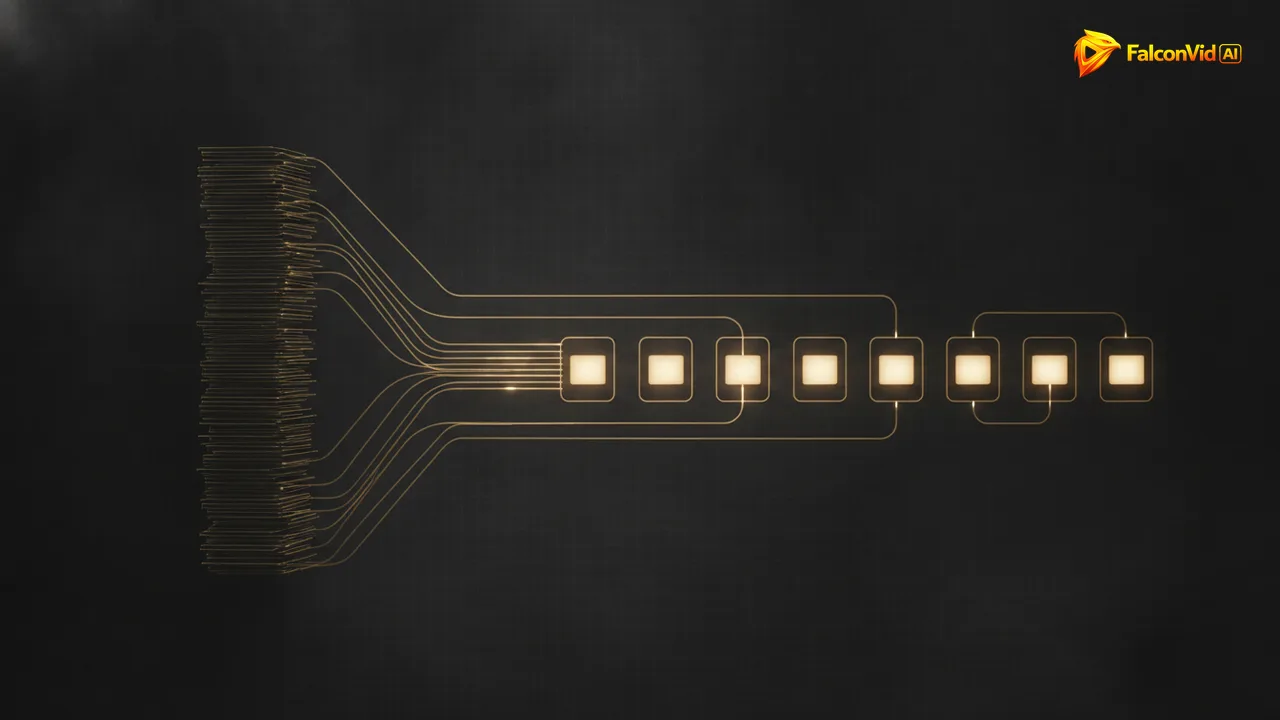
What FalconVid does with the text you already have
This is the part that turns a plan into a calendar. You bring the topic and the material, and the pipeline handles the conversion the sections above described by hand.
A researcher agent, a scriptwriter, a narrator, an editor and sound design work in parallel, and a finished video can be ready in up to 30 minutes. Plans run several pipelines at once, from 2 simultaneous on Starter to 50 on Scale, which is what makes a twenty video course a calendar instead of a year.
The script comes out as prose written for narration, not as bullets read aloud, which is exactly the transformation the reused content rule is asking for. Narration uses ultra realistic premium voices across 63 languages, so nothing needs your voice and nothing needs your face. Footage, images, subtitles, music and sound design are assembled by the pipeline, and karaoke style subtitles come in more than 15 styles.
Channel DNA keeps the identity consistent across every video in the series, which matters more for a course than for any other format, because a viewer who trusts video three has to recognise video eleven. And the Studio lets you watch version one and adjust before anything goes out, shorten the intro, swap a piece of media, change the music, or open the full timeline.
On today's engine ruler a finished 12 minute video costs 1,731 credits in economy, 4,597 balanced and 16,131 premium. A twenty video course in economy is 34,620 credits, for a catalogue that took you years to accumulate. The same logic applied to written sources is covered in our text to video generator page.
The same course in three languages, once the material is written
Here is the leverage that only exists when the content is already written down, and it is the reason educators are in a better position than most creators.
The expensive part of a second language channel is never the translation. It is doing the research, the structure and the examples a second time. You already did all of that once, in the original course, so the second version is genuinely a fraction of the work rather than a repeat of it.
A FalconVid project duplicates into another language paying only the difference, with its own channel, its own calendar and its own identity. Publishing goes to YouTube, Instagram, TikTok, Rumble and Facebook. For a technical or educational subject this matters more than for entertainment, because the audience for a specific method in Spanish is not competing with anything close to the volume it competes with in English. Our numbers on what a second language actually returns put a figure on it.
Manually, three languages is where the plan collapses. Nobody writes, records and edits the same twenty videos three times. Automated, it is the same catalogue with a different narration track and a different channel, running in parallel with the first one.
Seven days from a stalled folder to a published channel
Day one and two, inventory. Count words, not files. Separate handouts and transcripts, which are gold, from decks, which are outlines. You will usually find you have more usable material than you thought and fewer finished videos than you hoped.
Day three, write the question list. One question per video, phrased the way a stranger would search it, ordered by search demand rather than by teaching sequence.
Day four, decide the mode per video. The pillar videos that carry the channel deserve balanced or premium. The supporting ones that answer a narrow question run in economy, which is 1,731 credits each. Nobody runs a whole catalogue in one mode, you mix them.
Days five to seven, produce and review the first batch in the Studio before anything is published.
And be clear about where the real limit sits. Doing this by hand, a good week produces two or three finished videos, so a twenty video course is two months of evenings, and the third language never happens at all. That ceiling belongs to the manual version. With production running in parallel, the same twenty videos are a calendar you approve once, in as many channels and languages as you want to run. The FalconVid home page shows the whole flow end to end.