
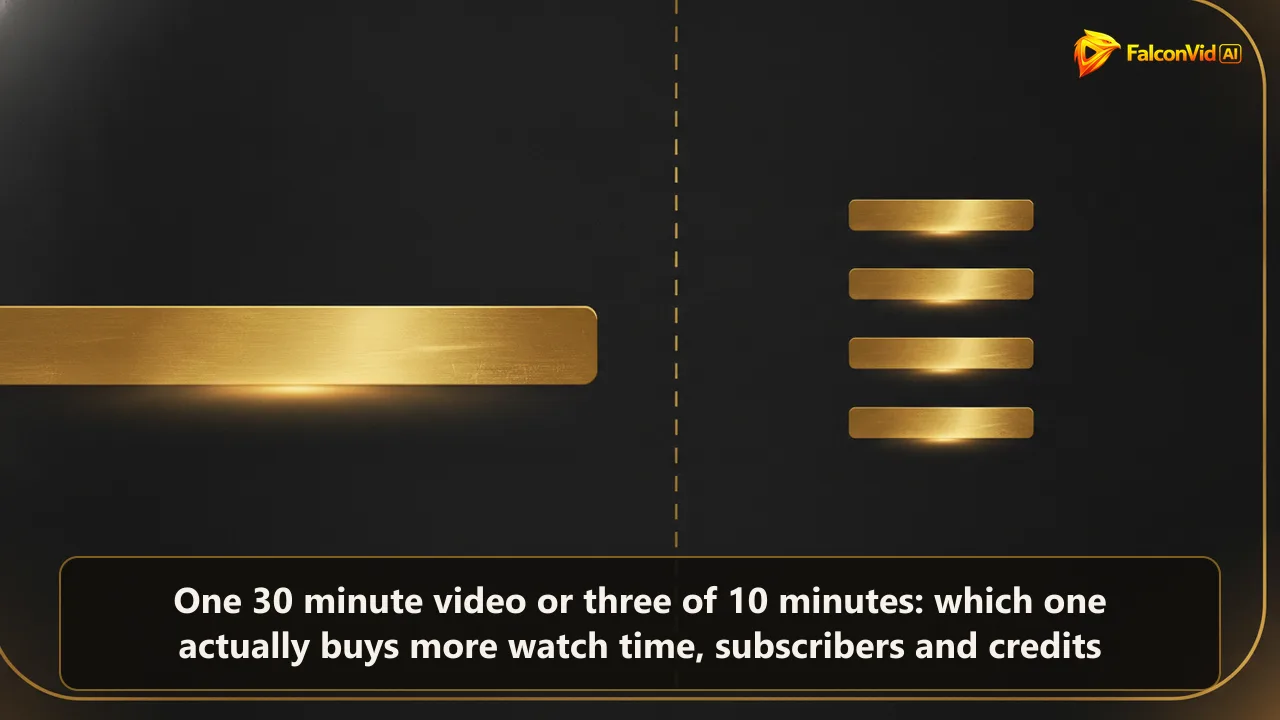
The same 30 minutes, two completely different bets
You have researched a topic wide enough to fill 30 minutes. You can publish it as one long video, or split it into three 10 minute videos released over a week. The content is the same. The audience is the same. The choice looks like a preference and it is not: the two options behave differently on almost every metric that decides whether a channel grows.
The long video concentrates everything into one shot at the algorithm. If it lands, it delivers a very large amount of watch time per view, which is the fastest route to the 4,000 hour threshold that applies until January 31, 2027, and to the 8,000 hours a channel applying from February 1, 2027 will need. If it does not land, you spent the whole week's production on a single failed experiment and you learn nothing about which part of the topic the audience actually wanted.
The three video split spreads the same content across three separate tests. Each one gets its own thumbnail, its own title, its own test audience and its own chance to be recommended. You learn three times as much. But each individual video delivers roughly a third of the watch time, and the second and third parts inherit the drop off of the first, because the viewer who did not finish part one rarely starts part two.
- Same content, same research, roughly the same credits.
- One long video: one algorithm test, maximum watch time per view.
- Three short videos: three tests, three thumbnails, three chances to be found.
- The split teaches you which third of the topic the audience wanted.
The watch time math, done properly
Average view duration is a percentage, and it falls as videos get longer. A well made 10 minute video commonly holds around 50%, which is 5 minutes of watch time per view. A 30 minute video on the same topic will not hold 50%: long form retention curves flatten but the percentage drops, and something around 35% is a realistic figure for a strong long video, which is 10.5 minutes per view.
So one 30 minute video at 35% delivers 10.5 minutes per view. Three 10 minute videos at 50% deliver 5 minutes per view each, or 15 minutes if the same person watches all three. The long video wins per viewer only if the split loses viewers between parts, which it does. A realistic sequel rate is that part two gets 40% to 60% of part one's views, and part three gets 40% to 60% of part two's.
Run it with numbers. Say part one gets 10,000 views, part two gets 5,000 and part three gets 2,500. Total watch time is 10,000 by 5, plus 5,000 by 5, plus 2,500 by 5, which is 87,500 minutes. A single 30 minute video with the same 10,000 views at 35% gives 105,000 minutes. The long video wins on watch time. But the split produced 17,500 total views against 10,000, three thumbnails in circulation and three entry points into the channel, which is what matters when you are trying to be discovered rather than trying to close the 4,000 hours.
- 10 minute video at 50% retention = 5 minutes of watch time per view.
- 30 minute video at 35% retention = 10.5 minutes of watch time per view.
- Realistic sequel rate: part two gets 40% to 60% of part one.
- Example: split = 87,500 minutes and 17,500 views. Long = 105,000 minutes and 10,000 views.
- Long wins watch time. Split wins discovery.

The credit math: the split costs more, and by exactly how much
Production cost is not proportional to length, because every video pays a fixed part regardless of duration. The engine charges a base pipeline fee of 16 credits, research plus script at 307 credits, and a cover at 479 credits in economy or 214 in premium. Those are paid once per video, not once per minute. Narration and scenes are the parts that scale with runtime: narration is 3 credits per minute in economy and 24 per minute with a premium voice.
That is why a 12 minute video costs 1,584 credits in economy mode, 9,000 in balanced and 27,084 in premium. A 30 minute video is not 2.5 times that number, because the fixed part does not repeat. It lands around 1,430 credits in economy mode. Three 10 minute videos, by contrast, pay the base fee, the research and script line and the cover three times: 961 credits each, about 2,883 in economy mode for the same total runtime.
So splitting costs roughly 1,450 extra credits per 30 minutes of content in economy mode, about double, in exchange for two extra thumbnails, two extra titles and two extra algorithm tests. Splitting every single week is around 5,800 extra credits a month, a bit over a third of the 15,000 that Starter gives and under a fifth of Pro's 30,000. While you are still being discovered, three doors into the channel are usually worth more than the credits they cost, so run the split on the topics you want tested and keep the long format for the ones already working.
- Fixed per video: 16 base + 307 research and script + 479 cover in economy.
- Scales with runtime: narration at 3 credits per minute in economy, 24 with a premium voice.
- 12 min = 1,584 credits in economy · 9,000 in balanced · 27,084 in premium.
- One 30 minute video is around 1,430 credits in economy. Three of 10 minutes, around 2,883.
- Splitting costs about double and buys two extra thumbnails and two extra tests.
Where the long video is clearly right
The long format wins when the topic has a single unbroken arc that loses its meaning if you cut it. A full timeline, a complete case, a documentary style build up to one revelation. If part one ends before the payoff, the viewer feels cheated, and a viewer who feels cheated does not click part two. That reaction alone destroys the sequel rate that the split depends on. The purest example is the sleep story, where the listener is trying not to choose anything: a sleep stories channel reaches 8,000 hours with about 16,000 views of a one hour story.
It also wins when the channel is already established and the goal is watch hours rather than discovery. If you have subscribers who reliably show up, you no longer need three thumbnails to be found, and the long format converts that existing audience into far more hours per upload. This is the single fastest legitimate way to close the 4,000 hour gap when subscribers are not the problem, and it weighs even more from February 1, 2027, when a channel applying to join needs 8,000 hours instead. The video essay is the clearest case: one thesis argued for 20 to 40 minutes only works in one piece, and how to make a video essay with AI shows the structure that holds that audience.
The third case is sponsorship and mid roll ads. A 30 minute video carries several mid roll slots where an 8 minute video carries one, and the RPM on a long video is often higher for that reason. If your channel is close to monetisation or already monetised, that difference is real money per upload. FalconVid produces either length from the same approved calendar, and the cost difference between one 30 minute video and three of 10 is about 1,450 credits in economy mode, so the format choice is a line you can price before you commit to it instead of a month of extra work.
There is a newer argument for the single long video, and it is the strongest one on the list: television is now the number one device for YouTube in the United States, with more than a billion hours a day watched on TV sets. On a couch a long video competes against episodes rather than against a scroll, which is exactly how the living room changes what you should publish.
- Unbroken arc: cutting it before the payoff destroys the sequel rate.
- Established channel with reliable subscribers: long converts them into hours faster.
- More mid roll slots and usually a better RPM per upload.
- The format should be a strategy call, not a budget call.
Where the three video split is clearly right
The split wins on a young channel, and it wins decisively. Before 1,000 subscribers your bottleneck is not watch time per view, it is being shown to anyone at all. Three thumbnails, three titles and three test audiences give you three lottery tickets instead of one, and the winner tells you exactly which sub topic to build the next month around. That information is worth more at month two than the extra hours are.
It also wins when the topic is genuinely modular. A list, a comparison, a set of independent cases: nobody feels cheated when part one ends, because part one was complete. When the parts are self contained, the sequel rate goes up and the split keeps almost all of its watch time advantage while keeping all of its discovery advantage.
And it wins on posting frequency, which is a growth lever in itself. Three uploads a week keeps the channel in front of the recommendation surface three times instead of once, and each upload warms the audience for the next. FalconVid makes this practical: you approve the calendar once and the specialists, researcher, scriptwriter, narrator, editor and sound designer, work in parallel, with a video ready in up to 30 minutes, so publishing three times a week costs you the same amount of your own time as publishing once.
- Young channel: three tests beat one. Discovery is the bottleneck, not hours.
- Modular topics (lists, comparisons, independent cases) split without feeling cut.
- Three uploads a week keeps the channel in front of the algorithm three times.
- Approving a calendar once costs the same whether it holds 1 video or 3.
The hybrid that most growing channels land on
The pattern that shows up again and again on channels that made it past 1,000 subscribers is not one or the other. It is two or three 10 to 12 minute videos a week as the working diet, plus one long 25 to 40 minute video a month as the flagship. The short ones do discovery and keep the upload rhythm. The long one converts the audience the short ones found into serious watch hours.
The flagship also does something the short videos cannot: it gives your best performing sub topic a definitive version. Take the 10 minute video with the highest average view duration from the previous month, expand it into 30 minutes, and publish it as the deep version. You are not guessing what deserves the long treatment, you are promoting the piece the audience already voted for.
Running that mix by hand is where the plan dies for most people: four to five videos a month at 10 to 12 minutes plus one at 30 is a second job. That ceiling is the MANUAL one. With FalconVid the whole month is a calendar you approve once, videos are produced in parallel, and in economy mode four 12 minute videos at 1,584 credits plus one 30 minute flagship at around 1,430 comes to roughly 5,462 credits, comfortably inside the 15,000 that Starter gives every month. Pro with 30,000 credits and 5 simultaneous generations runs the same plan across several channels at once.
- Working diet: two or three videos of 10 to 12 minutes a week.
- Flagship: one long video of 25 to 40 minutes a month.
- Choose the flagship topic from the best average view duration of last month.
- Four 12 minute videos plus one 30 minute flagship is about 5,462 credits in economy mode.
How to decide this week, in three checks
First, check the payoff. Write down where the payoff of your topic sits. If it only makes sense at the end, publish long. If there are three separate payoffs, publish three videos. This single check resolves most of the cases without any analytics at all.
Second, check your subscriber count. Under 1,000, favour the split, because discovery is the bottleneck. Over 1,000 with reliable views on every upload, favour the long format, because hours are the bottleneck. Between the two, run the hybrid described above and let the data pick.
Third, check your retention graph, not your view count. If your existing 10 minute videos hold above 50%, you have earned the right to try 30 minutes: your audience finishes what you make. If they hold below 35%, a 30 minute video will bleed out around minute six and teach you nothing. Fix the first six minutes before you attempt the long format, and remember that a 12 minute video costs 1,584 credits in economy mode inside FalconVid, so testing the fix is cheap and repeating the mistake at 30 minutes is not.
- Where is the payoff? One at the end means long. Three payoffs mean three videos.
- Under 1,000 subscribers: split. Over 1,000 with steady views: long.
- Existing 10 minute retention above 50% earns you the right to try 30 minutes.
- Below 35%: fix the first six minutes first. A 12 minute test costs 1,584 credits in economy mode.