
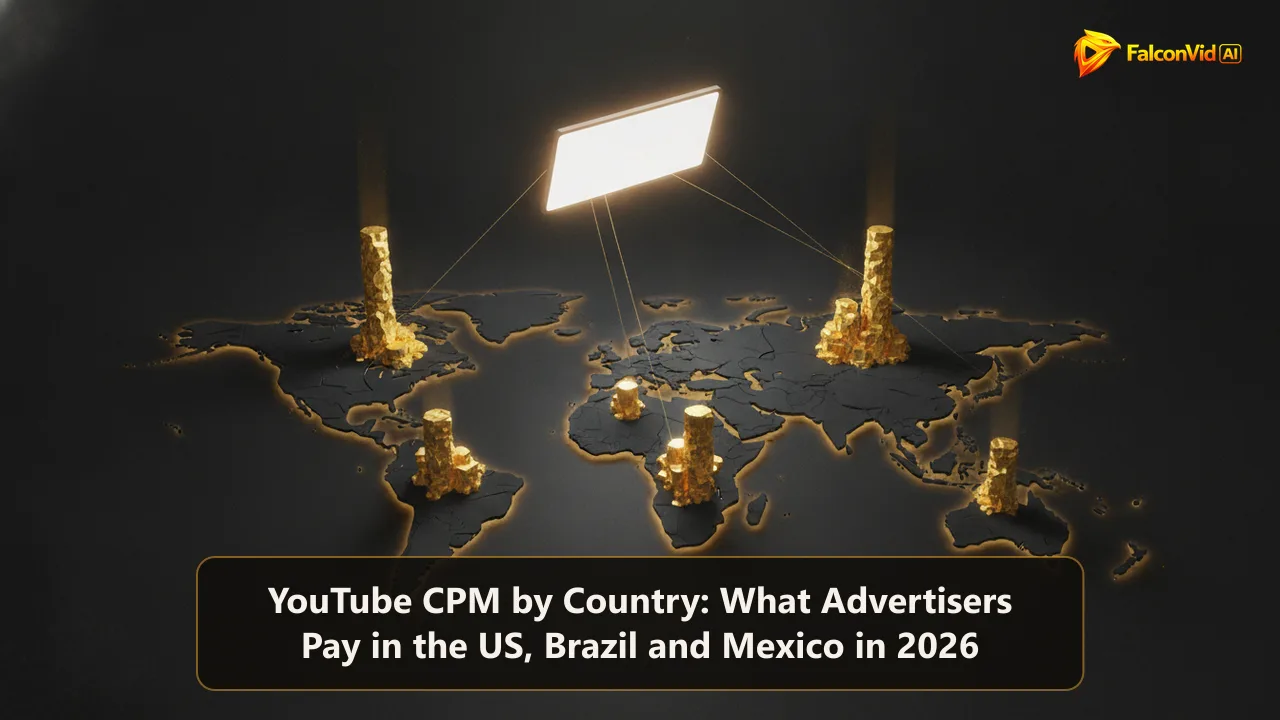
CPM is what the advertiser pays, RPM is what lands in your account
The number people quote in monetization videos is almost always CPM: what an advertiser pays for one thousand ad impressions, gross, before YouTube takes anything. It is a media buying metric borrowed from the ad side of the business. It was never a description of creator income, and repeating it as if it were is where the whole confusion begins.
RPM is the number that pays your bills. It is your total revenue divided by every thousand views of the video, already net of the 55/45 split, and it counts views that never showed an ad at all. A large share of views carry no ad, and RPM absorbs that dilution honestly. It also folds in YouTube Premium watch time, memberships and Super Thanks, so it is not purely advertising money.
In practice RPM lands somewhere between 30 and 50 percent of the CPM being advertised in those videos. A channel bragging about a 20 dollar CPM is usually looking at 6 to 9 dollars of RPM. Compare CPM to CPM and RPM to RPM, never mix the two, and you will stop feeling robbed by your own dashboard.
- CPM: what the advertiser pays per 1,000 ad impressions, gross
- RPM: your net revenue per 1,000 views of the video, after the 55/45 split
- RPM counts views that showed no ad, which is a large share of them
- RPM also includes Premium watch time, memberships and Super Thanks
- RPM typically lands at 30 to 50 percent of the CPM people quote out loud
The country that decides your pay is the viewer's, not yours
Advertisers bid for attention inside a market. When somebody in Ohio watches your video, an American advertiser paid for that impression at American prices. Your passport, your bank account and the desk you edit on play no part in that auction. The money follows the eyeballs, and the eyeballs have an address.
So a Brazilian creator whose audience is 60 percent United States earns like an American channel on those views. The reverse is just as true: an American creator publishing in Hindi gets paid Indian rates. The geography that matters lives on the Audience tab of YouTube Analytics, not on your utility bill.
This is why asking what the CPM is in your country is the wrong question. Open Analytics, go to Audience, look at top geographies and read the share of views by country. That distribution, weighted, is your real pay grade. Two channels in the same city with the same niche can be two entirely different businesses because of that one chart. That same distribution decides something else nobody reads on the dashboard: how much US tax is withheld before you get paid, since only the American slice is subject to it.
It is also the most actionable chart on the page, because audience geography is something you choose more than something that happens to you. The language a video is published in decides which market can even find it, so a channel that wants American or German viewers publishes in English or German. What used to make that impossible was the idea of running a whole second operation. In FalconVid every channel is its own thing, with its own calendar, visual identity, language and publishing targets, and you run 1 channel on Starter, 5 on Pro, 10 on Business, 25 on Agency and 50 on Scale. Choosing your pay grade turns into a setup decision instead of a career change.
- The ad auction happens in the viewer's market, at that market's prices
- A local channel with a US audience earns close to US rates
- A US creator publishing in a cheap language earns that language's rates
- Check Analytics, Audience, top geographies to see your real mix
- Your weighted share of views by country is your actual pay grade
- Each channel carries its own language and calendar: 1 on Starter, 5 on Pro, 50 on Scale
RPM ranges observed by country in 2026
What follows are observed bands, not quotes and not promises. They move with niche, video length, mid-roll placement and time of year, and the spread inside a single country is often wider than the gap between two countries. Treat the bottom of each band as your planning number and the top as a good year.
The top tier is the United States at roughly 4 to 12 dollars of RPM, followed by the United Kingdom, Australia, Canada, Germany and Norway at roughly 3 to 10. Southern Europe sits lower: Spain and Italy land around 1.50 to 4 dollars. Latin America is cheaper still, with Brazil around 0.50 to 2 dollars and Mexico and Argentina around 0.40 to 1.50. India runs about 0.20 to 0.80.
Read those numbers as tiers rather than as a scoreboard. The gap between an English speaking tier one market and Latin America is roughly six to ten times per view, which sounds brutal until you notice that the cost of the view is not the same either. That asymmetry is the entire argument for a second language, and we get to the arithmetic further down.
- United States: about $4 to $12 RPM, the reference market
- UK, Australia, Canada, Germany, Norway: about $3 to $10
- Spain and Italy: about $1.50 to $4
- Brazil: about $0.50 to $2
- Mexico and Argentina: about $0.40 to $1.50, India about $0.20 to $0.80
The niche multiplier is heavier than the country
Advertisers pay in proportion to what a customer is worth to them. Finance, software, insurance, real estate and B2B services chase clients worth hundreds or thousands of dollars, so they bid aggressively for a thousand impressions. Entertainment, curiosities, compilations and most gaming sit on cheap inventory with enormous volume, and the auction reflects that.
The consequence surprises people: a finance channel in Brazil can out earn a comedy channel in the United States on RPM. The country sets the floor of the auction, the niche decides how far above that floor advertisers are willing to push. Inside a single country the spread between the best and worst paying niches is commonly three to five times.
That also means moving to English is not automatically the fix for a low RPM. Changing what you talk about inside the language you already speak natively often multiplies your number more than changing language does, and it costs far less. Test the niche lever before you test the language lever, because only one of them requires building a second channel.
The catch with the niche lever is that testing it honestly costs videos, and videos cost weeks when you make them one at a time. Two things compress that. The FalconVid Spy reads the channels already monetizing inside a niche and extracts the pattern, so you pick from what demonstrably earns instead of from a hunch about what advertisers like. And because generations run side by side rather than in a queue, 2 at a time on Starter and 5 on Pro, testing a high paying niche is a batch you launch this week instead of a quarter you spend finding out.
- Finance, software, insurance, real estate and B2B pay far above average
- Entertainment, curiosities and compilations sit on cheap, high volume inventory
- Inside one country, top and bottom niches commonly differ by 3 to 5 times
- A finance channel in Brazil can beat an entertainment channel in the US
- Test the niche lever before the language lever: it is cheaper and faster
- The Spy shows what already monetizes, and parallel generations turn a niche test into a batch
The arithmetic of opening a second language
The fear is obvious: why publish in a market that pays a fifth of what English pays. The answer is that you are not buying RPM, you are buying views, and Spanish and Portuguese search inventory is far less contested. The same topic that has four hundred competent English videos may have eight decent ones in Portuguese, so each view costs you dramatically less effort to win. Travel is the niche where this is most visible, because the same guide is searched in three languages by audiences that never meet, which is the whole premise of a faceless travel channel without travelling.
Run the numbers instead of the feeling. Suppose the English channel does 100,000 views a month at a 6 dollar RPM: that is 600 dollars. Add 300,000 views in Portuguese at a 1 dollar RPM and you add 300 dollars. Total revenue goes to 900 dollars, a 50 percent increase, while the combined RPM of the operation falls to 2.25 because it is a weighted average by views, not an average of the two numbers.
So watch the revenue line and ignore the panic in the RPM line. The failure mode that actually hurts is a bad second language: machine translated narration with wrong stress and untranslated titles kills retention in the first thirty seconds, and no RPM saves a video nobody finishes. Native sounding narration and localized titles, descriptions and thumbnail text are what separate a second market from a second graveyard.
That is a production question rather than a translation question, which is why it is worth knowing what it costs. In FalconVid you duplicate an existing project into another language and pay only the difference instead of a whole new production, the narration is ultra realistic across 63 languages, and the video SEO, title, description and tags, is generated for the new market rather than translated word by word. The Spanish version stops being an English video wearing subtitles. If you want the RPM tier rather than the cheap tier, the same move runs in reverse: a proven Portuguese format can open in English and get paid at 4 to 12 dollars per thousand views instead of 0.50 to 2.
- Spanish and Portuguese search inventory is far less contested than English
- Cheap volume, not high RPM, is what makes a second language pay
- Combined RPM is a weighted average by views, so it drops while revenue rises
- 100k views at $6 plus 300k at $1 is $900 total and a $2.25 combined RPM
- Bad dubbing kills retention in 30 seconds and no RPM can rescue it
- Duplicate the project into another language paying only the difference, with video SEO localized too
Running the same channel in more than one market without doubling the work
The reason most creators never open a second market is not strategy, it is labor. Doing it by hand means a second script, a second narration, a second set of visuals, a second thumbnail and a second upload routine, every single week, for a market whose RPM is lower. The math works and the calendar does not.
FalconVid exists to remove that second workload. The same channel is published in up to 63 languages with native sounding narration, so the Spanish and Portuguese versions are not subtitles bolted onto an English video. You approve the content calendar and the rest runs on its own, publishing to YouTube, Instagram, TikTok, Rumble and Facebook without you sitting in the middle of every handoff.
The other half of removing that workload is that markets are produced at the same time, not in sequence. An AI researcher, scriptwriter, narrator, editor and sound designer work on the same video in parallel, so a long video is finished in up to 30 minutes, and videos run side by side: 2 concurrent generations on Starter, 5 on Pro, 10 on Business, 25 on Agency and 50 on Scale, with channels following the same curve from 1 to 50. A second market stops competing with the first one for your Sunday.
The numbers are worth stating exactly, because the quality mode weighs more than the plan. A 12 minute video costs 1,584 credits in economy mode, 9,000 in balanced and 27,084 in premium. Starter includes 15,000 credits, which is 9 videos in pure economy or a realistic 4 a month mixing economy with one in balanced. Pro includes 30,000 credits and 5 channels, up to Scale with 320,000 credits, 50 channels and 50 concurrent generations. Every creation feature is included on every plan, so no creation tool is locked behind a tier, what changes is volume, channels, simultaneous generations, the AI Senior Analyst and support. None of that changes what advertisers pay in Mexico or Brazil. It changes how many markets you can afford to be present in at those prices.
- The barrier to a second market is workload, not strategy
- Up to 63 languages with native sounding narration, not bolted on subtitles
- You approve the content calendar and publishing runs by itself
- Publishes to YouTube, Instagram, TikTok, Rumble and Facebook
- AI specialists in parallel: long video in up to 30 minutes, 2 to 50 at a time
- 12 minute video: 1,584 credits in economy, 9,000 balanced, 27,084 premium
- Starter for 15,000 credits: about 4 videos a month mixing modes, 9 in pure economy
Seasonality: why December lies and January scares
Ad budgets are not spread evenly across the year. The fourth quarter, October through December, is when brands dump holiday shopping money into the auction, and every RPM in every country inflates with it. Late November and December are the annual peak, and a channel that only ever looked at its dashboard in December has a distorted picture of itself.
Then January arrives, budgets reset to zero and the auction thins out. RPM can fall by a third to a half within the first days of the year, in every market, with no change whatsoever in your content. Creators who rebuild their entire strategy in January are usually reacting to a calendar, not to a problem.
The discipline is simple: never compare a month to the month before it. Compare it to the same month last year, which is the only honest read of whether the channel improved. Plan cash for a lean first quarter, aim your most monetizable topics at the fourth quarter wave, and treat any single month in isolation as noise.
Aiming topics at the fourth quarter only works if the videos exist before the wave arrives, and that is a production constraint, not a planning one. Anyone producing one video at a time writes the December batch in December, which is exactly when there is no time. Producing several at once is what lets you bank that batch in October: FalconVid runs videos side by side and finishes a long one in up to 30 minutes, and the calendar you approved releases them on the dates you chose, across YouTube, Instagram, TikTok, Rumble and Facebook. Seasonality is one of the few things in this business you can see coming a full quarter ahead.
- October to December inflates RPM everywhere, peaking in late November and December
- January resets ad budgets and RPM can drop by a third to a half in days
- The drop happens with zero change to your content or audience
- Compare month to the same month last year, never to the previous month
- Plan cash for a lean Q1 and aim monetizable topics at the Q4 wave
- Bank the Q4 batch in October: videos produced in parallel, released by the approved calendar