
What changed on August 10 and 11, 2026, and who it actually hits
YouTube announced the first big change to the Partner Program since 2018. From February 1, 2027, entering the program for ad and Premium revenue takes 1,000 subscribers and 8,000 qualified public watch hours in the last 365 days, up from 4,000. The Shorts door moved by the same factor, from 10 million to 20 million qualified views in 90 days. Both thresholds doubled at once, and they apply to who enters new.
Whoever is already inside is not measured by the new bar and keeps monetizing. One condition has nothing to do with hours: the new terms have to be accepted in YouTube Studio by January 31, 2027, or monetization access ends on February 1, 2027. That is a click inside Studio, not a growth target, and it is the cheapest item on this page.
One door did not move. Fan funding, which is Super Thanks, Super Chat and memberships, plus the shopping products, still asks 500 subscribers and 3,000 qualified hours in a year, or 3 million Shorts views in 90 days: a money door at half the new bar, still open. Premium Lite also expands to every country where Premium operates, with 30 percent of net subscription revenue on Premium and 60 percent on Premium Lite, split 55 percent to long video and 45 percent to Shorts.
The stated reason is scale: more than 200 billion daily Shorts views, more than 1 billion hours a day watched on TV, and the company expects to pay creators more in 2027 than in 2026. What changed for anyone building now is the size of the currency. The unit is the watched minute, and the ai avatar is the most interesting case of that: the most expensive piece in the catalog, and the one that promises the most presence.
- New entry from February 1, 2027: 1,000 subscribers and 8,000 qualified public watch hours in 365 days, or 20 million qualified Shorts views in 90 days.
- The old bar was 4,000 hours or 10 million Shorts views. Both doubled, the first big change since 2018.
- Already in the program: not measured by the new bar, but the new terms must be accepted in YouTube Studio by January 31, 2027.
- Activity rule to stay in: 1,000 qualified hours in 365 days, or 1 million Shorts views in 90 days, or 2 long videos or 5 Shorts every 90 days, with a 90 day window to recover.
- Shorts revenue from February 1, 2027: 10 million qualified Shorts views in 90 days. Below that nobody is expelled, long video keeps earning, and Shorts revenue returns on its own.
- Fan funding did not move: 500 subscribers and 3,000 qualified hours in a year, or 3 million Shorts views in 90 days.
172 days, 480,000 minutes, and why the real deadline is earlier than the printed one
From August 12, 2026 to January 31, 2027 there are 172 days, about 24.5 weeks, a little under 6 months. Whoever is accepted before February 1, 2027 enters under the 4,000 hour rule and stays on it. Whoever arrives after needs 8,000.
Being accepted is not the same as hitting the number: you hit the bar and then go through YouTube review, which takes days or weeks. So the real deadline sits well before January 31, not on top of it. Hours count on a rolling 365 day basis, so an hour accumulated today still counts in January.
Now the arithmetic that replaces every guess. 8,000 hours is 480,000 watched minutes, and 4,000 hours is 240,000. Divide by the minutes each view actually delivers and the target stops being abstract.
- 8 minute video at 45 percent: 3.6 minutes per view, so 133,333 views for 8,000 hours and 66,667 for 4,000.
- 12 minute video at 40 percent: 4.8 minutes per view, so 100,000 views for 8,000 hours and 50,000 for 4,000.
- 12 minute video at 50 percent: 6 minutes per view, so 80,000 views. A 20 minute video at 40 percent: 8 minutes, so 60,000 views.
- 30 minute video at 35 percent: 10.5 minutes per view, so 45,715 views for 8,000 hours.
- At 12 minutes and 40 percent, a video with 1,000 views is 80 watch hours, so 100 videos cover the 8,000. At 2,000 views it is 50 videos, at 5,000 views it is 20.
- Publishing every day for 172 days is about 172 videos. Every weekday is about 123. Three times a week is about 74. Once a week, what most manual channels really do, is about 24.
Watched minutes per credit: the only ruler that survives a fixed date
With a fixed budget and a fixed date, every credit is a bet on minutes. The ruler is simple: take the credits a decision costs, and ask how many watched minutes that same money buys spent another way. The avatar is where it bites hardest, because lip sync is not billed by the video, it is billed by the second of face on screen.
A 12 minute video in economy mode costs 1,584 credits. Kling Std charges 32 credits per second of face, so 90 seconds is 2,880 credits and the finished piece is 4,464. That is 1,584 credits for twelve minutes of research, script, narration, scenes, editing and captions, against 2,880 credits for a minute and a half of face.
Convert the same budget into videos: 4,464 divided by 1,584 is almost 4. At 1,000 views per video and 40 percent average on 12 minutes, each view is 4.8 watched minutes, so each video is 4,800 minutes, or 80 watch hours. The 4 videos are 320 hours. The single avatar video is 80. To tie, it has to pull 4 times the views or 4 times the retention. Not 4 percent more. Four times.
That is not an argument against the face, it is an argument about where it goes and how long it stays. Across twelve minutes of talking head, the answer is almost always no. Concentrated into 15 seconds of hook, or printed once on the cover, the arithmetic flips.
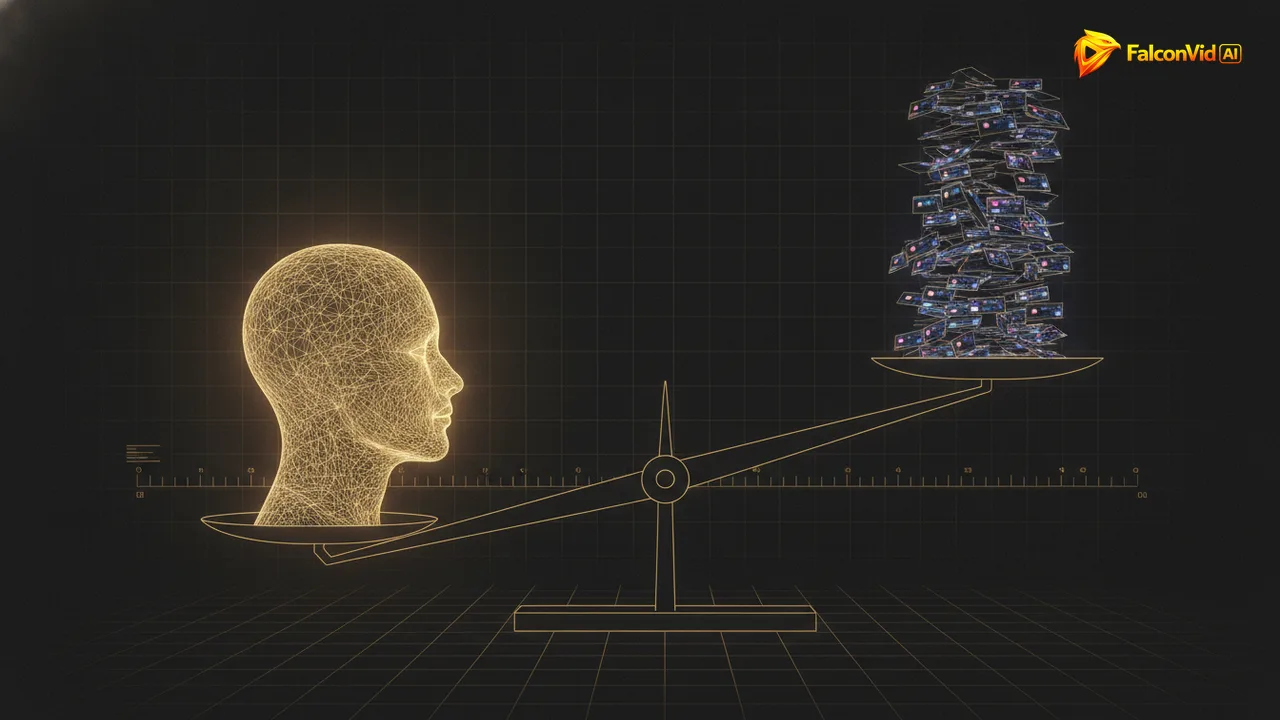
The one place the face is cheap: the cover is billed as an image, not by the second
There is exactly one spot where a face does not run a meter, and it is the spot every viewer sees first. A thumbnail is billed as one image, not by the second: 479 credits in economy mode, where the cover comes out of its own module, and 214 in premium. One charge, no stopwatch. The same face talking for 90 seconds inside the video is 2,880, which would pay for 6 covers in economy or 13 in premium.
A watched minute cannot exist before a click. The cover multiplies how many sessions start and is shown to everyone the algorithm puts the video in front of. The face inside multiplies, maybe, the retention of a session that already started, and only for people who already clicked.
One rule keeps this from backfiring: the face on the cover and the face in the video have to be the same. A cover promising a presenter over stock scenes breaks the promise in the first second, and that shows up as a retention cliff. Not every niche wins with a face on the cover, but the price asymmetry is not an opinion, it is how the meter works.
The 90 second budget: four doses that buy presence without paying for a talking head
Take the opposite extreme, because it sets the ceiling. A 12 minute talking head is 720 seconds of face, 23,040 credits on Kling Std, or 24,624 with the video. Divide by 1,584 and you get 23 economy videos. At 1,000 views each, that is 1,840 watch hours, almost a quarter of the 8,000 the new rule asks for, out of a single video's budget. One talking head costs what 23 finished videos cost, and those 23 carry watch hours it cannot match on its own.
So the design that survives a deadline is neither a talking head nor zero face. It is a dose design: the face appears where it decides something, and narration, scenes and motion carry the rest.
The four doses below add up to 87 seconds and 2,784 credits on Kling Std, rounding to the 90 second ceiling of 2,880 used here. That does not make the face cheap, it makes it bounded: 2,880 instead of 23,040, eight times less. Spending it at all stays a decision per video, not a channel default.
- Hook, 15 seconds at the open: 480 credits. The one stretch where a face turns a scroll into a viewer.
- Transitions, 8 seconds each, four times, so 32 seconds: 1,024 credits. The joints where attention naturally dips.
- Verdict, 25 seconds: 800 credits. Information can be narrated over visuals, judgement lands better from a face.
- Close, 15 seconds: 480 credits. The call to action delivered by a presenter, not read over a graphic.
- Total: 87 seconds and 2,784 credits, rounded to 2,880, against 23,040 for twelve minutes of face.
- Three honest levels: cover only at 479 credits in economy or 214 in premium, doses at 2,880, full presenter at 23,040.
What actually moves watched minutes when the clock is short, and why the avatar comes after it
The biggest lever has nothing to do with faces. Format and length alone move the target by a factor of almost three: an 8 minute video at 45 percent needs 133,333 views for 8,000 hours, a 20 minute at 40 percent needs 60,000, a 30 minute at 35 percent needs 45,715. Choosing them costs nothing extra.
Then the first 30 seconds, because the hook decides whether the average retention feeding every calculation above is 20 percent or 45 percent, and it is written, not filmed. Then pace and scene density. Then narration quality, because a robotic voice gets abandoned no matter how good the script is. Karaoke captions and CTAs are on in every plan with no credit line of their own.
Only then does the avatar earn its turn. It is the last multiplier in the chain and by far the most expensive. A channel with a weak hook and a face on screen is paying 2,880 credits to be abandoned in a nicer looking way. That is an ordering, not a ban: in opinion channels, reviews and UGC style ads the face is what produces the minutes. The mistake is treating a presenter as the default for a faceless channel racing a date.
How FalconVid closes the distance in 172 days without turning the face into the bill
The gap almost never sits in production quality. It sits in the calendar. One person editing by hand does not put out 100 videos in 172 days. FalconVid researches, writes, narrates, edits, captions and publishes to YouTube, Instagram, TikTok, Rumble and Facebook in up to 63 languages, from a calendar you approve once, with AI specialists working in parallel and a video ready in up to 30 minutes.
The number that ends the budget argument: 100 videos of 12 minutes in economy mode is 158,400 credits. That is the entire production run behind 8,000 hours at 1,000 views per video. On Business, 95,000 credits, 59 economy videos fit in a single month, essentially the whole run inside one calendar month. On Pro, 30,000 credits, 18 economy videos a month clear it in under four. Capacity is not the bottleneck. The calendar is.
The avatar stays a switch, not a plan. Every creation feature is on in every plan and what changes is volume, channels, simultaneous generations, the Senior Analyst (from Pro, with 7 free days on Starter) and support, so the face is a line you turn on where it pays: Kling Std at 32 credits per second of face, Kling Pro at 64, HeyGen at 80, OmniHuman 1.5 at 112, so 90 seconds costs 2,880, 5,760, 7,200 or 10,080. The same 30,000 credits of the Pro plan give 18 economy videos with no avatar, or 7 videos with 90 seconds of face each. Channel DNA holds the same face across covers and videos, and duplicating a project into another language pays only the difference, basically the narration again, 288 credits in premium and 36 in economy, about 3.6 percent of a 1,584 credit economy video.
The plans, with volume stated in the mode: Starter with 15,000 credits, 1 channel and 2 simultaneous generations, realistically around 4 videos a month mixing economy with one in balanced, since nobody runs a whole month in one mode. Pro with 30,000 credits, 5 channels, 5 simultaneous generations and 18 economy videos. Business with 95,000 credits and 94. Agency with 190,000 and 188. Scale with 320,000 credits, 50 channels, 50 simultaneous generations and 317. A 12 minute video costs 1,584 credits in economy, 9,000 in balanced and 27,084 in premium.
172 days: what to do this week
There are 172 days between today and January 31, 2027, and YouTube review eats part of them. Every hour published from here counts on a rolling 365 day window, so the week you skip is the week you do not get back.
The objections, in order. I do not know how to make video: you do not produce, you approve a calendar, and the AI specialists research, write, narrate, edit and caption in parallel. I do not know how to pick a niche: the modeler starts you from channels that already monetize. What if it comes out bad: Studio shows you the V1 before it goes out and you adjust, and the free plan with 4 videos a month and no card lets you judge first. I do not have time: a video is ready in up to 30 minutes and the calendar publishes without you.
And the honest one. What if I do not hit the bar by the deadline. Nobody can promise you will. What is true: hours count on a rolling 365 day window, so what you publish now still counts in January, and the fan funding door stayed at 500 subscribers and 3,000 qualified hours in a year, half the new bar and still open.
The offer is plain: free plan with 4 videos a month and no card, cancel whenever you want, annual billing is two months free. The promise is about production, not the algorithm. FalconVid produces and publishes the volume, in the mode you choose, with the face where you decide it pays. It does not promise monetization, views, subscribers or revenue. The bottleneck it removes is putting enough good video into the world before January 31.
- 100 videos of 12 minutes in economy mode cost 158,400 credits, the whole production run behind 8,000 hours at 1,000 views per video.
- Pro with 30,000 credits fits 18 economy videos in one month, with 5 channels and 5 simultaneous generations, so the 100 video run this math asks for lands inside four months. Business does 94 in a single month.
- Each video is researched, written, narrated, edited, captioned and published in up to 30 minutes, from a calendar you approve once.
- The face is a switch, not a plan: 479 credits on the cover in economy and 214 in premium, 2,880 for 90 seconds of doses on Kling Std, 23,040 for a full presenter.
- Karaoke captions in 15 plus styles and CTAs are on in every plan with no credit line of their own.
- Publishing goes to YouTube, Instagram, TikTok, Rumble and Facebook, and duplicating into another language re pays basically the narration, 36 credits in economy and 288 in premium.
- Every creation feature is on in every plan, including the ai avatar. What changes is volume, channels, simultaneous generations, the Senior Analyst (from Pro) and support.