

The face premium: what a host actually buys you
Faceless channels are the easiest thing in the world to start and the hardest to push past a plateau. A drone shot of a skyline, a stock clip of hands typing, a voice reading over both: your video is interchangeable with four hundred others, and the viewer has nothing to attach to. Nobody ever became loyal to b roll.
The lift from a presenter is real, and smaller than the hype suggests. In educational and commentary niches, cutting a consistent host into the same script tends to move average view duration somewhere in the 5 to 15 percent range, and the gain concentrates in the opening. That matters, because the first thirty seconds is where faceless videos routinely shed 30 to 50 percent of the audience.
The larger effect lands on subscriptions, not watch time. People subscribe to a person, and a character counts as a person. The old advertising rule of thumb puts basic recognition at three to seven encounters, so a channel showing the same host in every upload banks those encounters for free.
The hard part: the same face in episode 1 and episode 300
Generating one striking presenter takes about ninety seconds and costs nothing. That is not the job. The job starts on the second video, when you need the same cheekbones, eye color, hairline and apparent age, and the tool that handed you a masterpiece yesterday now hands you their cousin.
Character drift is cumulative and nearly invisible step by step. The jaw narrows a little, the eyes shift half a shade, the hairline sits two millimeters higher. Nobody catches it between video twelve and thirteen. Everybody catches it between twelve and forty, and by then your library looks like three hosts sharing one name.
The fix is structural, which is why it belongs in the tool rather than in your memory. FalconVid treats the presenter as part of the channel instead of a prompt you retype: you build your own AI influencer, an ultra realistic avatar with its own scenario, and the Channel DNA holds that identity in place from one episode to the next, together with the format, the voice and the visual style. Video forty comes out of the same stored identity as video one, because nothing about it was improvised on a Tuesday night.
- Cross episode drift: the face slowly becomes a different person over weeks of uploads
- Shot to shot drift: two angles inside one video that are clearly not the same head
- Frame to frame flicker: teeth, earrings and hair strands reshuffling every few frames
- Wardrobe drift: the collar or the jacket changes without anyone deciding it should
- Lighting drift: a warm key light this week, flat clinical light the next
- Expression drift: the host looks ten years younger every time they smile
The identity kit: what actually locks a character
Stop treating the presenter as a prompt and start treating it as an asset. The foundation is a locked reference identity: eight to fifteen images of the same face, generated in one session, covering front, three quarter and profile, neutral and mid speech, under a single lighting setup. Every future render points back to that set, never to your last video.
Then comes seed and prompt discipline, unglamorous and decisive. Fix the seed, freeze the character block of the prompt word for word, and change only the scene around it. Keep that block in a versioned file. Most people lose a character by rewording the description because a synonym sounded better.
The third piece is a style bible you actually reuse. Two or three wardrobe options, one key light position, one background family, one framing rule, one palette. Constraints are what make a host recognizable at thumbnail size, and the smaller the wardrobe, the faster a viewer spots your channel mid scroll.
Notice that all of this is bookkeeping, which is exactly why it decays. Done by hand it is a folder of reference images, a text file with a seed, and the discipline to open both every single time you sit down to produce, and it lasts about as long as any manual checklist. In FalconVid the kit is the product rather than a habit: the avatar and its scenario are created once and stored, the Channel DNA carries them into every generation, and the branding, palette and framing travel with them automatically. You are not remembering the identity, you are configuring it.
- Reference set: 8 to 15 locked images, one session, one lighting setup, several angles
- Seed policy: one fixed seed for the character, documented, never improvised per video
- Prompt block: the character description frozen word for word and version numbered
- Wardrobe: two or three outfits maximum, written down with exact colors
- Lighting: one key position and one color temperature for every single episode
- Framing: the same shot size on every opener, so the intro is instantly recognizable
- Regeneration rule: rebuild from the reference set, never from yesterday's output
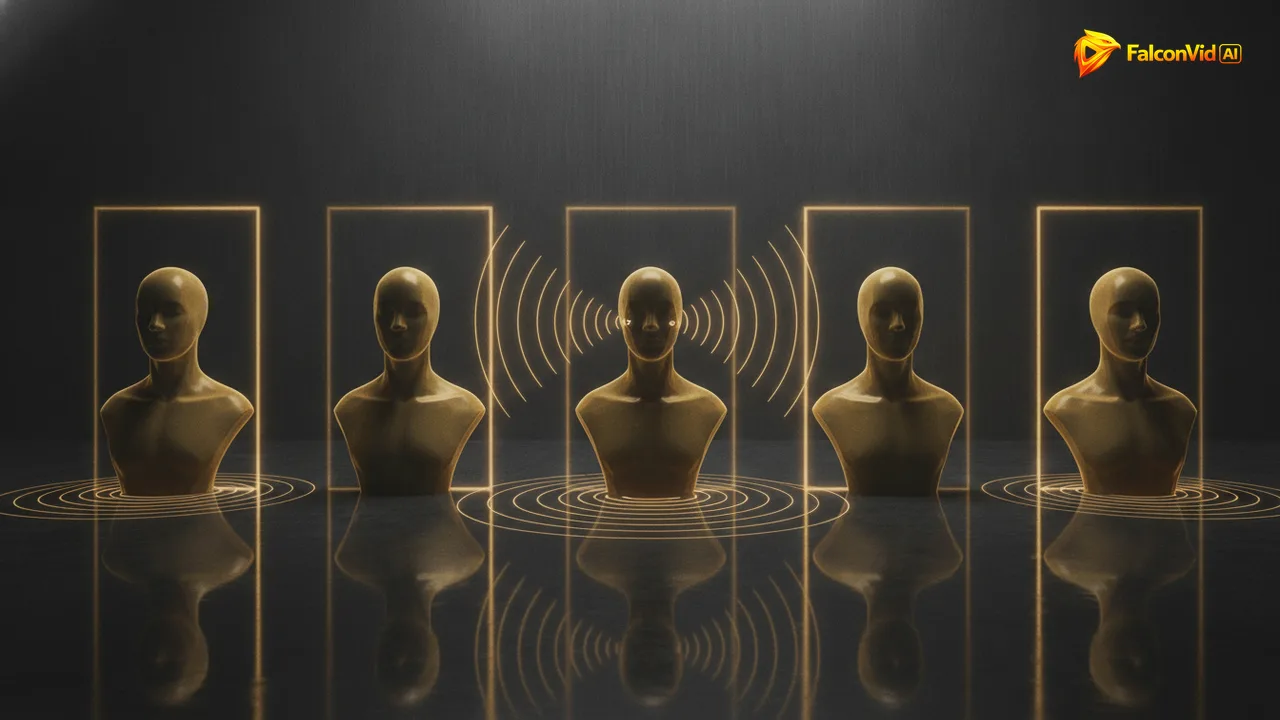
Lip sync and voice: where the illusion breaks first
Viewers forgive a lot in the picture. Soft footage, odd hands, a flat background, a stiff pose. They do not forgive a mouth running a beat behind the words, because bad sync does not read as a small budget, it reads as a fake. Broadcast guidance puts detection at roughly 45 milliseconds when audio runs ahead and 125 when it lags, one to three frames.
The audio has to match the face as well as the clock. A twenty five year old face with a fifty year old baritone, or a clearly regional face with a flat neutral accent, gets spotted in seconds even by viewers who cannot say what is wrong. Pace counts too: narration at 180 words per minute over a mouth animated for 140 never quite settles.
Decide the order and lock it. Pick the voice first if the voice is your brand, the face first if the face is, then cast the other to match age, gender, accent and energy. Once locked, never swap the voice mid season, because audiences notice a change in timbre long before a new thumbnail style.
Both halves of that are model quality problems, and it is where the gap between tools is widest. FalconVid drives the mouth with top tier lip sync models, Kling, OmniHuman and HeyGen, instead of a generic mouth warp, and the narration comes from ultra realistic premium voices in any of 63 languages, or from your own cloned voice when the voice is the brand. If your format has two people talking, multi character narration gives each one a distinct voice rather than one reader doing an impression. Casting the face against the voice is still your call. Holding them in sync frame after frame, episode after episode, stops being your problem.
Running a daily channel with the same presenter
Add up what this costs by hand. One presenter video is realistically 4 to 10 hours once you count prompting and re rolling the character, checking for drift, running the lip sync pass, fixing the shots where the jaw slipped, and then the actual edit. Outsourcing runs $50 to $300 per video, and a real on camera presenter is $150 to $500 a day before editing.
This is the part FalconVid was built for. You set up the project, create your presenter, choose the narration language out of 63 and approve the calendar: how many posts per day and the exact time of each one, in your audience's timezone. From there the research, the script, the narration, the editing and the sound design are handled by AI specialists working in parallel instead of in a queue, which is why a long video is ready in up to 30 minutes rather than over two evenings, and it goes out on its own across YouTube, Instagram, TikTok, Rumble and Facebook.
The budget deserves real numbers instead of a slogan. On a 12 minute long video the engine spends 1,584 credits in economy mode, 9,000 in balanced and 27,084 in premium, so the quality mode you choose weighs more than the plan you are on. Starter carries 15,000 credits: that is 9 videos if you stay in economy the whole month, or exactly one if you shoot everything in balanced. Nobody runs a month on a single mode, so the realistic working plan on Starter is around 4 videos a month, most of them economy, with the one that really matters pushed up to balanced.
Volume is not the only thing that scales. Generations run side by side, 2 at a time on Starter, 5 on Pro, 10 on Business, 25 on Agency and 50 on Scale, and channels follow the same curve, so a second presenter on a second channel is a settings decision rather than a second job. Every creation feature is on in every plan: what changes as you go up is volume, concurrency, channels, the Senior Analyst (from Pro, with 7 free days on Starter) and support. You approve the calendar and the machine runs the channel with the same presentation every single day, which is exactly the consistency a human operator loses around week three. There is a free plan with 4 videos a month and no card to watch it produce before you commit after that.
- By hand: 4 to 10 hours per presenter video, or $50 to $300 outsourced
- 12 minute video in FalconVid: 1,584 credits economy, 9,000 balanced, 27,084 premium
- Starter for 15,000 credits: 9 videos in pure economy, or about 4 a month mixing modes
- AI specialists work in parallel, a long video ready in up to 30 minutes
- Concurrent generations: 2 Starter, 5 Pro, 10 Business, 25 Agency, 50 Scale
- Every creation feature on every plan, free plan with 4 videos a month and no card
The uncanny valley trap: stylized usually beats hyperreal
The instinct is to chase photoreal, and it is the most expensive mistake on the menu. The closer a face gets to real, the more every small error costs, because the viewer's brain switches from watching a character to auditing a human. At eighty percent realism a stiff blink is a style choice. At ninety eight percent it is a warning sign.
The cheap and reliable answer is to step back from the edge deliberately. Semi stylized, illustrated, clearly a character rather than a claim about a person. Animation has shipped decades of beloved hosts this way. You lose nothing in trust and gain enormous tolerance for imperfection, which is the difference between publishing daily and re rendering forever.
How real a video looks is a lever, not a fixed property of AI generated videos, and in FalconVid you set it per video: the engine runs from economy up to premium, with Veo 3 with audio and Seedance Pro at the top. A stylized daily episode can stay cheap while the one video you actually want to look expensive runs premium. And when a first cut still lands in the valley, the Studio is where you fix it: watch the V1, shorten the intro, swap the shot where the jaw slipped, change the music, or open the full timeline and do it yourself. It ships with every plan, so the answer to a bad face is a five minute edit rather than a lost week.
Disclosure, likeness and consent: the rules that keep you online
YouTube has required creators to disclose realistic altered or synthetic content since 2024, declared during upload. The platform then shows a label in the expanded description, or on the player for sensitive subjects like health, elections and finance. Everyone assumes this is a penalty. It is not: the disclosure does not remove monetization, demote you in search or change how the video gets recommended.
It also does not apply to everything. Clearly unrealistic or animated content, beauty filters, background blur, color correction and ordinary production effects sit outside the requirement. The trigger is realism about things a viewer could reasonably mistake for real, one more reason the stylized presenter is the cheaper path.
Likeness is the one place with no gray zone. Never build a presenter on a real person's face, a celebrity or a stranger from a photo, without written permission. Platforms run privacy complaint processes for exactly this, image rights are enforceable in most markets you care about, and one valid complaint can end a channel.
- Declare synthetic content during upload, every episode, without exception
- Expect the label in the description, or on the player for health, news and finance
- Monetization, search and recommendations are not affected by the disclosure
- Filters, grading and clearly animated characters do not require the label
- Never use a real person's face or voice without documented written consent
- Archive the consent and the reference set, because the burden of proof is yours
How many videos before people recognize your host
Set the expectation before you start. Recognition needs repetition, and the rule of three to seven exposures means a subscriber who watches half your uploads needs fifteen to twenty published videos before the face registers as yours. On a daily calendar that is three to four weeks. Treat ninety days as the point where the presenter becomes a brand asset.
The order of work matters more than the tooling. Lock the identity kit before video one, because retrofitting consistency onto forty published videos means re rendering forty videos. Then hold everything still. The urge to redesign the host in month two is what kills most of these channels.
Read that ninety day schedule as the manual one, because that is where it breaks. Ninety daily episodes by hand is ninety rounds of prompting, drift checking and lip sync repair at four to ten hours each, and hardly anyone finishes: the presenter gets redesigned in week five out of boredom or exhaustion, and the recognition clock resets to zero. With a pipeline producing in parallel, the clock is the only thing left running. The identity holds because it is stored rather than remembered, the calendar goes out because you approved it once, and the ninety days pass while you spend thirty to sixty minutes a week reading the numbers and deciding what the host talks about next. The recognition math does not get faster. It just stops depending on your stamina, which is the only reason most people never reach day ninety.
- Days 1 to 3: build the reference set and the style bible, then stop generating faces
- Days 4 to 7: cast the voice against the face and test sync on three sample scripts
- Days 8 to 10: publish three videos and check opener retention against your old format
- Days 11 to 30: run the daily calendar and change nothing about the presenter
- Day 30: compare click through rate and thirty second retention with your old baseline
- Day 90: only now consider a wardrobe or set refresh, and never a new face