
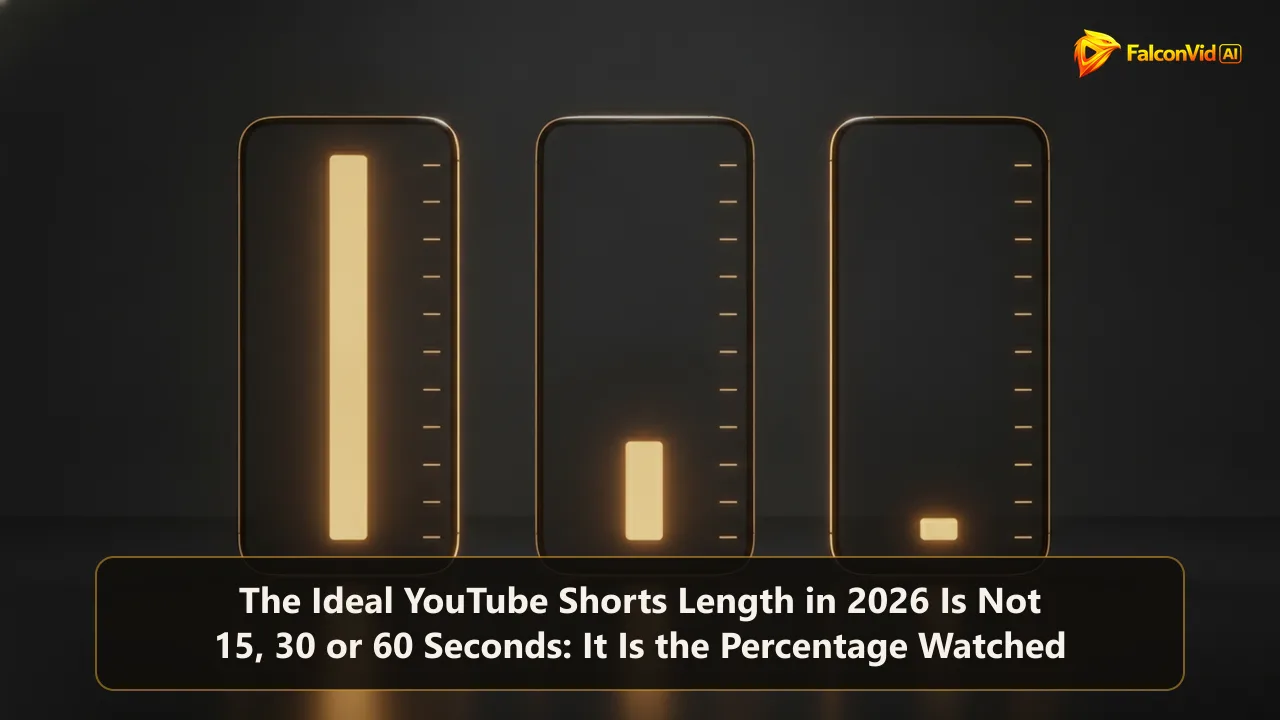
The ideal length is not a duration: the feed compares Shorts by percentage watched
Every guide hands you a number, and every number is wrong, because a Short of 12 seconds and a Short of 58 seconds compete for the same slot in the same feed. If YouTube ranked them by raw seconds watched, the longest video would win by default and the feed would fill with padding. What survives the comparison is the share of the video each viewer actually watched, plus how often they let it play again.
Run the arithmetic. Short A is 20 seconds and holds 95% to the end: each viewer watches 19 seconds, and 12% let it loop once more, which adds 2.4 seconds and puts effective completion at about 107%. Short B is 55 seconds and holds 40%: each viewer watches 22 seconds and almost nobody replays it. Watch time is nearly identical, 21.4 seconds against 22.4. Completion is 107% against 41%. The feed pushes A.
That comparison rewrites the planning question. You are not asking how long your Short should be, you are asking how many seconds this idea holds at full attention, then cutting to that number. A weak idea stretched to 50 seconds is not a bigger video, it is a worse one carrying exactly the same content.
- Shorts of every length share one feed, so the ranking metric is normalized.
- Percentage watched and replays beat raw seconds of watch time.
- 20 seconds at 95% and 55 at 40% deliver the same watch time, not the same reach.
- A replay pushes effective completion above 100%, which no long Short reaches.
Where the curve breaks: second 2, second 5 and the cliff near second 30
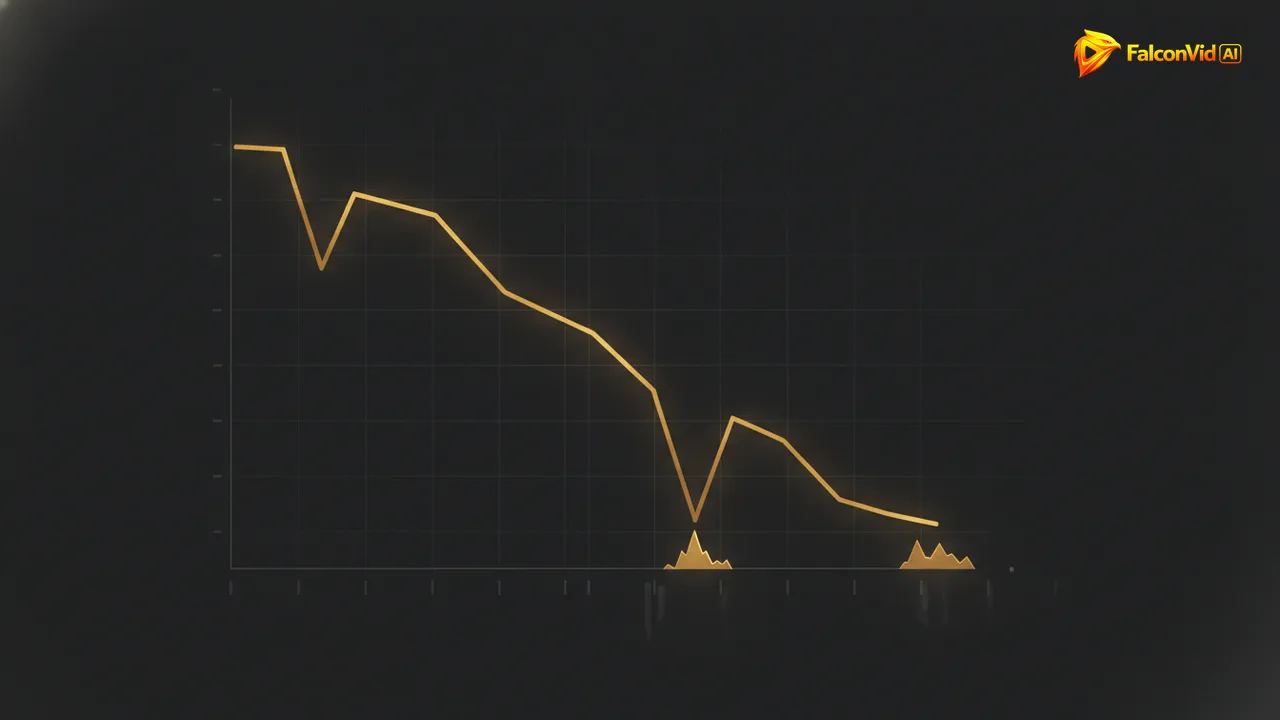
Pull up the retention graph of any Short and the same two drops appear. The first sits between second 2 and second 5, the swipe decision: the viewer is not judging your content yet, only whether the first frame and the first sentence promise anything. In a typical Short, 20% to 35% of the audience is gone before second 3, and nothing you place at second 20 brings them back.
The second break is the one nobody plans for. It sits close to second 30, the moment the viewer works out that the promise will not close in time. A well built 60 second Short usually reads like this: 100% at second 0, 70% to 80% at second 3, 55% to 65% at second 15, 40% to 50% at second 30 and 30% to 40% at the end.
So every second between 5 and 30 has to pay rent. If your idea holds 12 seconds of substance, a 45 second Short is 33 seconds of a person waiting, and waiting is what the swipe gesture was invented for. The fix is almost never a better hook at second 0. The fix is deleting the middle.
- 20% to 35% of viewers leave before second 3, on the first frame and first sentence.
- The second cliff sits near second 30, when the payoff looks too far away.
- Typical curve: 100% at 0, around 75% at 3, 60% at 15, 45% at 30, 35% at the end.
- The usual fix is cutting the middle, not rewriting the hook.
15, 30 or 60 seconds: the three bands, by objective, with the word count
Narration runs at roughly 2.5 words per second, about 150 words a minute, which turns seconds into a script budget. Fifteen seconds is about 38 words, twenty is 50, thirty is 75, forty five is 113 and sixty is 150. Subtract the fixed costs of the format, around 3 seconds of hook and 2 of close and loop, and a 20 second Short leaves you 15 seconds, roughly 38 words, to prove the entire point.
The 15 to 20 second band carries the highest completion and the highest replay rate, and it fits one claim plus one proof: a joke, a shocking number, a before and after. It does not fit context, and adding context is how a 17 second winner becomes a 34 second loser. It is the natural home of a facts Shorts channel done right: one verified fact, one proof, and out.
The 25 to 35 second band is the balanced one, where a single useful tip lives: setup, tip, example, close, around 75 words. The 40 to 60 band earns its length only with a real story or a twist, and demands a double hook, one at second 0 and another near second 15, where the first wave of doubt arrives. Past 60 seconds the ruler changes: the viewer stops judging a loop and starts judging a video.
- 15 to 20 s: one claim plus one proof, highest completion and highest replay.
- 25 to 35 s: the balanced band for one useful tip, setup, tip, example, close.
- 40 to 60 s: only with a story or a twist, and only with a second hook near second 15.
- Above 60 s: a different ruler, judged as a video instead of a loop.
The same subject in three lengths: the test that decides for you
The only honest way to find the band your channel lives in is to publish the same subject at three lengths and read the percentage watched. Cut one idea at 18, 32 and 52 seconds, with the same first frame and the same first sentence, then space them across a week so they do not fight each other.
Read the result carefully, because the trap hides in the seconds. Say the 18 second version holds 88% and the 52 second version holds 35%. The long one shows more absolute watch time per viewer, 18.2 seconds against 15.8, and looks better in any report that counts seconds. It is still the loser: the feed compares completion, and 35% does not earn a second wave of impressions.
Almost nobody runs the test because of arithmetic of a different kind. Assembling one good Short by hand, script, cut, captions and cover, takes 40 to 90 minutes, so three variations cost 2 to 4.5 hours. In FalconVid the three variations are three generations of the same subject, produced in parallel, and the metric decides instead of your taste. You watch the first version in the Studio, shorten it if the middle sags, and publish.
- Cut one subject at 18, 32 and 52 seconds with the same opening.
- Read percentage watched, not seconds: 88% at 18 s beats 35% at 52 s.
- Manual route: 40 to 90 minutes per Short, so 2 to 4.5 hours for three variations.
- Generated route: three variations in parallel, with the Studio to shorten before publishing.
What FalconVid does here: three lengths, karaoke captions and five networks
Shorts and Reels in 9:16 come out of the pipeline automatically, and a long video is cut into a batch of Shorts instead of being reassembled by hand. Captions are karaoke style with more than 15 presets, which matters because most of the feed plays muted and the caption is effectively the script. Publishing goes to five networks, YouTube, Instagram, TikTok, Rumble and Facebook, while you approve the calendar.
Speed is what makes length testing realistic. Production runs in parallel, a researcher, a scriptwriter, a narrator, an editor and a sound designer at the same time, video ready in up to 30 minutes, with simultaneous generations set by plan: 2 on Starter, 5 on Pro, 50 on Scale. Three lengths of one subject stop being three evenings of editing and become one afternoon reading numbers.
A 12 minute video in economy mode costs 1,584 credits, so Starter with 15,000 credits is a realistic 4 videos a month mixing economy with one in balanced, or 9 in pure economy, which is 2 hours of video, and every long video also becomes a batch of 9:16 Shorts. Pro has 30,000 credits, 5 channels and 5 simultaneous generations, up to Scale with 320,000 credits, 50 channels and 50 simultaneous generations.
- Automatic 9:16 Shorts and Reels, plus a long video cut into a batch of Shorts.
- Karaoke captions with more than 15 styles, and publishing to 5 networks while you approve the calendar.
- Parallel production, video ready in up to 30 minutes, 2 simultaneous generations on Starter to 50 on Scale.
- Economy 12 minute video: 1,584 credits. Starter plan includes 15,000 credits, about 4 videos a month mixing modes, 9 in pure economy.
Loop, silence and captions: three fixes that raise percentage watched without touching the length
The loop is the cheapest win here. If the last frame lands back on the first, the restart reads as intentional and a slice of the audience watches twice. Twelve per cent of replays on a 20 second Short adds 2.4 seconds per viewer, the same as making the video 12% longer without asking anyone to sit through more content.
Silence is the most expensive thing in a spoken Short. Every 0.3 second of dead pause costs retention, and a 60 second script carries around 25 natural pauses, which is 7.5 seconds, 12.5% of the video, spent on nothing. Cutting them returns a Short 12% shorter with the same content, or 18 more words in the same slot.
Captions are the third fix, and they are not an accessibility extra, they are the script. Keep the type large, around 7% to 9% of screen height, in the upper half of the center, clear of the bottom 20% where the app interface sits. In FalconVid that arrives as a karaoke preset timed word by word, so the loop, the silence cut and the caption are decisions inside the cut, not a manual pass in an editor.
- Close on the first frame: a clean loop turns replays into free watch time.
- 12% of replays on a 20 second Short is worth 2.4 extra seconds per viewer.
- Every 0.3 s of dead pause costs retention: a 60 s script hides about 7.5 s of silence.
- Captions at 7% to 9% of screen height, center upper, clear of the bottom 20%.
The trap of stretching a Short to monetize more
Shorts monetization does not behave like long form. Revenue comes from a pool split by views, not by minutes watched, with market RPM in the range of $0.01 to $0.07 per thousand Shorts views against roughly $2 to $12 per thousand on long form. A 60 second Short does not pay more than a 20 second Short for the same view.
So stretching pays only if it brings more views, and stretching without content does the opposite: it lowers the percentage watched, the number that decides how many impressions the next wave gets. Padding is a tax paid in distribution to buy nothing. The lever for more revenue is more Shorts that finish, or a long form catalog where the RPM is two orders of magnitude higher.
The honest conclusion of an article like this is usually post fewer and better Shorts, and it holds only while a human assembles every cut. Quantity and quality fight over the same evening when one person writes, edits, captions and uploads. They stop fighting when production runs in parallel and a video is ready in up to 30 minutes: you keep a high frequency and still test three lengths, which is exactly what the algorithm rewards. A faceless channel on FalconVid does that on 1 channel at Starter and on 50 channels, with 50 simultaneous generations, at Scale.
- Shorts pay from a pool split by views, not by duration.
- Market range: $0.01 to $0.07 per thousand Shorts views, against $2 to $12 on long form.
- Padding lowers percentage watched, which decides the next wave of impressions.
- Quantity and quality only compete while a person assembles each cut by hand.