
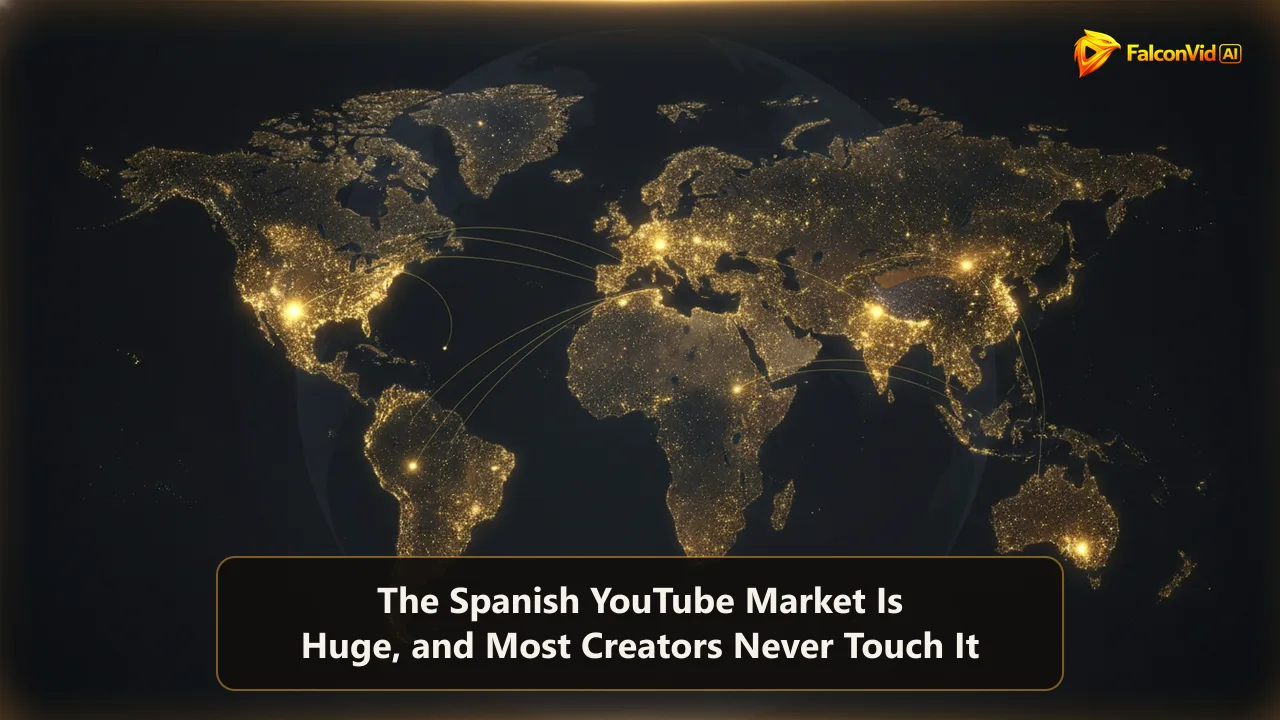
How big the Spanish YouTube market really is
Spanish is the second most spoken native language on the planet, with roughly 500 million native speakers and close to 600 million once you count second language speakers. On YouTube it sits consistently among the top three content languages by watch time. The spanish youtube market is not a niche you are entering, it is one of the largest audiences that exists, spread across twenty countries and one enormous diaspora, and most creators outside it never bother to look.
Mexico is the anchor. It is one of the biggest YouTube markets on earth, with an estimated eighty million plus users and some of the highest average watch time per person anywhere. A hit video in Mexico can pull the kind of view counts that would take a mid size English channel years to reach. Volume like that changes the math, because even a modest per view rate multiplied by tens of millions of views turns into real monthly income.
Beyond Mexico the map keeps giving. The United States has more than sixty million Hispanic residents, Colombia around fifty two million people, Argentina roughly forty six million, Spain about forty seven million, and then Peru, Chile, Ecuador and Venezuela. No other single content language, except English, hands you this many countries at once. You narrate in one language and you are eligible for an audience that spans two continents plus a wealthy diaspora in the north.
- Around 500 million native Spanish speakers, close to 600 million total worldwide
- Spanish ranks among the top three content languages on YouTube by watch time
- Mexico is one of the largest YouTube markets on earth, roughly 80 million plus users
- The US alone has more than 60 million Hispanic residents
- Colombia, Argentina and Spain each add 45 to 52 million people
- One language, twenty plus countries, and a wealthy diaspora in the United States
The RPM truth: what a Spanish view is actually worth
RPM is the number that matters, and it is not CPM. RPM is what actually lands in your account for every thousand views after YouTube keeps its roughly forty five percent cut. Here is the honest part most guides skip: Spanish language RPM in Latin America is generally lower than United States English, often sitting in a rough one to four dollar range. That gap is real, and pretending otherwise only sets you up for disappointment.
The reason is not the language, it is the advertisers. Ad budgets, local buying power and currency all feed the auction that sets your rate. A car brand pays more to reach a viewer in California than one in Lima, so the bids in Latin America come in lower. Chile and Uruguay tend to sit at the top of the regional band, while Argentina and Peru often sit near the floor because of currency and macro pressure.
Now the good news. Not every Spanish view is a Latin American view. When a person watches your Spanish video from inside the United States, you get close to United States rates, roughly four to twelve dollars RPM depending on niche. Spain sits in between, often three to seven dollars. The audience location decides the payout far more than the language does, and that single fact is the whole strategy in this article.
- RPM is post split earnings per 1000 views, not the higher CPM advertisers pay
- Latin American Spanish RPM is honestly lower, roughly $1 to $4 in most niches
- US based Spanish viewers can pay near US rates, roughly $4 to $12
- Spain usually lands in between, around $3 to $7
- Advertiser budgets and local buying power set the rate, not your effort
- Audience location, not language, is what decides the payout
Country by country: the approximate 2026 numbers
The table below uses approximate 2026 RPM ranges, blended across niches and reported after YouTube's cut. Treat them as bands, not promises, because a finance channel and a kids channel in the same country can differ by five times. Still, the shape is stable year after year, and it tells you exactly where to point a new channel if raw payout per view is what you care about most.
At the top for Spanish content sits the United States Hispanic audience, near four to twelve dollars, followed by Spain around three to seven. Chile lands near two to four, helped by higher income. Then the volume giants: Mexico around one to three, Colombia one to three, Argentina under one to about two and a half, and Peru roughly one to two and a half. These are ranges, and your niche can push you above or below them.
The lesson from the table is not to chase the highest single number. It is to understand your blended RPM, the weighted average across everyone who actually watches. A channel with eighty percent Mexican views and twenty percent United States views earns far more than its Mexican rate alone suggests. Design your topics so a healthy slice of your audience sits in the high paying regions, and your effective rate climbs without a single extra video.
Blended RPM is also an argument for more than one channel. A single upload cannot chase Mexico and the United States Hispanic audience with different titles and different thumbnails, but two channels can. In FalconVid a channel is its own object, with its own calendar, its own identity and its own publishing targets, and how many you can hold is a line on the plan: 1 on Starter, 5 on Pro, 10 on Business, 25 on Agency and 50 on Scale. They also generate at the same time instead of taking turns, so pointing a second channel at the higher paying half of the market costs credits rather than evenings.
- US Hispanic (Spanish): approx $4 to $12 RPM, 60 million plus potential viewers
- Spain: approx $3 to $7 RPM, around 47 million people
- Chile: approx $2 to $4 RPM, close to 19 million people
- Mexico: approx $1 to $3 RPM, 80 million plus YouTube users
- Colombia: approx $1 to $3 RPM, around 52 million people
- Argentina: approx $0.80 to $2.50 RPM, roughly 46 million people
- Peru: approx $1 to $2.50 RPM, around 34 million people
Where the money actually is in Spanish
The first place the money hides is the United States Hispanic audience. More than sixty million people, Spanish preferred or bilingual, watching from a country where advertisers pay premium rates. Make content that speaks to their reality, life, work, money and culture inside the US, and a large share of your views arrive at United States RPM even though every word is in Spanish. That single targeting choice can triple your effective rate.
The second place is niche selection. RPM varies more by topic than by country. Personal finance, investing, business, software, insurance and technology draw advertisers with deep pockets in any language, and Spanish is no exception. A Spanish finance channel with a United States and Spain heavy audience can see RPM in the high single digits or above, while a Spanish entertainment channel with a Latin American audience might sit near a dollar. Pick the niche before you pick the language.
The third place is pure volume. Latin American views are cheaper per thousand, but they arrive in floods that English creators rarely see. Ten million cheap views can beat one million expensive ones, and the region rewards consistency generously. Add the buying power of the United States Hispanic market, estimated near three point four trillion dollars a year, and you have an audience that is both enormous and, in the right niches, genuinely wealthy.
Picking that niche is the part worth handing to data instead of instinct, because it moves your RPM more than the country does. The Spy and the channel modeler inside FalconVid read what already monetizes in a niche and extract the pattern, so you start from a format that is already earning in that market rather than guessing which Spanish finance angle happens to work. You do not begin from zero, you begin from what is already making money, and in a market this large that shortcut is worth more than any thumbnail trick.
- Target US based Spanish speakers to earn near US RPM on Spanish content
- Niche beats country: finance, tech and business pay well in any language
- A US and Spain heavy finance channel can reach high single digit RPM
- Latin American views are cheap but arrive in huge, consistent volume
- Ten million low RPM views can outearn one million high RPM views
- US Hispanic buying power is estimated near $3.4 trillion per year
The competition is thinner than English, for now
English YouTube is a knife fight. Almost every evergreen topic has a dozen polished channels with years of head start and huge budgets. Spanish is not there yet. In many of the same niches the Spanish results are thinner, older or simply missing, which means a well made new channel can rank and grow in months rather than years. The barrier that stops most creators is the language, and that barrier is now optional.
This is a real first mover edge in 2026, not a slogan. Whole categories that are brutally saturated in English, from finance explainers to history documentaries to product reviews, still have room in Spanish. You are not inventing demand, the audience already searches for these topics daily. You are simply meeting a demand that far fewer creators bother to serve, because they assumed the payout was too low to matter.
That window will not stay open forever. Every year more creators notice the gap, and the easiest niches fill first. The advantage belongs to whoever plants a flag while the search results are still thin. If you already have a proven format in English or Portuguese, the fastest move available to you right now is to bring that exact format into Spanish before the person in the next niche over does it first.
That optional barrier has a price, and it is now small. In FalconVid the narration runs in 63 languages with ultra realistic voices, and you duplicate an existing project into Spanish paying only the difference instead of producing the whole thing again. The moat that has kept most creators out of these search results is a moat you cross for a fraction of a new video. The window narrows for everybody at the same speed. What actually changed is how cheap it became to walk through it while it is still open.
- English niches are saturated with well funded, long established channels
- The same Spanish niches are often thinner, older or missing entirely
- A good Spanish channel can rank in months, not years
- Finance, history and reviews still have real room in Spanish
- The language barrier is the moat, and it is now optional
- The first mover window narrows every year, so timing matters
Who should target Spanish, and who should wait
If you already run a working channel in English or Portuguese, you are the ideal candidate. Your format is proven, your research process exists, and Spanish simply opens a second door onto the same building. Evergreen niches travel best: finance, history, science, tech, health, true crime and self improvement need almost no local rewriting to work across borders. If your topic is universal, Spanish is close to free money waiting to be collected.
The creators who gain the most are the ones willing to duplicate rather than reinvent. You do not need a new idea, you need your existing idea in a second language. A channel that earns in English can run a Spanish twin that targets the United States Hispanic audience for the high rate and the Latin American audience for the volume, doubling reach off a format you already trust, with almost no extra creative work.
Who should wait? Anyone whose content is deeply tied to English language wordplay, local slang, or a hyper specific national culture that does not translate. Comedy built on puns is a hard sell in any second language. Everyone else, and that is most informational and evergreen creators, should treat Spanish as a first choice for expansion. Neutral Latin American Spanish is widely understood, so you rarely need a separate version per country.
Duplicating rather than reinventing is precisely what the tooling now does for you. In FalconVid you duplicate the project into Spanish and pay only the difference, choose the narration language from 63, and the twin gets its own channel: its own calendar, its own Channel DNA holding format, voice and visual style steady, and its own title, description and tags written in Spanish rather than translated from yours. The two channels produce side by side, so the Spanish one is never waiting on the English one, and the creative work you already trust stays exactly where it is.
- Best fit: existing English or Portuguese creators with a proven format
- Evergreen niches travel best: finance, history, science, health, true crime
- Duplicate the idea you already trust instead of inventing a new one
- Run a Spanish twin for both US RPM and Latin American volume
- Weak fit: pun heavy comedy or hyper local national culture
- Neutral Latin American Spanish covers most countries in one version
The duplication play, and how FalconVid runs it
The duplication play is simple: take a channel that already works and clone it into Spanish to capture a second audience for very little extra effort. The old blocker was labour, because a human team would have to re research, rewrite, re narrate and re edit every video. That is why so few creators did it, and why the Spanish results are still thin. Automation removes exactly that blocker, which is what makes the play viable now.
FalconVid is built for this. It generates faceless videos and publishes them automatically, and it can duplicate a channel into another language with narration available in sixty three languages, Spanish included. It publishes to five networks: YouTube, Instagram, TikTok, Rumble and Facebook. You set which days you post, how many videos per day, and the exact publishing time. You approve the calendar once per language, and the pipeline builds each video ahead of its slot and publishes it.
The economics fit the strategy, and they turn on the quality mode rather than the plan. A 12 minute video costs 1,584 credits in economy, 9,000 in balanced and 27,084 in premium. Starter includes 15,000 credits and one channel: 9 videos if you stay in economy, or around 4 a month once the one that matters moves up to balanced. Nobody runs a month on a single mode, so plan for the mix. A Spanish twin living on its own channel is a Pro question, with 30,000 credits, 5 channels and 5 concurrent generations, and the ladder runs to Scale with 50 channels and 50 concurrent generations.
Every creation feature comes with every plan, from the calendar and the video SEO to karaoke subtitles, automatic 9:16 Shorts, automatic comment replies and 4K: what you buy as you climb is volume, concurrency, channels, the AI Senior Analyst from Pro up with a 7 day trial on Starter, and support. If a Spanish cut lands wrong, the Studio lets you shorten the intro, swap media or change the music before it publishes. There is a free plan with 4 videos a month and no card.
So the honest ending has two versions. Done by hand, the Spanish market stays exactly where it is: a huge audience behind a language you would have to research, rewrite, narrate and edit again, which is why the search results have stayed thin for years and why that ceiling stops almost everyone. Duplicated through a pipeline, the same market is a second calendar on a second channel paying only the difference, produced in parallel with the first one. Approve one calendar for your original language, approve another for Spanish, and the thin search results become an opportunity you can actually act on rather than one you keep reading about.
- The play: clone a proven channel into Spanish for a second audience
- FalconVid generates faceless videos and publishes them automatically
- Duplicate a channel into another language, narration in 63 languages
- Publishes to YouTube, Instagram, TikTok, Rumble and Facebook
- You set the days, the count per day, and the exact publish time
- Approve one calendar per language, the pipeline builds each video ahead of its slot
- Duplicate a project into Spanish and pay only the difference, not a new video
- Starter with 15,000 credits: 9 economy videos, or about 10 to 12 mixing modes
- Pro with 30,000 credits and 5 channels, one per market, generating in parallel
- Every creation feature on every plan, AI senior analyst from Pro with 7 free days on Starter, free plan with 4 videos a month and no card