
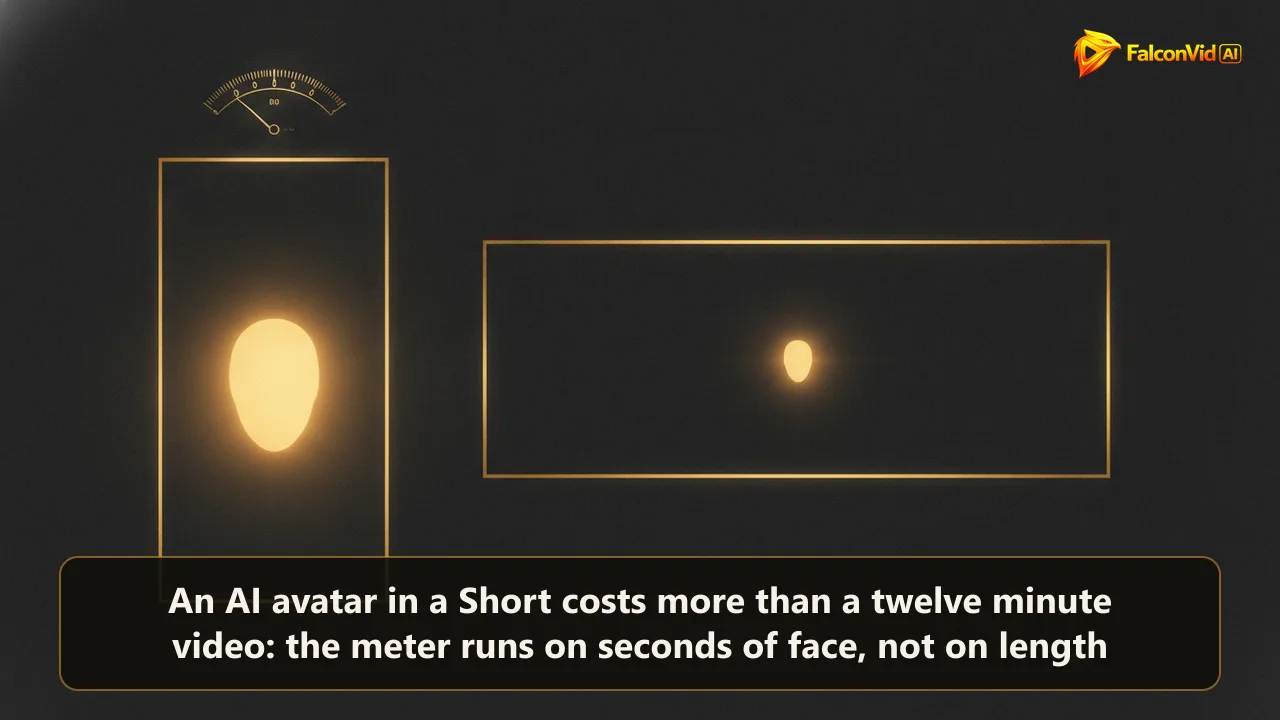
The avatar meter runs on seconds of face, not on videos
Every other piece of a video is priced by the video. Research and script are one flat charge of 307 credits whether the script runs six minutes or twenty. Narration is priced per minute of finished video, 3 credits a minute in economy mode and 24 in premium, which means a twelve minute video pays 36 or 288 and that is the end of it. Images are per image, the thumbnail is one charge, the render is one charge. You can predict all of it from the runtime.
Lip sync does not work like that. It is billed per second of face on screen, and the engines have very different meters: Kling Avatar Standard is 32 credits a second, Kling Avatar Pro is 64, HeyGen Avatar is 80 and OmniHuman 1.5 is 112. Nothing else in the pipeline behaves this way. Ten seconds of avatar is a real line on the bill, sixty seconds is a serious one, and twelve minutes of it is a different product entirely.
The consequence people miss is the one that decides their month. A second narrator voice costs zero extra, because narration is priced by minute of video and not by voice. A second face costs full price, because each visible face runs its own meter. Voices are free to add, faces are not, and that single asymmetry is the whole economics of AI avatars in short form. It is also why buying an avatar studio plan by the minute rarely fits a channel, as the avatar studio versus channel math shows month by month.
The sixty second Short, with the bill on the table
Take the format everybody wants: a vertical video, sixty seconds, an AI avatar talking straight into the camera from the first frame to the last. On Kling Avatar Standard, the cheapest engine of the four, that is 60 seconds times 32 credits, which is 1,920 credits. On Kling Avatar Pro it is 3,840. On HeyGen it is 4,800. On OmniHuman 1.5 it is 6,720.
Now put a twelve minute long video next to it. In economy mode a twelve minute video costs 1,584 credits, complete: research, script, narration, images, thumbnail, render, the lot. So the sixty second Short with a full talking head costs 1.9 times an entire twelve minute video. One minute of vertical face is worth almost two whole long videos, and the long video is the one that carries the qualified public watch hours the 2027 monetization ruler asks for.
The ratio does flip when you climb the quality modes, and it is honest to say so. A twelve minute video in balanced mode is 9,000 credits and in premium it is 27,084, so against those the 1,920 credit Short looks cheap. But almost nobody produces a daily Short pipeline in premium. The comparison that decides real calendars is the economy long video against the full face Short, and there the Short loses by nearly two to one.
Why Shorts are the worst case, and it has nothing to do with being short
The intuition that a shorter video should cost less is correct for every piece except this one. What drives the avatar bill is not the runtime of the video, it is the share of that runtime in which a face is visible. Once you look at it that way, the Short stops being a small video and becomes the densest possible face format.
Do the comparison properly. A twelve minute long video is 720 seconds. Put 90 seconds of avatar in it, spread across the hook, a transition, the verdict and the close, and the face occupies 12.5 percent of the runtime. The bill is 1,584 for the video plus 2,880 for the face, 4,464 in total, and the face is already 74 percent of it at only an eighth of the screen time. Now the Short: 60 seconds of runtime, 60 seconds of face, 100 percent occupancy. Eight times the density.
That is the rule to carry around. The avatar is not expensive because of the format, it is expensive in proportion to how much of the runtime shows a face. A ten hour video with 30 seconds of avatar costs 960 credits of face. A ten second Short that is all face costs 320. Length is irrelevant, occupancy is everything, and the vertical format pushes occupancy to its ceiling by design. In FalconVid the presenter is a setting on the project, so this is a number you decide before generating rather than discover afterwards.
The four doses of face that fit inside sixty seconds
The way out is not to drop the avatar, it is to stop treating it as a background that runs for the whole video. A face earns its keep at the moments where a human presence changes the viewer's decision, and those moments are short and identifiable. Everywhere else, generated scenes, motion and captions do the same job for a fraction of the price.
Four doses cover almost every vertical script. The hook, about 5 seconds, where a face establishes that a person is talking to you and not a slideshow. The turn, about 4 seconds, at the point where the argument changes direction and the viewer is deciding whether to stay. The verdict, about 4 seconds, where the payoff is delivered and credibility matters most. The close, about 2 seconds, the ask. That is 15 seconds of face out of 60.
Fifteen seconds on Kling Avatar Standard is 480 credits instead of 1,920. Same script, same voice throughout, same length, one quarter of the avatar bill, and the other 45 seconds are covered by generated scenes and karaoke captions, which are on in every plan and do not carry a credit line of their own because they are part of the render. The face went from wallpaper to punctuation, which is also what it should be doing editorially.
- Hook, around 5 seconds: a face proves a person is speaking, not a slideshow
- Turn, around 4 seconds: where the argument changes direction and the viewer decides
- Verdict, around 4 seconds: the payoff, where credibility is worth the most
- Close, around 2 seconds: the ask, short enough that nobody swipes on it
- The remaining 45 seconds: generated scenes, motion and captions, no face meter running

The month, with two calendars side by side
One Short a day is the cadence most people try first, so run the arithmetic on it. Thirty Shorts a month with a full sixty second talking head is 30 times 1,920, which is 57,600 credits spent on face alone, before a single long video exists. Pro carries 30,000 credits a month, so this calendar does not fit inside it at any point. Business carries 95,000, so the daily talking head Short would eat 61 percent of the plan and leave the rest for everything else the channel needs.
Now the dosed calendar. Thirty Shorts a month at 15 seconds of face each is 30 times 480, which is 14,400 credits. That fits inside Starter with 15,000 credits a month, though realistically the Starter month is around 4 videos mixing economy with one in balanced, so a channel running both formats sits better on Pro. On Business, the same dosed Shorts calendar takes 15 percent of the plan instead of 61, and the remaining 80,600 credits pay for roughly 80 long videos in economy mode.
The gap between those two calendars is 43,200 credits a month, which is not a rounding difference, it is the difference between a plan that works and a plan that runs out on the twentieth. And the dosed version is usually the better video anyway, because a face that appears at four decision points reads as deliberate while a face that never leaves the screen reads as a webcam recording.
The three cases where a full talking head Short is worth its 1,920 credits
There are formats where the face is not decoration, it is the product, and cutting it to fifteen seconds would destroy the thing people came for. Advice delivered in first person is the clearest: personal finance, coaching, legal or health explainers, anything where the viewer is weighing whether to trust the speaker. In those niches the face is the evidence, and 1,920 credits buys the only version of the video that works.
The second case is paid creative. A UGC style ad, a hook test for a campaign, a product demonstration where somebody holds and reacts. There the Short is not competing with your other Shorts on cost per view, it is competing with hiring a creator, a studio and a shoot day, and against that comparison 1,920 credits for a finished sixty second creative is not close. Testing six hooks at 1,920 each is 11,520 credits, which is less than one hour of an editor.
The third is the anchor piece: the channel trailer, the pinned Short, the introduction that a new visitor watches before deciding to subscribe. You produce it once, it sits at the top of the channel for months, and it is the one place where paying full price for a face that never leaves the screen is obviously correct. Everywhere else on the calendar, doses win.
Deciding the avatar before you generate, not after the bill
The reason this gets expensive in practice is almost never a bad decision, it is an invisible one. Somebody sets a presenter on a project, produces thirty Shorts, and only sees the shape of the spending at the end of the month. Deciding the number of seconds of face up front is what turns the avatar from a surprise into a line you control, and it is a thirty second decision per project.
In FalconVid the presenter and the lip sync engine are settings on the project, and the budget for a video is quoted from the real engine before generation rather than estimated afterwards, so the seconds of face you chose are visible while you can still change them. Voices are separate from faces, so a script with two characters can have two distinct voices at no extra cost while only one of them is ever on screen. If version one comes back with the face in the wrong place, fixing the piece in the Studio costs 5 to 320 credits, against 1,584 to 27,084 to regenerate the video.
The rest of the pipeline is the part that makes a daily vertical calendar survivable at all. AI specialists work in parallel, a researcher, a scriptwriter, a narrator, an editor and a sound designer at the same time, with a video ready in up to 30 minutes and simultaneous generations going from 2 on Starter to 50 on Scale. You approve a calendar once and the videos leave on their slot, on YouTube, Instagram, TikTok, Rumble and Facebook, in up to 63 languages. The avatar becomes a deliberate ingredient in that calendar instead of the thing that quietly consumed it.