Why French: 396 million speakers, four markets that pay well
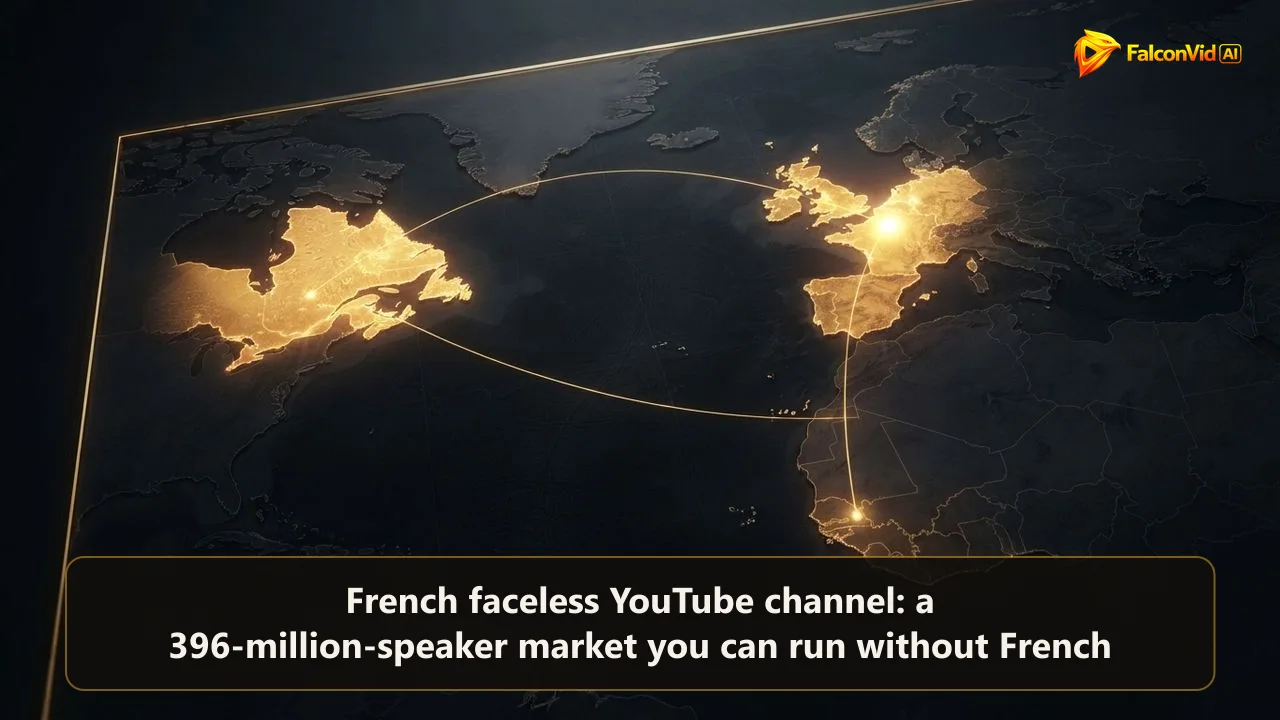
The 2026 report of the Observatory of the French Language, from the International Organisation of La Francophonie, counts 396 million French speakers and ranks French as the world's 4th language. Part of the jump from 321 million in 2022 comes from a method change that started counting children aged 6 to 9 schooled in French, but the order of magnitude holds: it is one of the largest audiences reached by a single narration language.
What matters for monetization is how that audience splits. About 65% of French speakers live in Africa, with low RPM and huge volume. The rest sits in four markets that pay well: France, with about 68 million people and 63 million internet users according to DataReportal, Quebec and French-speaking Canada, Belgium and French-speaking Switzerland. A French channel sells to both audiences with the same video.
Google does not publish RPM, what the channel keeps per thousand views, and observed ranges vary a lot by niche. Canada sits in the top tier at about 3 to 10 dollars, next to the UK, Australia and Germany, and France usually lands below Germany and above Spain and Italy, in an observed range near 2 to 6 dollars. How country and language add up across a portfolio of channels is laid out on the multilingual YouTube channel page.
The competition picture: France, Quebec and the African audience
In English, almost every faceless niche has dozens of channels posting every day. In French, many of those niches have few serious players, and much of the French-speaking audience ends up watching in English with captions or through auto-dubbing. It is the same gap that made German an interesting second market, and the comparison with that case is in German faceless YouTube channel.
French has an edge German does not: the same video serves markets with very different RPM. A finance video in France's French can earn like a European video in France and Switzerland, and still pick up views in Ivory Coast, Senegal and Cameroon, which pay less per view but add watch hours. For the 8,000-hour bar, an African view counts exactly like a Parisian one.
Thinner competition is a hypothesis to check, not a promise. In FalconVid the Spy runs that sweep in any language: it shows the videos that broke out above each channel's median, with channel age, posting rhythm and estimated revenue. By hand, comparing one niche in two languages means opening 20 to 40 channels and building a spreadsheet, one or two days per niche. With the Spy it is an afternoon for three niches.
Running a French channel without speaking French: the honest version
You can run a French channel without speaking French, as long as production is native and the operator knows where the traps are. The audience does not care who owns the channel. It cares whether the narration sounds natural, whether the numbers are right and whether the thumbnail looks made for them. The full checklist for that logic, applied to English, is in English YouTube channel as a non-native speaker.
What does not work is the shortcut: a script pushed through a free translator, a robotic voice, a title that reads like a translation. French viewers are known for being demanding about their own language, and they notice in seconds. Retention drops before the first minute, and the video does not get pushed.
In FalconVid the French version is not a translation pasted over another video. The script is written in French, the narration is generated with ultra-realistic premium French voices, and title, description, tags and thumbnail text come out in French within the same production. The word-for-word title is the most common mistake, and why it kills reach is in translating YouTube titles and descriptions.
Six language traps that give away non-native operators
Each mistake below is small, and each one costs retention in the first minute, the minute that decides whether the video gets recommended. Listen to the first video end to end before scaling, and check these six points closely.
- Billion is a trap. English billion is milliard in French, and the French billion means a million million. A finance script that keeps the English word inflates the number a thousand times.
- Large numbers use spaces: 1 000 is a thousand, 2,5 is two and a half, and symbols come after with a space, 15 % and 10 €. A chart in American formatting looks foreign.
- 70, 80 and 90. In France they are soixante-dix, quatre-vingts and quatre-vingt-dix. In Belgium and Switzerland, septante and nonante, and part of Switzerland says huitante. AI voices still trip on numbers above sixty: listen to every number in the script.
- Tu or vous. Addressing the audience as vous works in any niche; tu is common on young channels. Pick one per channel and never mix them in a video.
- Sentence case titles. French does not capitalize every word the way English titles do, and a Title Case title reads as a translation. French typography in France also puts a space before colons, question marks and exclamation marks, and uses « these » quotes.
- France or Quebec. Standard French is understood in both, but vocabulary shifts: week-end and e-mail in France, fin de semaine and courriel in Quebec. Pick the main market and keep its vocabulary.

French law: sponsorships, virtual images and the EU representative
France has one of the most detailed laws in the world on commercial influence, law 2023-451 of June 9, 2023, aligned with EU law by an ordonnance of November 6, 2024. It does not target a channel that lives only on YouTube ads. It kicks in when the channel promotes a product or service in exchange for payment or a benefit: a sponsorship, an affiliate link, a product received.
In that case three rules catch foreign operators by surprise. Sponsored content must carry the mention Publicité or Collaboration commerciale, clearly. An AI-generated image of a face or body in promotional content calls for the mention Image virtuelle, and a retouched one calls for Image retouchée; enforcement is by the DGCCRF, and the fines cited reach 300,000 euros. And anyone doing commercial influence for the French public from outside the European Union must appoint a legal representative in the EU and hold civil liability insurance there.
None of these rules is a reason to skip the market. They are a reason to separate the ad-revenue channel from the sponsored one, and to check with a local adviser before signing the first deal with a French brand. On YouTube, apart from the law, realistic AI-generated content still needs the altered or synthetic content disclosure in Studio, in any language.
What FalconVid does for a French channel
FalconVid produces and publishes faceless videos on autopilot in 63 languages, and French is one of them. You approve a calendar of topics, and the AI specialists work in parallel: the researcher gathers facts before the script, the scriptwriter writes in French for retention, the narrator reads with ultra-realistic premium voices or your own cloned voice, the editor assembles the scenes and the sound designer adds music and effects. A 12-minute video is ready in up to 30 minutes.
The fastest path into French is not a channel from scratch. If you already have a project that works in English, Spanish or Portuguese, you duplicate it into French and pay only the difference. The angle, the research and the structure carry over; what gets generated again is the part that changes with the language. The step-by-step for opening a second language, from niche to calendar, is in the multilingual YouTube channel guide.
Each channel keeps its own identity through the channel DNA: voice, tone, palette and thumbnail style, including the tu or vous choice. Each has its own calendar in the market's time zone, so the French channel goes out at 6 p.m. in Paris or 6 p.m. in Montreal, never at 6 p.m. where you live. The Studio lets you fix any stretch of the first version, for instance a number read the Belgian way on a channel for France, without remaking the video.
- Duplicate an existing project into French, paying only the difference.
- Script written in French, not translated line by line.
- Narration with ultra-realistic premium French voices, or your own cloned voice.
- Title, description, tags and thumbnail text in French as part of the video's SEO.
- Calendar in the Paris or Montreal time zone, depending on the main market.
- Karaoke captions in 15+ styles, 4K thumbnail and 9:16 Shorts.
- Publishing to YouTube, Instagram, TikTok, Rumble and Facebook, with automatic replies to comments in French.
The math: by hand, outsourced and on autopilot
By hand, the French version of a 12-minute video starts with a script of about 1,800 words. Professional translation usually runs 0.10 to 0.15 euros per word, or 180 to 270 euros. A native voice actor for 10 to 12 minutes usually charges 150 to 400 euros. Add 2 to 4 hours to rebuild the edit on the new audio and a new thumbnail: 330 to 670 euros per video before the editor's hours. At 15 videos a month, over 5,000 euros, which is why most creators never open the second market.
On autopilot, the scale is the 12-minute video at 1,731 credits in economy, 4,597 in balanced and 16,131 in premium. A French channel with 15 videos a month in economy uses 25,965 credits, which fits Pro, with 30,000 credits, 5 channels and 5 simultaneous generations. An English channel and a French one with 15 videos each use 51,930 credits, inside Business, with 95,000 credits and 10 channels. That math charges each French video at full price; duplicating the project costs less.
Starter, with 15,000 credits, 1 channel and 2 simultaneous generations, runs 8 videos in economy or 3 in balanced, enough to test French as your only channel. Pro adds the dedicated server and the AI Senior Analyst, who reads your account and writes every 2 days. Agency, with 190,000 credits and 25 channels, runs 109 videos in economy, and Scale, with 320,000 credits and 50 channels, runs 184. The monetization door is the same in any language: 4,000 hours today, 8,000 for anyone joining from February 1, 2027.
A 90-day plan to open the French market
Month 1: pick the niche and the market with data. Use the Spy to compare the niche in English and French, and decide whether the main target is France or Quebec, because that sets vocabulary, time zone and thumbnail. Finance, tech, history, science and true crime are the usual candidates. Set the voice and the tu or vous choice in the channel DNA.
Month 2: publish on a steady rhythm and read the right numbers. In YouTube Analytics, check the percentage viewed in the first minute and RPM by country. If Belgium, Switzerland and Canada show up next to France, the narration is landing as native. If French-speaking Africa dominates the views, the channel is earning hours, and the next step is pulling topics that European advertisers pay more for.
Month 3: duplicate the winners. The topics that held retention best in another language go into French first, paying only the difference. By hand, this plan is a second production line in a language you do not speak. On autopilot, it is one more channel producing at the same time as the first, and the number of markets you run stops depending on your hours. The plans, and the free plan to try the platform, are on the FalconVid home page.