
What this guide gives you, and what it does not
By the end of this page you will know how to find channels that are already making money, how to read every number that matters about them, how to turn one of those formats into a channel of your own, and what YouTube actually requires before it pays you. No fluff, no vague motivation, real numbers throughout.
What this guide will not do is promise you money in thirty days. Monetization has hard thresholds that no tool skips, and any page telling you otherwise is selling something. What automation genuinely changes is how much you can build in the months before those thresholds arrive, and how good the result looks when it does.
Read it in order the first time. Sections four through six teach you to read the tool, section seven does the money math, section eight is the step by step to get in, and everything after that is execution: niche, consistency, credits, monetization and scale.
- How to read a screen of channels that are already monetized
- What each metric on a channel card actually means for your decision
- The honest math behind a twenty thousand dollar month
- The step by step from zero to inside the tool
- The AdSense and monetization rules as they stand in July 2026
- Why low effort AI content stopped working, and what replaced it
The legitimate shortcut: copy the format, never the content
Every serious creator studies what works before making anything. The difference between modeling and stealing is precise and worth stating clearly: format is fair game, content is not. Structure, pacing, thumbnail logic, video length, the type of hook and the emotional promise are the format. The exact script, the exact footage, the exact voice, those belong to whoever made them.
This distinction is not a legal technicality, it is the whole strategy. If you copy content you get a copyright claim and a channel that dies. If you copy format you get a proven demand curve with your own angle on top, which is exactly what every successful channel in any niche has always done.
The reason this matters here is that a tool showing you winning channels can be used either way. Used well, it removes guesswork about what an audience wants, and leaves you free to be original where originality actually pays: the angle, the market, the language and the depth.
- Format is copyable: structure, pacing, length, hook type, thumbnail logic
- Content is not: script, footage, voice, specific creative work
- Copying content gets you a claim and a dead channel
- Copying format gets you proven demand with your own angle
- Originality pays most in the angle, the market and the depth
What a faceless channel is, and the myth that AI video cannot be monetized
A faceless channel is a channel where the creator never appears on camera. The narration, the visuals and the editing carry the value instead of a personality. It is not a loophole and it is not new. Documentary channels, explainer channels, top ten channels, news channels and meditation channels have worked this way for over a decade.
Now the myth. You have read that YouTube does not monetize AI videos. That is not what the policy says. What is not eligible is content without meaningful originality or value, mass produced or repetitive, regardless of the tool used to make it. A camera does not make you eligible and a generator does not disqualify you. The judgement is on the work, not on the software.
The proof is on the screen in the next section. Channels created two to four months ago, marked as monetized, pulling tens of thousands of views per video. They exist right now, they were made with modern production pipelines, and they are being paid. What separates them from the ones that fail is covered in the barrier of entry section further down.
- Faceless means the creator never appears, not that the channel has no author
- The policy targets content without originality or value, not the tool
- Mass produced and repetitive is the disqualifier, generated is not
- Realistic synthetic content should be disclosed at upload
- Monetized faceless channels created months ago are visible in the tool
Inside the FalconVid Selection screen
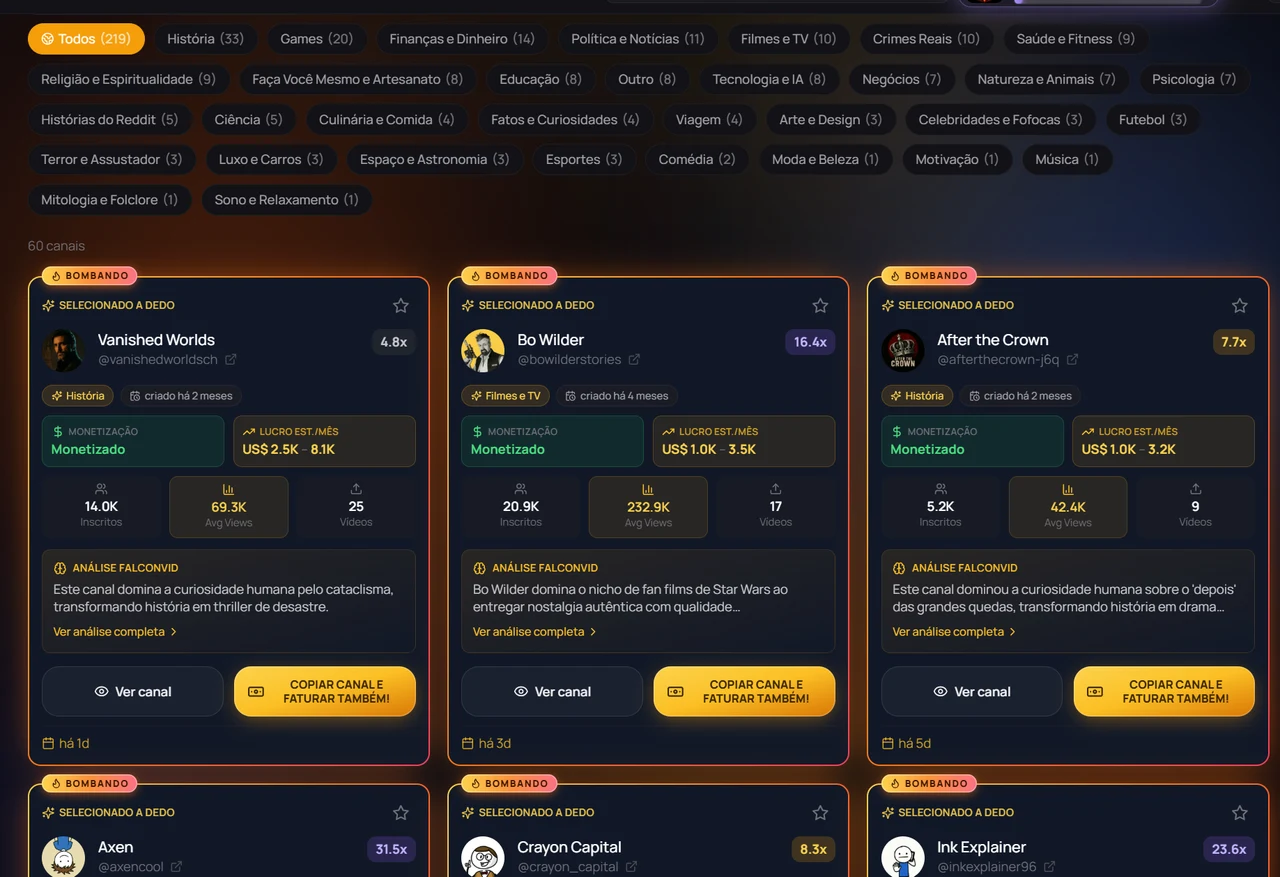
This is the screen the whole guide revolves around. It is the curated tab of FalconVid Spy, and everything on it was chosen by hand. Not scraped in bulk, not sorted by an algorithm alone: every channel there was reviewed, classified and approved before appearing, and the list is refreshed daily.
At the top you have the niches, each with its own count, so you immediately see where the volume is. History, Games, Finance and Money, Politics and News, Movies and TV, True Crime, Health and Fitness, and so on down to the small ones. Clicking a niche filters the grid instantly, which means your first decision, the market you want to be in, takes about five seconds.
Below that comes the grid of channels. Two badges are worth understanding immediately. Trending marks a channel with unusual momentum right now, and Hand Picked marks it as part of the curated selection rather than a raw search result. Both are quality signals, and together they mean somebody looked at this channel and decided it was worth your time.
- Curated tab of FalconVid Spy, refreshed daily
- Every channel reviewed and classified by hand before it appears
- Niche filters at the top, each showing how many channels it holds
- Trending badge means unusual momentum right now
- Hand Picked badge means the channel passed human curation
Reading a channel card, number by number
Take the first card in the screenshot. Vanished Worlds, History niche, created two months ago, marked Monetized, estimated profit between two and a half and eight thousand dollars a month, fourteen thousand subscribers, sixty nine thousand average views, twenty five videos published. Every one of those fields answers a different question, and reading them together is the actual skill.
The multiplier in the corner is the one most people misread. Four point eight times means the channel gets roughly that many times more views than its subscriber count would predict. It is a measure of how far the content travels beyond the people who already follow it, which is precisely what you want to copy. A channel with sixteen times is being pushed hard by the recommendation system, not by its own audience.
The age field is the one that changes how you feel about all the rest. Created two months ago, twenty five videos, already monetized and already earning. That combination tells you the niche has open demand right now, not five years ago, and that the format works from a standing start rather than requiring a decade of accumulated trust.
- Monetization status: confirmed by ads, memberships or Super Thanks on the channel
- Estimated monthly profit: calculated from niche RPM over the last 30 days of views
- Subscribers, average views and video count: the shape of the channel
- The multiplier: how far the content travels beyond its own subscriber base
- Above 5x is an outlier, above 15x is heavy recommendation push
- Channel age: proves whether the demand is open right now
FalconVid Intelligence: the why behind a winning channel
Every curated card carries a short verdict and a link to open the full analysis. This is where the tool stops being a list of channels and starts being a teacher, because raw metrics tell you that something works and never tell you why. The panel breaks the channel into the five things you actually need in order to reproduce it.
The trend is the underlying human interest being served. The format is how that interest is packaged, for example cinematic documentary building tension with cold facts. The market is who watches and what they came for. The niche assessment tells you how crowded or open that specific corner is. And the last block, why it worked, names the single creative decision that made the difference.
Under that sits the channel's most hyped video with its views per hour, which is the fastest read of momentum available anywhere. Views per hour, not total views, because a video with half a million views accumulated over a year is history, while the same number accumulating at eight hundred views per hour is a live wave you can still ride.
- Trend: the human interest the channel is serving
- Format: how that interest is packaged and paced
- Market: who watches and what they came for
- Niche: how crowded or open that specific corner is
- Why it worked: the one creative decision that made the difference
- Most hyped video with views per hour, the cleanest momentum signal

The math of twenty thousand dollars a month
Use the tool's own estimates rather than imagination. On the screen above, one channel is estimated between two and a half and eight thousand dollars a month, another between one and three and a half thousand, a third between one and three point two thousand. Those are ranges produced from niche RPM applied to the last thirty days of views, and they are estimates, not guarantees.
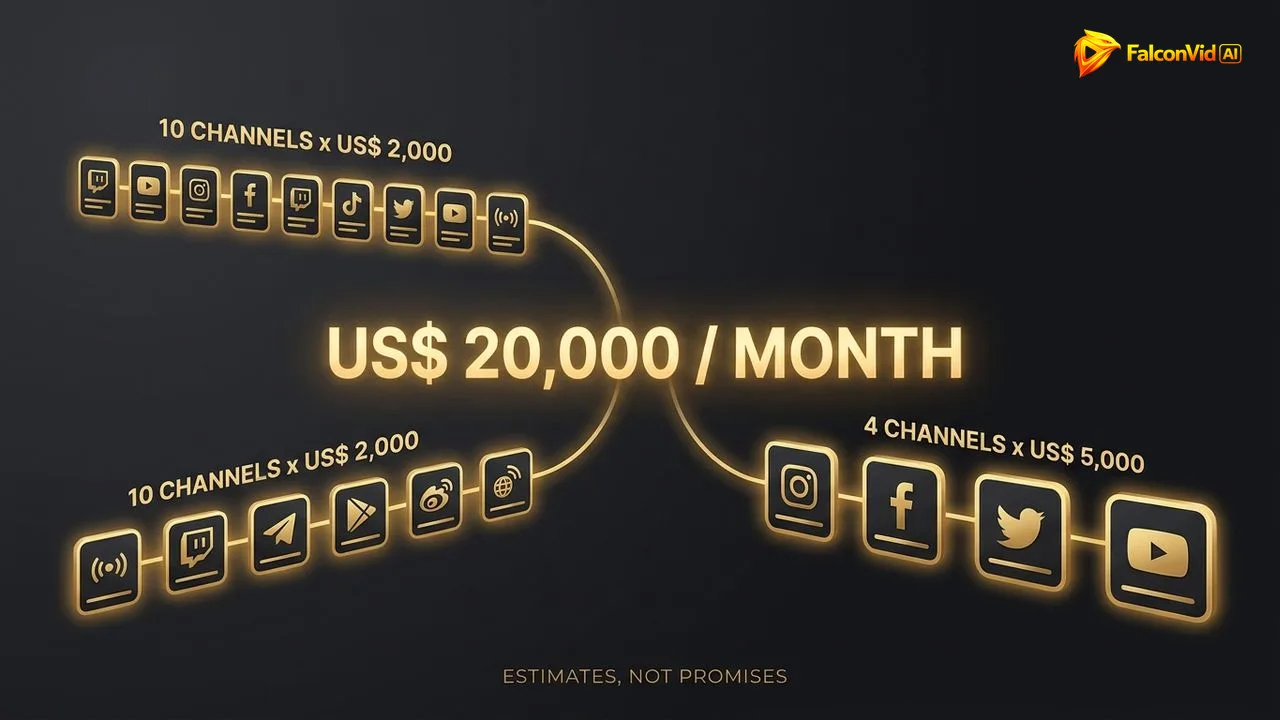
Take a deliberately conservative midpoint of two thousand dollars a month per established channel. Twenty thousand dollars then needs ten channels. Take a stronger performer at five thousand and you need four. The honest answer is that a twenty thousand dollar month sits somewhere between four and ten channels depending on niche, market and how well you execute.
That reframes the entire business. One channel is a project, and it is fragile. A portfolio of six to ten channels is an income, because no single algorithm change or bad month can take the whole thing down. This is also the exact moment where doing everything by hand stops being possible, and the reason the rest of this guide exists.
- The tool estimates from niche RPM over the last 30 days of views
- Conservative case: 10 channels at $2,000 each
- Strong case: 4 channels at $5,000 each
- Realistic answer: 4 to 10 channels, depending on niche and execution
- One channel is a project, a portfolio is an income
- Estimates, not promises: your results depend on your market and your work
Step by step: from zero to inside the tool
The path is short and there is no trick to it. Go to falconvid.ai. In the top navigation click FalconVid Spy. Create your account. Confirm your email, which is mandatory and not a formality, because the curated selection only opens after the address is verified. Then the Selection screen is yours.
Once inside, work in this order. Pick a niche from the filters. Read three or four cards in it without deciding anything, just to calibrate what normal looks like in that market. Open the full analysis on the one that made you curious. Only then use the button on the card to start modeling it, which walks you through turning that format into your own channel.
One habit that separates people who get results from people who browse: choose fast and go deep. The selection is refreshed daily and there will always be a shinier channel tomorrow. The channel you actually publish beats the channel you spent three weeks comparing.
- Go to falconvid.ai
- Click FalconVid Spy in the top navigation
- Create your account
- Confirm your email, the selection only opens after verification
- Filter by niche, read a few cards, open the full analysis on one
- Use the card button to start modeling it into your own channel

Choosing a niche without guessing
The filters already did most of the work, because a niche with thirty three curated channels is a niche with proven demand and proven monetization. Your job is narrower than picking a topic: you are picking a corner of a topic that you can stand behind for a hundred videos without losing interest.
Weigh three things. Demand, which the curated count gives you. Payout, which varies enormously, since finance and business audiences are worth several times more per thousand views than entertainment. And your own tolerance, because a niche you find boring produces videos that feel boring, and audiences detect that faster than any metric shows.
One warning about the biggest niches. History has the most curated channels, which means demand is real and competition is heavy. That is not a reason to avoid it, it is a reason to go narrower inside it. Not history, but maritime disasters. Not finance, but the specific mistakes that keep people poor. Specific beats broad every single time on a new channel.
- The curated count per niche is your demand signal
- Payout varies hugely: finance and business pay several times entertainment
- Pick something you can sustain for a hundred videos
- In crowded niches go narrower rather than elsewhere
- Specific beats broad on a new channel, always
Consistency, length and quality: the three levers you control
Consistency is the one nobody wants to hear about and the one that decides everything. A schedule the audience can feel matters more than any single video, because the system reads absence far more clearly than it reads effort. Publishing on a rhythm you can hold for a year beats a heroic month followed by silence, and it is not close.
Length should follow the format rather than a rule. Explainer and documentary content generally rewards eight to fifteen minutes, because that is enough to develop an idea without padding. Padding is the actual enemy: a tight eight minute video outperforms a bloated eighteen minute one, since retention percentage is what gets measured, not duration.
Quality is where the real leverage lives now. The first thirty seconds, whether the narration sounds like a person, whether the visuals match what is being said, whether the thumbnail promise is honest. These are the things that separate a channel that compounds from one that publishes into the void, and they are all decisions rather than budget.
- A rhythm you can hold for a year beats a heroic month
- Absence is read more clearly by the system than effort is
- Eight to fifteen minutes suits most explainer and documentary formats
- Padding kills retention, and retention percentage is what is measured
- The first thirty seconds decide most of the outcome
- Honest thumbnail promises protect the channel long term
How credits work, and why quality costs more
FalconVid runs on credits rather than on a video counter, and the distinction matters more than it sounds. A plan gives you a monthly credit balance, and each video consumes according to what it actually demands: how long it is, how many scenes it carries, which engines you choose, whether you want premium narration, lip sync, upscaling to 4K or a richer visual treatment.
This is deliberate. A counter would push you toward thin videos to make the number look good, which is exactly the behaviour that gets a channel demonetized. Credits push you the other way: you decide, video by video, whether this one deserves the heavier treatment, and you pay for what you actually asked for.
The practical rule is to spend where the audience feels it. Narration quality, the opening, and the visual coherence of the whole piece are worth the extra consumption. Effects nobody notices are not. Over a month this is the difference between a library that builds authority and a library that merely exists.
- Credits, not a video counter: you pay for what a video actually demands
- Length, scene count, engines, premium voice, lip sync and 4K all consume more
- A counter would reward thin videos, which is what gets channels demonetized
- Spend where the audience feels it: narration, opening, visual coherence
- Decide the treatment video by video rather than by a fixed template
High barrier of entry: why easy content stopped working
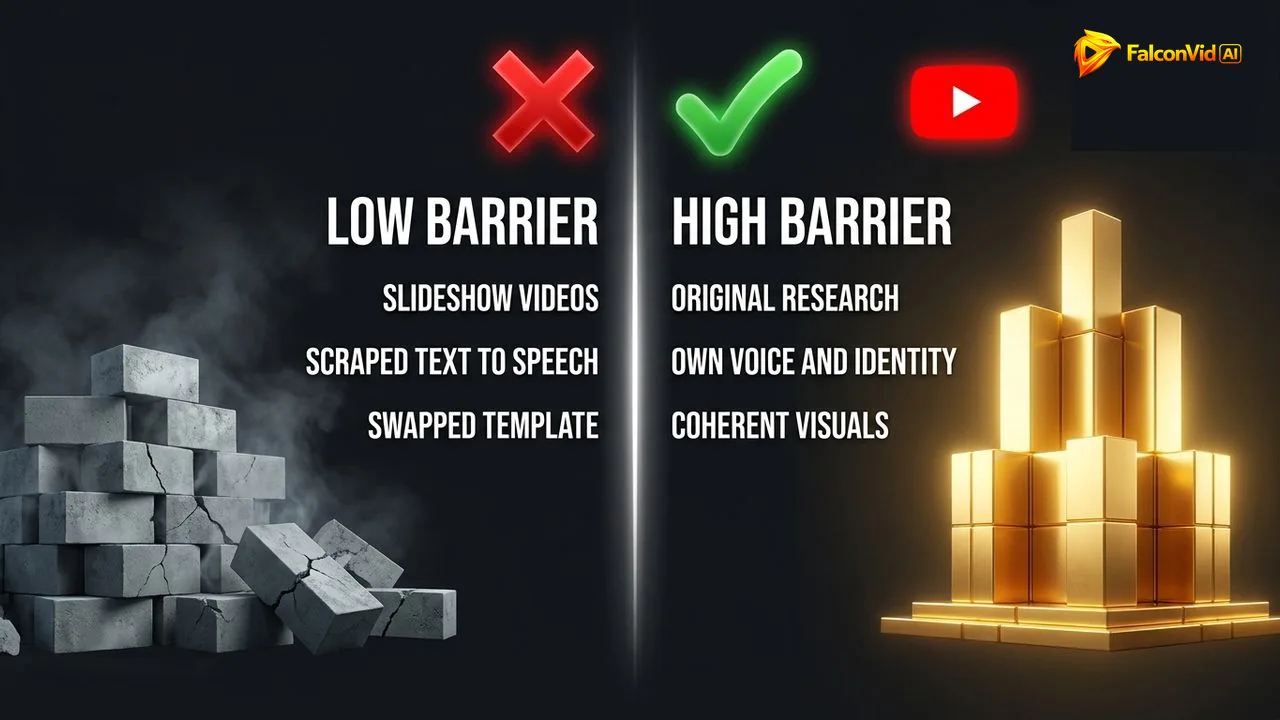
Here is our reading of what changed, and it is the most important paragraph in this guide. YouTube tightened its stance on content that is mass produced or repetitive without meaningful originality. In practice that means anything a thousand people could generate identically, with no research, no point of view and no craft, no longer earns a place in the payout pool.
Call that low barrier of entry content. Its defining trait is that it costs nothing to reproduce, which is exactly why it is worth nothing. Slideshow videos over stock music, text to speech reading a scraped article, the same template with the topic swapped. It worked for a while, it does not anymore, and no amount of volume brings it back.
High barrier content is the opposite, and it is what we built the pipeline to produce. Original research condensed into a narrative, a defined voice and visual identity per channel, scenes that actually illustrate the sentence being narrated, a thumbnail built for that specific promise. It costs more to make, which is precisely the point: the cost is the moat.
- Mass produced and repetitive content without originality is the target of the policy
- Low barrier content is worthless because it is costless to reproduce
- Slideshows, scraped text to speech and swapped templates are the classic examples
- High barrier content: original research, defined voice, coherent visuals, honest packaging
- The extra cost of making it well is exactly what protects you
AdSense and monetization: the quick guide for July 2026
The requirements as they stand in July 2026 are one thousand subscribers plus four thousand valid public watch hours in the last twelve months, or one thousand subscribers plus ten million valid public Shorts views in the last ninety days. Those two numbers hold until January 31, 2027: from February 1, 2027 a channel that applies new needs 1,000 subscribers plus 8,000 qualified public watch hours in 365 days, or 1,000 subscribers plus 20 million qualified Shorts views in 90 days, because YouTube doubled both bars. You also need to live in an eligible country, have two step verification active on your Google account, have no active Community Guidelines strikes, and follow the monetization policies.
The mechanics are simple once you know them. Apply through the YouTube Studio monetization tab, accept the partner terms, then create or link an AdSense account. Review typically takes around a month. After approval, AdSense mails or displays a verification PIN once your earnings pass the identification threshold, you submit your tax information, and payment is released once your balance clears one hundred dollars, in the window between the twenty first and the twenty sixth of the month.
Two practical warnings. One AdSense account per person, so do not create a second one for a second channel, link the extra channels to the same account instead. And treat these rules as a snapshot: YouTube changes thresholds and policies periodically, so confirm the current version in the official help before you apply.
- 1,000 subscribers plus 4,000 valid public watch hours in 12 months until January 31, 2027, then 8,000 hours for whoever applies new, or
- 1,000 subscribers plus 10 million valid public Shorts views in 90 days, 20 million from February 1, 2027
- Eligible country, two step verification on, no active strikes
- Apply in YouTube Studio, accept the terms, link an AdSense account
- Review usually takes around a month
- PIN verification, tax information, then payment above $100 between the 21st and 26th
- One AdSense account per person: link extra channels, never open a second account
- Rules change: confirm the current version in the official help
How FalconVid puts your version live today
Modeling a channel with the tool means taking the format and rebuilding it as yours. The niche and structure come from the analysis you just read, the angle, the market and the language come from you, and the pipeline produces the actual videos: script, narration, scenes, assembly, thumbnail, scheduling and publishing to YouTube, Instagram, TikTok, Rumble and Facebook.
Speed is the part that changes what is possible. Each video is ready in up to thirty minutes and channels run in parallel, so the format you found this morning can be a published channel today rather than a project you get around to. And because narration is available in sixty three languages, the same proven format can be pointed at a second and third market without building a second production line.
The workflow itself is one decision. You approve the content calendar, and generation, narration, assembly and publishing run to the scheduled slots without you in the loop for individual videos. That is what makes six channels feasible for one person, and six channels is what the twenty thousand dollar math actually requires.
- The format comes from the analysis, the angle and market come from you
- Script, narration, scenes, assembly, thumbnail, scheduling and publishing in one pipeline
- Each video ready in up to 30 minutes, channels running in parallel
- 63 languages, so a proven format can enter a second market quickly
- Publishes to YouTube, Instagram, TikTok, Rumble and Facebook
- You approve the calendar, nothing waits on you per video
Choosing your plan by ambition, and what to expect month by month
Pick the plan by how many channels you intend to run, not by the sticker price. Starter carries fifteen thousand credits, one channel and two concurrent generations, which fits someone proving the model on a single channel. Pro doubles the credits to thirty thousand and carries five channels with five concurrent generations. Business carries ninety five thousand credits, ten channels and ten concurrent generations, which is the portfolio tier, and above it Agency carries one hundred ninety thousand credits with twenty five channels, while Scale carries three hundred twenty thousand credits with fifty channels and fifty concurrent generations.
Map that back to the math. If your target is twenty thousand dollars a month, you are running six to ten channels at real quality, which puts you on Business or above, and from there credits rather than channel slots become the binding constraint. What a credit buys depends on the quality mode: a 12 minute video costs 1,584 credits in economy, 9,000 in balanced and 27,084 in premium, so nobody runs a whole month on one mode. Starting on Starter to validate is sensible, and there the realistic plan is around ten to twelve videos a month mixing economy with one in balanced. Trying to run eight channels on a plan built for one is how people end up with thin channels instead of good ones. There is a So the cost of finding out is bounded.
As for timing, be realistic. The first month is setup and format finding. Months two and three are consistency with little visible reward. Monetization thresholds typically arrive somewhere between month four and month nine, and the compounding starts once the back catalogue outweighs the new videos. Over four thousand monetized creators and six hundred million views generated came through this pipeline, and none of them got there in three weeks.
- Starter: 15,000 credits, 1 channel, 2 concurrent generations
- Pro: 30,000 credits, 5 channels, 5 concurrent generations
- Business: 95,000 credits, 10 channels, 10 concurrent generations, the portfolio tier
- Agency: 190,000 credits and 25 channels, Scale: 320,000 credits with 50 channels and 50 simultaneous generations
- A 12 minute video is 1,584 credits in economy, 9,000 in balanced, 27,084 in premium, so always read the mode next to the number
- On Starter that is 9 videos in straight economy, or around 4 a month on the realistic mix of economy plus one in balanced
- Credits, not channel slots, are the binding constraint once you are on the portfolio tiers
- Month 1 setup, months 2 to 3 consistency, monetization usually month 4 to 9
- 4,000+ monetized creators and 600M+ views generated on the platform