
Why the face drifts: the model has no memory between videos
Every generation is a fresh sample. The model does not store your presenter anywhere. It reads the description again and draws a new person who fits it, so two renders from the same prompt are two different human beings who both match the words. A line like woman in her thirties, dark hair, brown eyes describes a few hundred million people, and the engine picks a different one every time.
Language is low resolution compared to a face. What makes a face recognisable is measurement: the distance between the eyes, the width of the jaw, the bridge of the nose, the height of the forehead. No adjective controls any of those. So drift is not a defect you can prompt your way out of, it is the default behaviour of a system that samples from a distribution instead of remembering a person.
It also compounds. Videos one and two look close by luck, video five has moved a little, and by video twelve you have a family instead of a person. The reason it slips past you is that you always compare the new render to the previous one, never to the first. Your audience does the opposite: they compare to the version they met.
- Each render is a new draw from the same description, not a saved character
- The model keeps no memory of the person it drew in the last video
- Adjectives cannot control the measurements that make a face recognisable
- Drift compounds, so it is invisible per video and obvious across twelve
- You compare each video to the previous one, the viewer compares to the first
The six identity locks, in order of return
A fixed reference image is worth more than the other five locks put together. If your engine accepts an image input, that is the whole game: one frontal portrait, neutral expression, even lighting, no hard shadow, no extreme angle, fed into every single generation. Produce that portrait once, treat it as a permanent asset of the channel, and never regenerate it casually, because a new reference restarts the drift from zero.
Second is the frozen description, copied word for word. Rewriting dark hair as deep brown hair is not a synonym to the model, it moves the sample. Third and fourth are the physical constants: the same lighting and the same framing, plus a short wardrobe of three or four repeated outfits. A face lit from another side and shot at a different focal length reads as different bone structure.
Fifth is the seed, when the engine exposes it. Reusing the same seed with the same prompt narrows the sampling to nearly the same draw, and it costs nothing. Sixth is the voice, which almost nobody thinks of as a visual identity lock and which is probably the strongest one you own. The order matters because your effort is finite, and locks one and two carry most of the result.
Read the list again and notice that five of the six are settings rather than talent. That is exactly why they belong to the channel instead of to your memory of what you typed last Tuesday. In FalconVid the identity lives in the Channel DNA, a persistent identity covering presenter, voice, visual style and rhythm, and every generation inherits it automatically, so the reference, the wording and the framing do not depend on you pasting them correctly at eleven at night. The engine stays a separate choice you make per video, from the economy mode up to the premium ones, Veo 3 with audio and Seedance Pro, and none of them is locked to an expensive plan.
- 1. A fixed reference image reused in every generation, never regenerated
- 2. The description frozen word for word, copied and never paraphrased
- 3. The same lighting setup in every render, same side, same intensity
- 4. The same framing and focal length, usually a medium close up
- 5. The same seed whenever the engine lets you set one
- 6. The same voice, the lock most people forget and the one viewers use most
- Channel DNA applies the locks on its own, so the identity never depends on a paste
The character sheet that solves eighty percent of it
Write one page and stop improvising. The sheet holds apparent age, face shape, hair colour and cut, eye colour, skin tone, build, three or four outfits, the setting, the colour palette and the camera rules. Twelve to fifteen lines is plenty. The value is not in the detail, it is in the fact that it never changes.
The rule that makes it work is boring: reuse it exactly, never paraphrase, and never add a nice adjective because today's script felt cinematic. Keep the file next to the channel, version it, and if you genuinely need to change the character, change it once, deliberately, and then stay there. Drifting back and forth between two versions is worse than either one alone.
One point of ethics that is not optional: do not build the presenter on a real person's face without written authorisation. Likeness rights exist, platforms act on complaints, and a channel built on somebody else's face is a channel with a switch in a stranger's hand. And when the platform asks you to disclose realistic synthetic or altered content, tick the box.
There is a second failure the sheet alone does not prevent, and it appears the day you run more than one presenter. Two channels with two sheets start borrowing from each other, a phrase migrates, a palette bleeds across, and both characters slide at once. Keeping identities apart is what channel level storage is for: in FalconVid each channel carries its own DNA, its own voice, its own palette and its own calendar, and you run 1 channel on Starter, 5 on Pro, 10 on Business, 25 on Agency and 50 on Scale without video forty of one wandering into the other.
- Twelve to fifteen fixed lines: age, face shape, hair, eyes, skin, build
- Three or four outfits, one setting, one palette, one camera rule
- Reuse the text exactly, never paraphrase and never improvise adjectives
- Version the sheet, and change the character once rather than gradually
- Never base the presenter on a real person without written authorisation
- One identity per channel, kept separate: 1 on Starter, 5 on Pro, 50 on Scale
What the audience actually notices
Not all drift is equal, and treating it as one problem wastes most of your effort. Bone structure and apparent age get caught almost every time. The viewer will not say the jaw is wider, they will say the video feels off or that it does not seem like the same channel. That vague reaction is the entire cost of drift, and it comes from two variables out of ten.
Hair, lighting and clothing move without being punished. Real people change shirts, get haircuts and stand in different rooms, so variation there reads as life rather than as error. Locking every surface detail too hard produces the opposite problem: a presenter in the same shirt and the same chair forever stops looking like a person.
So the priority is simple. Spend your locks on structure and age, and let the surface breathe. A fast test: line up the thumbnails of your last six videos at thumbnail size, not full size, and ask somebody who does not watch your channel whether that is one presenter or several. At small size only structure survives, the layer that decides recognition.
- Face structure and apparent age are noticed almost every time
- Viewers rarely name the change, they just feel the video is off
- Hair, clothing and lighting variation passes, and can even help realism
- Over locking the surface makes the presenter look like a mascot on a loop
- Test at thumbnail size: only the layer that matters survives that scale
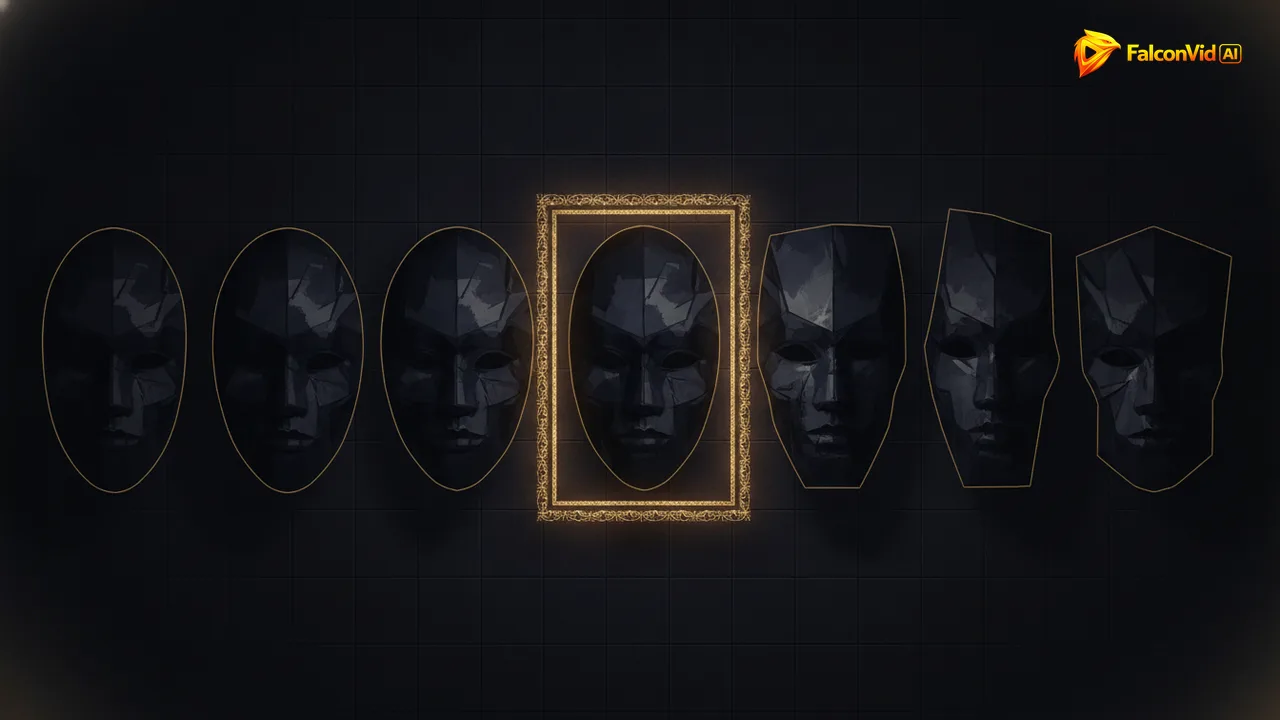
How FalconVid keeps the same presenter across the series
Drift is normal because identity usually lives in a prompt that somebody retypes for each video. In FalconVid it lives at channel level instead: the channel is born with a fixed identity, voice, visual style and presenter, and every video in the series inherits it rather than rolling the dice again. The character sheet becomes a property of the channel.
From there the loop is the calendar. You approve the content calendar and the videos are generated and published on their own to YouTube, Instagram, TikTok, Rumble and Facebook, with narration available in sixty three languages. The same presenter and the same voice carry across every network and every language you decide to open.
Production runs in parallel rather than in a queue. An AI researcher, scriptwriter, narrator, editor and sound designer work on the same video at once, so a long video is finished in up to 30 minutes, and videos are generated side by side: 2 at a time on Starter, 5 on Pro, 10 on Business, 25 on Agency and 50 on Scale. If one render still comes back with the character off, the Studio lets you watch the first cut and swap that piece of media before it publishes rather than after.
The numbers, because vague pricing helps nobody, and the quality mode weighs more than the plan. A 12 minute video costs 1,584 credits in economy mode, 9,000 in balanced and 27,084 in premium. Starter includes 15,000 credits: 9 videos in pure economy, or a realistic 4 a month mixing economy with one in balanced. Pro includes 30,000 credits and 5 channels, up to Scale with 50 channels and 50 simultaneous generations. Every creation feature ships with every plan, and what changes per plan is volume, channels, simultaneous generations, the Senior Analyst and support, and there is a free plan with 4 videos a month and no card, which is enough to publish a handful of videos and see whether the presenter holds together.
- Identity is set once at channel level: voice, visual style and presenter
- The same character carries across the whole series instead of per video
- You approve the calendar, the videos generate and publish on their own
- Five networks: YouTube, Instagram, TikTok, Rumble and Facebook
- AI specialists in parallel: long video in up to 30 minutes, 2 to 50 at a time
- 12 minute video: 1,584 credits in economy, 9,000 balanced, 27,084 premium
- Starter for 15,000 credits: about 4 videos a month mixing modes, 9 in pure economy
Voice consistency is worth more than face consistency
The ear recognises before the eye does, and it recognises with far less evidence. Two seconds of a familiar voice is enough for a returning viewer to settle into the video, and the face may not even be on screen at that moment. On most presenter channels the voice runs for the entire runtime while the face appears in a fraction of it.
This is why swapping the voice between videos breaks the channel harder than a slightly different jawline. A new voice reads as a new channel, or worse, as a channel that changed hands. If you are going to lock exactly one thing this week, lock the voice: the same voice, the same speaking rate, the same opening cadence and the same sign off.
The practical order is therefore voice first, face second. Lock the voice permanently, put the opening and closing lines in the sheet, and only then spend effort on the reference image and the seed. Channels that work in that order survive a surprising amount of visual drift, because the signal the audience uses to recognise them never moved.
Locking a voice permanently is easy to say and easy to lose, because a voice is one dropdown away from changing on a tired evening. In FalconVid the voice belongs to the channel identity rather than to each video, chosen once from the ultra realistic voices and carried through every episode of the series. It also survives crossing a border: when you duplicate the project into another language, paying only the difference instead of producing from scratch, the presenter, the visual style and the opening and closing lines come with it across the 63 languages available. The Spanish edition of the channel reads as your channel in Spanish, not as a stranger who bought the format.
- The voice runs for the whole video, the face only appears in part of it
- Two seconds of a familiar voice is enough for a returning viewer
- Changing voice reads as a new channel, or a channel that changed hands
- Lock voice, speaking rate, opening cadence and sign off as constants
- Voice first, face second: that order absorbs a lot of visual drift
- Duplicate into another language paying only the difference, identity included, 63 languages
When chasing the perfect face is not worth it
On a pure narration channel, a list channel or a news channel, the presenter is decoration. It costs render time, credits and one more way for a video to fail, and it buys nothing the audience came for. Plenty of the largest faceless channels on YouTube have no presenter at all, and no viewer experiences that absence as a missing feature.
The face starts to pay when the channel sells personality, authority or a recurring character. If the proposition is this person's opinion, this person's expertise or this character's world, then recognition is the product and every lock above is worth the minutes it takes. If the proposition is the information itself, the face is a tax on every video.
The honest test is one question: if you removed the presenter entirely, would the viewer get less? If the answer is no, remove it and move that effort to the thumbnail, the first thirty seconds and the voice, which are the three things that actually move retention on a faceless channel. Consistency problems you no longer have are cheaper than the ones you solved well.
That decision also has a price you can calculate instead of debating. The quality mode dominates what a video costs, 1,584 credits in economy against 27,084 in premium for the same 12 minutes, so a presenter rendered at the top of that range is a genuine budget line rather than a rounding error. And a channel with no presenter is not a lesser citizen of the pipeline: in FalconVid it gets the same Channel DNA, the same fixed voice, the same calendar and the same publishing to YouTube, Instagram, TikTok, Rumble and Facebook, minus one thing that can go wrong on every video.
- Narration, list and news channels usually gain nothing from a presenter
- A face costs render time, credits and one extra failure mode per video
- The face pays when you sell personality, authority or a recurring character
- Ask if removing the presenter would give the viewer less, and be honest
- On faceless channels, thumbnail, first 30 seconds and voice move retention
- Price the decision: 1,584 credits in economy against 27,084 in premium for 12 minutes